Adult Vital Signs Chart: Recording Template, Units, and Trend Documentation
 Lauren Bennett · October 30, 2026 · 14 min read · Published by Vero Scribe Inc.
A vital signs chart is a time-based record of physiological observations. A useful entry includes the measured value, unit, observation time, method and relevant conditions—such as whether oxygen was being given. It also records changes, concerns raised and the actual response. A list of numbers without that context makes the next clinician reconstruct what happened.
Download the printable, fillable adult chart, copy the detailed prompts or read the completed trend example. Use this guide for adult observation documentation, especially inpatient records. Sources checked October 30, 2026.
What belongs on a vital signs chart?
Start with the patient identifiers required by the service, encounter, date, observation time and observer. Give a later entry its own timestamp. Put results from different measurement times in separate rows or clearly timed blocks. An “08:00 observations” label should not conceal an oxygen reading obtained twenty minutes later.
For adults in acute hospitals, the UK’s NICE CG50 guidance identifies heart rate, respiratory rate, systolic blood pressure, consciousness, oxygen saturation and temperature as minimum physiological observations. It also calls for a written monitoring plan that reflects the person’s condition and treatment. This chart adds fields that preserve how those observations were obtained. NICE CG50 recommendations
| Observation | Value and unit | Context to preserve |
|---|---|---|
| Temperature | Number with °C or °F | Route, device and actual time; keep the original unit visible. |
| Pulse / heart rate | Beats/min | Palpated pulse or device source; site and any rhythm or quality actually assessed. |
| Respiratory rate | Breaths/min | Counting method, breathing effort and relevant symptoms actually assessed. |
| Blood pressure | Systolic/diastolic in mmHg | Arm, position, cuff size, device and relevant activity or rest. |
| SpO2 | Percent (%) | Probe site, signal concerns, room air or oxygen device and setting. |
| Consciousness | Observed response or approved assessment result | Method used and change from the documented baseline; a numerical score needs its named scale. |
Keep oxygen flow in L/min separate from oxygen concentration in percent. Record the setting actually present and the source of any prescribed target. A recorded flow rate does not establish a known set concentration; use the concentration field only when it applies and the setting is known. “On oxygen” does not tell the next reader the device or setting. Likewise, a pulse-oximeter percentage cannot establish whether the person was breathing room air.
Pain, weight, glucose, fluid balance and other observations may be needed for the assessment or care plan. Give each its own field and unit or scale. Keep the findings from a head-to-toe assessment and other completed assessments alongside the observation record.
Printable and fillable adult observation grid
Download the adult observation chart — fillable PDF, 2 pages. Type into the blank fields in a PDF reader, save a local copy, or print the chart for handwriting. The layout uses US Letter landscape with six observation rows and six linked note spaces.
- Page 1 — measurements: enter each observation date and time separately. Keep the temperature unit visible, distinguish room air from the oxygen device, and record flow and known set concentration in their separate columns. Resolve each observer ID to a full name and role in the key.
- Page 2 — context and response: link each note to its observation row numbers. Record measurement methods and conditions, the actual response, follow-up owner, checkpoint, backup route and author/entry time. For example, row 01 can refer to N1, while N1 identifies row 01; several rows may share a note when its context applies to all of them.
- Keep the pages connected: repeat patient identifiers and the sheet ID on both pages. Use an identified continuation record when a note needs more space. Reopen the saved PDF and check that every entry is visible before printing at actual size; use fit-to-page when printing on a different paper size.
Preview the blank six-row observation grid
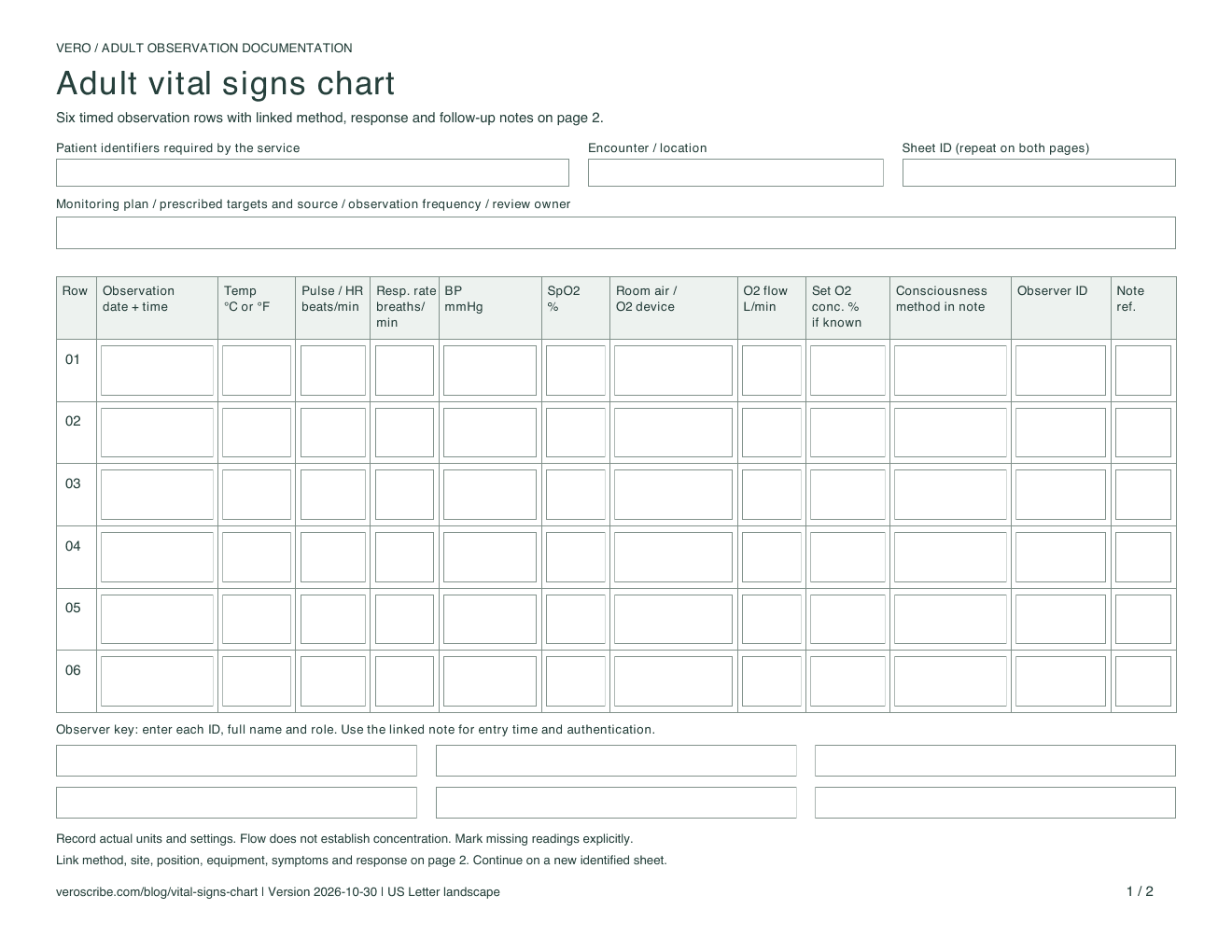
Use the detailed prompts below to adapt the grid to the service’s observation record and handling process.
Copyable vital signs chart
Copy these blank prompts into the approved observation record or a document configured for the service. Repeat the measurement block for each observation time. Preserve the response and follow-up fields even when the EHR stores them in a separate note or task list.
Place the monitoring plan, prescribed targets, local escalation pathway and authentication in their designated fields. Map the chart to the EHR’s structured observations so the values stay connected. Store and handle patient information through the organization’s approved systems and process.
The template leaves findings empty. Filling a blank with “normal,” copying the previous result or entering zero changes the meaning of the record. For an observation that was not obtained, record its actual status and what will happen next.
Adult reference values are not escalation thresholds
MedlinePlus gives the following general reference values for an average healthy adult at rest. The page was reviewed January 1, 2025. Interpret these population reference values alongside the patient’s condition, symptoms and documented clinical targets. MedlinePlus: vital signs
| Measurement | MedlinePlus resting-adult reference |
|---|---|
| Pulse | 60–100 beats/min |
| Respiratory rate | 12–18 breaths/min |
| Blood pressure | 90/60–120/80 mmHg |
| Temperature | 36.5–37.3°C (97.7–99.1°F) |
Compare readings with the patient’s prior observations, symptoms and prescribed targets. Record SpO2 targets from the documented clinical plan and applicable protocol.
NICE’s acute-hospital guidance supports escalation triggered by the approved track-and-trigger system or clinical concern, with response thresholds set locally. Seek the response the situation requires without waiting to finish the chart. Record any early-warning score using the service’s approved scoring tool. NICE: graded response
Make the measurement comparable
A trend can change because the person changed, the conditions changed, or the measurement was unreliable. Preserve enough context to investigate those possibilities. Do not dismiss a concerning result as “just technique” without assessing it, or silently replace it with a more reassuring number.
For blood pressure, the American Heart Association’s home-monitoring instructions specify a correctly sized upper-arm cuff, quiet rest, a bare arm and support at heart level. Those instructions explain why cuff, posture and recent activity are useful record context; use the measurement procedure appropriate to the clinical setting. AHA home blood-pressure monitoring
Pulse oximetry estimates oxygen saturation. The FDA identifies limitations associated with factors including poor circulation, skin pigmentation, skin temperature and nail polish. Interpret readings alongside symptoms and other clinical information. Record signal or placement problems and an actual repeat result when obtained; a reassuring display alone should not erase a concern. FDA pulse oximeters
For temperature, retain the route and unit rather than presenting every measurement as equivalent. For respiratory rate, record the measured result rather than accepting a default field value. For pulse, distinguish a counted peripheral pulse from a monitor-derived heart rate. When methods change between observations, say so beside the comparison.
VT-01: a vital signs trend with an actual response
Fictional adult ward case. Each entry in the sample note traces to the supplied observations, reported symptoms and recorded actions.
At each observation, Alex Morgan, RN, obtains the readings while the patient is seated. Blood pressure uses the right arm, the same automatic device and appropriately sized cuff. Radial pulse and respiratory rate are each counted for sixty seconds. Temperature is oral when measured. A finger pulse oximeter has a satisfactory signal; the patient is breathing room air throughout. Responsiveness is observed as alert. At 08:30 the patient reports, “My breathing feels harder.”
Scroll the chart sideways to read all columns.
| Time | Pulse, beats/min | RR, breaths/min | BP, mmHg | Oral temperature | SpO2 / support | Symptoms / responsiveness |
|---|---|---|---|---|---|---|
| 08:00 | 78 | 16 | 124/76 | 36.8°C | 97%, room air | Reports comfortable; alert |
| 08:30 | 104 | 24 | 110/70 | 37.0°C | 93%, room air | Reports harder breathing; alert |
| 08:35 | 102 | 24 | 112/70 | Not repeated | 93%, room air | Reports breathing unchanged from 08:30; alert |
At 08:31, Alex uses the unit’s clinical escalation route and communicates the new symptom and trend to Dr. Taylor Lee. At 08:32, Dr. Lee acknowledges the report, states they will attend immediately, and asks Alex to remain with the patient and repeat observations while awaiting assessment. Alex does so. The unit’s urgent-response route remains available for deterioration or a delayed response. Dr. Lee attends at 08:36 and begins assessment; the outcome is not yet supplied in this packet.
Finished observation and response entry
08:30 — Patient reports “My breathing feels harder.” Alert. Pulse 104 beats/min, radial count over 60 seconds; respiratory rate 24 breaths/min, counted over 60 seconds. BP 110/70 mmHg, seated, right arm, same automatic device and appropriate cuff as 08:00. Oral temperature 37.0°C. SpO2 93%, finger probe with satisfactory signal, room air. Compared with 08:00: pulse 78 → 104, RR 16 → 24, SpO2 97% → 93%; BP 124/76 → 110/70. New respiratory concern escalated through the unit route to Dr. Taylor Lee at 08:31.
08:32 — Dr. Lee acknowledged and will attend immediately; requested that I remain with the patient and repeat observations while awaiting assessment. Remained with patient. Urgent-response escalation available under the unit pathway for deterioration or delay.
08:35 — Same measurement conditions: pulse 102, RR 24, BP 112/70, SpO2 93% on room air; alert. Patient reports breathing unchanged from 08:30. Temperature not repeated.
08:36 — Dr. Lee at bedside, assessment begun. Assessment outcome and subsequent monitoring plan pending. Alex Morgan, RN, remains responsible for observations until that plan is communicated and recorded.
The note preserves three different kinds of information: measurements, the patient’s report and the clinician’s response. It does not turn “will attend” into a completed review. At 08:36, attendance is documented, while the assessment outcome remains open. The temperature at 08:35 stays unmeasured. The lower blood pressure is retained as part of the trend without assigning a diagnosis from it.
Practice: find the unsupported conclusion
Consider this draft: “08:35: Vitals stable, temperature 37.0°C, oxygen 93%. Doctor reviewed; continue routine monitoring.” Compare it with the supplied packet before opening the answer.
Reveal the VT-01 record check
“Stable” does not describe the new breathing concern and changed observations. Temperature was not repeated at 08:35. “Oxygen 93%” should identify SpO2 and room air. Dr. Lee had acknowledged the call but had not yet arrived at 08:35, and the packet supplies no instruction to resume routine monitoring. Replace the sentence with the actual repeat readings, symptoms, response status and open monitoring responsibility shown above.
For the spoken escalation, use the relevant local communication structure. The SBAR examples show how to separate a request from the receiver’s actual response.
VT-02: correct the oxygen context without changing the time
Fictional saved-record comparison. At 08:20, the source observation records SpO2 96% with oxygen via nasal cannula at 2 L/min, consistent with the existing order. Oxygen initiation time is not supplied. At 08:24, the transferred structured row incorrectly says “room air.” Alex identifies the mismatch and corrects it at 08:28 through the record’s amendment process.
| Field | Source at 08:20 | Saved at 08:24 | Correction entered at 08:28 |
|---|---|---|---|
| Observation time | 08:20 | 08:20 | 08:20 retained |
| SpO2 | 96% | 96% | 96% retained |
| Oxygen context | Nasal cannula, 2 L/min | Room air | Nasal cannula, 2 L/min |
| History | Original observation | Incorrect structured context | Original entry remains retrievable; correction attributed to Alex Morgan, RN |
The correction reads: “08:28 correction to 08:20 observation: source documents SpO2 96% on nasal cannula oxygen at 2 L/min; transferred room-air field was incorrect. Oxygen context corrected and saved row rechecked. Observation time and saturation unchanged.”
The British Columbia College of Nurses and Midwives’ documentation standard, effective April 1, 2026, requires corrections to preserve access to the original information. It also addresses chronological entries, late-entry timing and recording the recipient and response when escalating concerns. Apply the record-amendment process for the relevant service and jurisdiction. BCCNM RN documentation standard
Check where the incorrect field was used: a trend view, handoff, score or subsequent note may also need review. Correcting the observation does not establish that those downstream records were updated. Record the actual checks and any outstanding owner. This structured-versus-narrative distinction also appears in the medical charting software guide.
Missing, unreliable and repeated readings
Use a status that explains the evidence available. “Not measured” means no result was obtained. “Unable to obtain: device did not produce a usable reading” describes an attempted measurement. “Declined” records a decision, with the relevant discussion and plan. None means zero, normal or unchanged.
For a repeat, preserve the new time, conditions and value. If a reading is considered unreliable, record the reason and the action taken. Do not average two numbers simply to remove a discrepancy or delete the first result from the history. A repeat may resolve a measurement question while leaving the clinical concern unresolved.
Avoid combining a current respiratory rate with yesterday’s temperature under today’s timestamp. Historical observations can inform a comparison, but their dates remain attached. The clinical note examples demonstrate this distinction between current observations, historical facts and unfinished work.
Quality checklist for the saved chart
Before authenticating the entry or handing over, review the record against the actual observations:
- Identity and chronology: the correct patient, date, observation times and any later entry time are visible.
- Values and units: systolic and diastolic pressure are separate from pulse; temperatures retain their unit; percentages and flow rates are labelled.
- Method and conditions: route, posture, device source, oxygen context and important measurement limitations survive transfer.
- Completeness: missing or repeated readings are explicit; no old result has become a new finding.
- Trend and response: the change, recipient, contact time and actual response are documented without an invented diagnosis or completed action.
- Open work: a person owns the next observation or review, with the applicable checkpoint and backup route.
- Destination: structured fields, narrative, handoff and any task agree after saving; corrections retain their history.
At shift change, carry the outstanding monitoring task into the handoff and record acceptance. A nursing shift report sheet can help organize that conversation, while the approved clinical chart remains the observation record. A well-written paragraph is only useful if the next clinician can find the same values and the still-open work.
Questions about vital signs charts
Units, missing readings, observation times and saved-record checks.
What is a vital signs chart?
It is a chronological observation record. Each measurement needs its unit, observation time and relevant method or conditions, with the response to a concerning change recorded alongside it.
Can I print, type into or copy the blank vital chart?
Yes. The two-page fillable PDF provides six observation rows and linked response notes. Type and save it in a PDF reader, or print it in landscape for handwriting. Reopen the saved copy and check that all entries are visible. The Copy blank vital signs chart and Select chart text controls provide the detailed companion prompts.
Does a blank field mean the result was normal?
No. Record whether an observation was not taken, could not be obtained or was declined, with the reason and next action. An empty field cannot establish a finding.
Which time belongs beside a late-entered reading?
Preserve the actual observation time and record the later entry time separately. In VT-02, the correction at 08:28 still refers to the observation at 08:20.
Can temperature routes be compared directly?
Keep the route and unit visible when comparing temperatures. A change in route or device is context for interpretation; do not silently relabel one route as another.
How should a Fahrenheit result be recorded?
Retain the original value and °F label. If the record also requires a converted value, label the conversion and check the calculation instead of replacing the source measurement without explanation.
Show all questions
Are pulse rate and device heart rate always the same field?
Record what was measured and how. A palpated pulse and a monitor-derived heart rate have different sources; identify both if both were assessed, including any discrepancy for review.
What belongs next to an SpO2 percentage?
Include the observation time, probe context, room air or the actual oxygen device and setting, and relevant symptoms or signal concerns. VT-02 shows why 96% alone is incomplete.
Should an earlier temperature appear in a later observation row?
Only as an explicitly dated prior observation. In VT-01, temperature was not repeated at 08:35; copying 37.0°C into that row would create a measurement that never occurred.
Can a reading inside a reference interval still matter?
Yes. Compare it with the person’s earlier observations, symptoms and monitoring plan. In VT-01, the blood-pressure value does not erase the change in breathing, pulse and oxygen saturation.
Is this chart an early-warning score?
No. It records observations and follow-up. Record any score separately using the locally approved scoring tool, its complete inputs and its response pathway.
How often should observations be repeated?
Use the patient’s documented monitoring plan and the response required by their condition and local protocol. Record the agreed next observation or review checkpoint.
Where do pain, weight and glucose belong?
Add separately labelled fields when required by the assessment or care plan, with their own time, unit or scale and method. Do not treat an absent additional observation as a negative finding.
Can this adult chart be used unchanged for children?
For children, use the age-specific observation chart, reference guidance and escalation pathway selected by the clinical service. This download is designed for adult observations.
What should be checked after copying a chart into the EHR?
Compare the saved values, units, times and oxygen setting with the source; then confirm that notifications and open review tasks remain visible. A correct narrative can still accompany an incorrect structured field.