Nursing Shift Report Sheet: Printable Template and Med-Surg Examples
 Sam Ellis · October 26, 2026 · 15 min read · Published by Vero Scribe Inc.
A nursing shift report sheet organizes what the next nurse needs to know and do: current concerns, relevant findings, unfinished tasks and who has accepted responsibility. Download the free printable nursing report sheet below, then follow the med-surg examples to see how its blank fields become an actionable handoff.
Use this one-patient organizer for adult medical-surgical handoffs, with your unit’s documentation and escalation process. The worked examples show how to capture findings, pending tasks and receiver acceptance. Sources checked October 26, 2026.
Free printable nursing shift report sheet PDF
One patient. One page. Outstanding work stays visible.
Blank handwriting fields, three task rows, receiver acceptance and a later-update space. No registration or patient details required.
US Letter: 8.5 × 11 inches · A4: 210 × 297 mm · Version 1.1 · October 26, 2026
Preview the blank one-page sheet
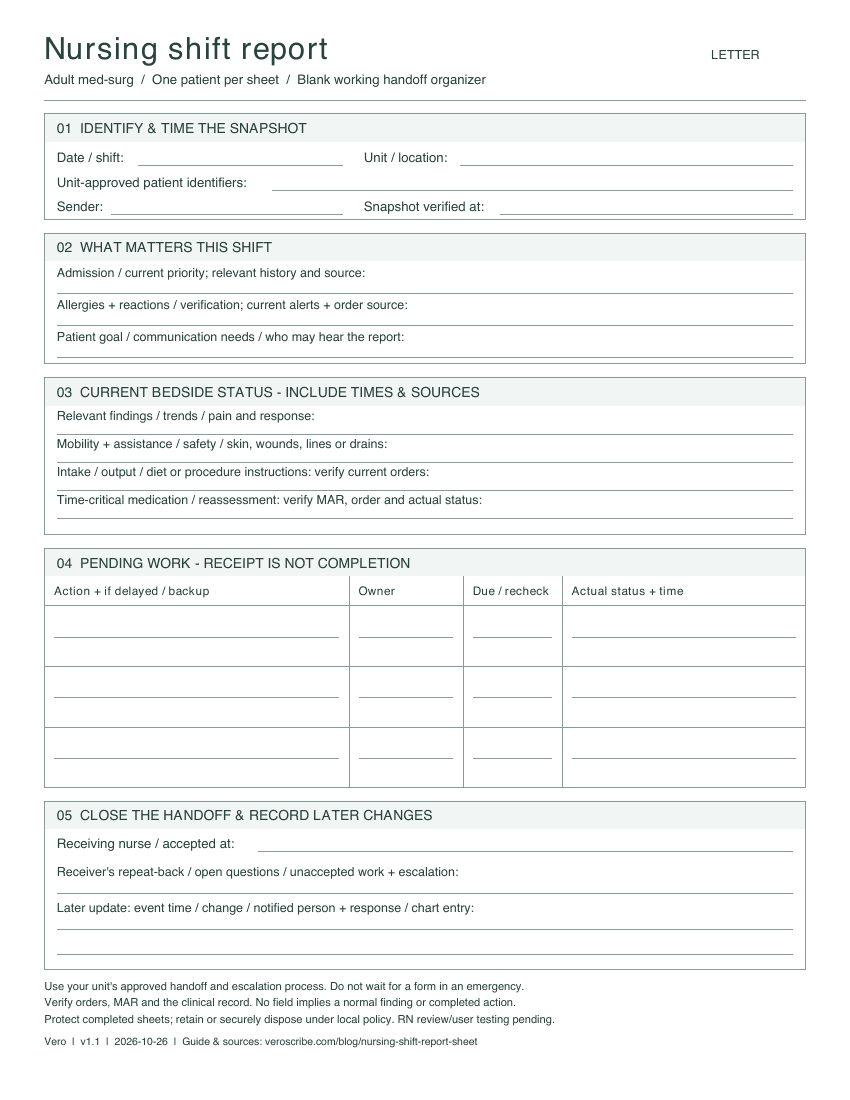
Print in portrait, select the matching paper size and use actual size where your printer supports it. Check the preview for complete borders and footer text. These are static PDFs for handwriting, not fillable online forms. No field contains a preselected “normal,” “none” or “complete.” The A4 version uses its extra height for writing space rather than shrinking the type.
Version 1.1 includes document-language and reading-order tags, headings and a structured pending-task table. The five-section explanation below also presents the fields in HTML.
What belongs on a med-surg report sheet
The useful question is not “How much of the chart fits?” It is “What would the receiving nurse miss if this detail disappeared?” Admission context helps explain the plan. A new concern, a changed assistance requirement or an unreviewed result may change the next action. Several pages of unrelated history can hide those priorities.
The five sections deliberately separate information about the patient from work still owed to the patient:
- Identify and time the snapshot. Use unit-approved patient identifiers, the correct encounter, date, shift and verification time. A room is a location, not a reliable substitute for identity. Record who prepared the report.
- What matters this shift. State the admission reason, current priority, relevant history, allergy/reaction information and its verification status. For alerts or an escalation plan, identify the current order or record source instead of copying yesterday’s label. Include the patient’s goal and communication preferences.
- Current bedside status. Select relevant findings and trends with times. Include assistance needs, skin or device concerns, intake/output and current diet or procedure instructions when relevant. Highlight medication-related work and reassessment, but verify the order and medication administration record (MAR) rather than making the sheet a second MAR.
- Pending work. Write a verb: check, reassess, contact, obtain or clarify. Add an owner, due/recheck time, actual status and what happens if delayed. “Labs” is a topic; “Nora to check the pending result at 19:30” is a task.
- Close and update. Capture the receiving nurse’s acceptance, repeat-back, questions and any work that remains unaccepted. Leave space for a subsequent change, its time, who was notified, their response and the clinical-record entry.
This emphasis follows AHRQ’s distinction between passing information and transferring responsibility. A handoff should communicate uncertainty, recent changes and contingencies, with an opportunity for clarification and explicit acceptance. A document delivered to an inbox does not establish that exchange. AHRQ TeamSTEPPS handoff guidance
For the spoken structure, use the unit’s approved method; the SBAR examples show requests and receiver responses. For selecting assessment details, the head-to-toe assessment checklist separates observed findings from deferred work. Carry the relevant findings and outstanding assessments into the shift summary.
How to use the sheet at shift change
Prepare from the current record
Match the patient and encounter before copying information. Check the source of time-sensitive details: a bedside observation, an active order, a patient report or an earlier note. Write “reported by patient at 18:40” when that is the evidence. Do not silently promote a historical finding into a current assessment.
Refresh the snapshot shortly before handoff. If a task already happened, replace the pending status with the actual action, time and outcome; if it did not, keep the outstanding work visible. Explain a deferred assessment rather than leaving a blank that another nurse might interpret as normal.
Check the bedside and invite questions
Introduce the incoming nurse and ask how the patient wants to participate. Confirm who may hear the conversation. Use plain language, let the patient correct a misunderstanding, and address sensitive details in an appropriate private setting. AHRQ’s bedside-report resources place patients and families within the handoff, rather than treating report as a conversation only between staff. AHRQ nurse bedside shift report strategy
Compare the summary with the patient and surroundings, following unit practice. AHRQ’s bedside checklist includes a focused assessment, inspection of relevant wounds and devices, room safety, outstanding tasks and the patient’s goals. A label such as “IV present” should not stand in for checking the relevant site or current setup. AHRQ bedside shift report checklist
Confirm who is doing what
Ask the receiver to restate the priority actions and raise questions. AHRQ’s I-PASS guidance explicitly pairs the action list with ownership and timelines, then includes synthesis by the receiver. The PDF’s task and acceptance fields support that exchange without imposing a different local handoff standard. AHRQ I-PASS guidance
If someone cannot accept a task, identify the gap and use the unit’s escalation route to arrange coverage. Do not write a colleague’s name as though agreement has occurred. For an immediate clinical concern, act through the local emergency or escalation pathway; finishing the sheet must not delay care.
SR-01: a completed med-surg shift report
Fictional source packet. Use these supplied findings, care instructions and times to follow the completed sheet below.
- October 26, 2026, 19:00 handoff: Elena hands over Morgan Lee, training identifier SR-101, on an adult surgical ward after knee surgery the previous day. The training record and identity have been matched. Elena checks the snapshot at 18:55.
- The current documented mobility plan is one-person assistance with a walker; physiotherapy review is outstanding. At 18:40, Morgan reports pain 3/10 at rest and is alert and conversing. Prescribed analgesia was administered at 18:30 and recorded in the MAR; the supplied plan calls for reassessment at 19:15.
- The allergy record, confirmed with Morgan at 18:45, lists a previous penicillin-associated rash. Other alerts and current orders are to be checked in the designated EHR sections; no additional findings are supplied here.
- At 18:50, the nurse observes the dressing dry and intact. Other device, intake/output and diet details are not supplied in this exercise and must not be invented.
- Morgan wants help to the bathroom and asks for the assistance plan to be explained directly. Morgan permits the partner present to hear mobility planning but requests medication-history discussion privately.
- Nora accepts care at 19:00 and repeats the 19:15 pain reassessment and 19:30 physiotherapy-status check. If therapy has not attended by that check, the supplied instruction is to contact therapy and the charge nurse. Worsening symptoms require earlier escalation through the unit pathway.
The same five fields, filled
| Printable section | Completed example at 19:00 |
|---|---|
| 01 · Identity and time | 26 October 2026, night shift. Morgan Lee / training ID SR-101; surgical ward. Sender Elena. Snapshot verified 18:55. |
| 02 · Shift priorities | Day after knee surgery. Assisted mobility and outstanding reassessments. Penicillin-associated rash, record/patient verified 18:45. Other alerts: check current EHR source. Patient goal: bathroom assistance. Partner may hear mobility planning; patient requests medication-history discussion privately. |
| 03 · Bedside status | 18:40: patient reports pain 3/10 at rest; alert and conversing. Current plan: one-person assistance with walker. Dressing dry/intact at 18:50. Analgesia administered 18:30 per MAR; reassessment outstanding. Device, intake/output and diet details not supplied in this exercise. |
| 04 · Pending work | Reassess pain — Nora — 19:15 — pending. Check physiotherapy status — Nora — 19:30 — pending; if absent contact therapy and charge nurse. Escalate worsening symptoms sooner through the unit pathway. |
| 05 · Acceptance/update | Nora accepts care at 19:00 and repeats the 19:15 pain reassessment and 19:30 physiotherapy-status check. No later outcomes recorded yet. |
The report keeps the 18:40 observation separate from the 19:15 reassessment and 19:30 physiotherapy check. Nora receives both the known findings and the remaining work.
SR-01 on the actual sheet
Fictional, typed example using the blank form’s original fields, page size and writing lines. Blue entries use fixed 9-point type; no fields were enlarged to fit the example.
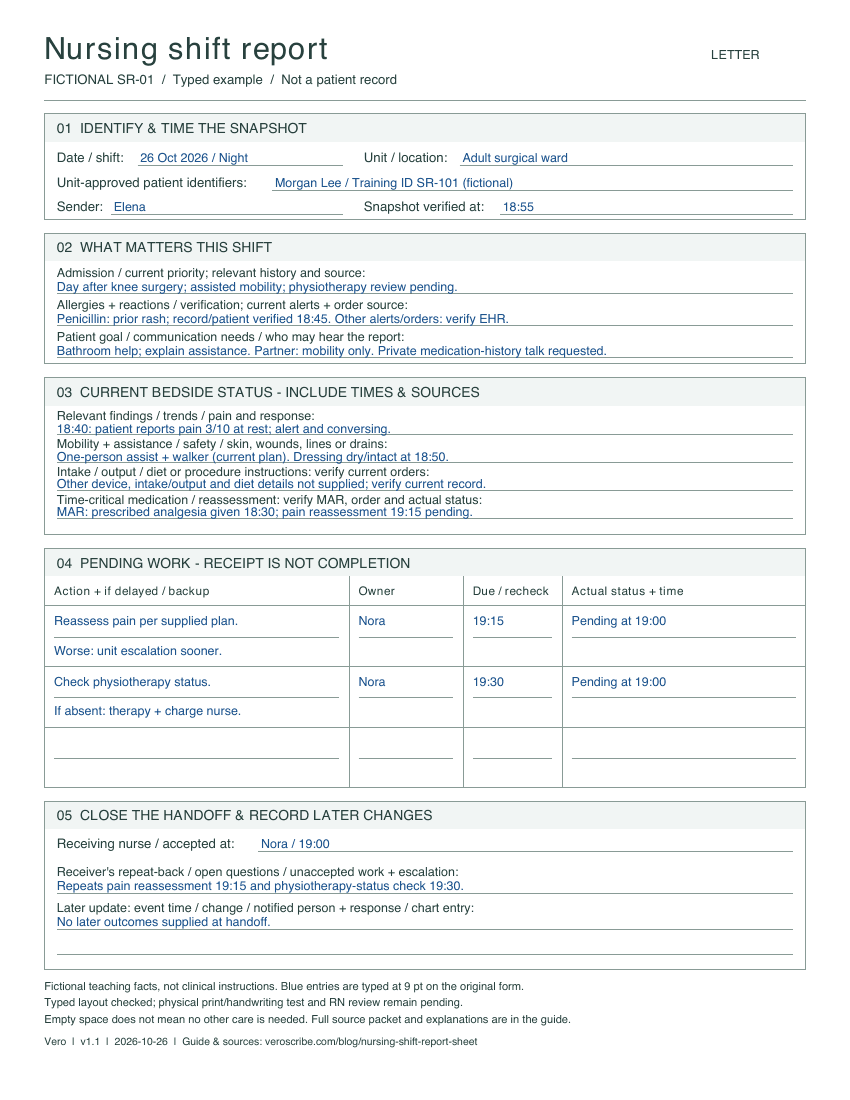
Digital layout checked October 26, 2026. Review and testing status
The filled sheet preserves “private medication-history talk requested” as a request, and the two actions remain pending at 19:00. Keep additional clinical context in the record and add task space when needed, rather than squeezing smaller writing between lines.
Find the error: “Pain controlled; independent mobility; therapy done”
A pain rating at rest does not establish the outcome of the planned later reassessment. Independent mobility contradicts the supplied assistance plan. “Therapy done” turns an outstanding review into completed care.
Restore the timed observation, current assistance requirement and both pending tasks. Then confirm that the receiving nurse heard the corrected version. Correcting only the paper leaves a mistaken verbal handoff unaddressed.
SR-02: a result arrives after the handoff
A separate fictional medical-ward example: at 07:00, Mina accepts care of training patient Taylor Reed, SR-102. A specimen was collected at 06:20, but its result is unavailable. The supplied plan assigns Mina to check at 07:30 and contact the responsible team if it is still absent. Escalate a clinical concern immediately through the unit pathway; the 07:30 checkpoint tracks the outstanding result.
The pending row reads: “Check result availability; Mina; 07:30; unavailable at 07:00; contact responsible team if absent.” At 07:12, the result appears in the EHR. That changes availability—not clinical interpretation or the treatment plan. At 07:15, Mina contacts the responsible clinician, who acknowledges receipt and states that review is still pending. Mina records that exchange in the clinical record and updates the sheet: “Available 07:12; clinician acknowledged 07:15; review pending.”
The agreement at 07:15: Dr. Chen accepts responsibility for clinical review. Mina retains responsibility for following up on that review, and they agree on a 07:30 checkpoint. If review is still outstanding then, Mina will contact Dr. Chen and the charge nurse to arrange an available covering clinician through the unit’s escalation process. Mina keeps tracking the task until any replacement owner explicitly accepts it; sending a message alone does not transfer responsibility. These checkpoints belong to SR-02; agree real-patient timing with the responsible team using the clinical situation and local process.
The updated pending-work row is:
- Action: confirm the clinician’s review and any resulting instructions; result availability is already established.
- Owner: Mina for follow-up; Dr. Chen for clinical review, accepted at 07:15.
- Checkpoint: 07:30, as agreed in the 07:15 exchange; escalate earlier for a clinical concern through the unit pathway.
- If still outstanding: Mina contacts Dr. Chen and the charge nurse, records the response and obtains explicit acceptance from any covering clinician, with a new agreed checkpoint if needed.
- Status at this snapshot: review pending; no review outcome or subsequent action is supplied yet.
The update does not justify ticking “resolved.” If clinical review produces a new action, record that actual decision, its authorized source, who will carry it out and the next checkpoint. Preserve the distinction between collected → available → reviewed → acted on. A report sheet is useful precisely because those states can diverge.
Keep paper and the clinical record in step
A working sheet can become stale while still looking neat. When a plan changes, confirm the current source, communicate the change to the responsible person, and document it in the official workflow. Follow local correction rules instead of erasing the only trace of what was previously communicated. Do not use a task checkbox as proof that care occurred.
For British Columbia nurses, BCCNM’s documentation standard requires a clear, timely record of assessment, care, decisions and outcomes; escalation entries include the recipient and response. It also distinguishes the time of an event from the time of a late entry. BCCNM documentation standard, in force April 1, 2026
Use the nursing care plan guide for goals and evaluation, and nursing documentation guidance for the longitudinal entry. A shift summary should carry forward a revised goal without making it appear that the original goal was achieved.
Handle patient information safely
A blank download contains no patient information. A completed sheet may contain identifiers, diagnoses and sensitive care details. Keep it under the organization’s approved handling process, including printer collection, storage during the shift, access and disposal. Do not photograph it into a personal cloud library, send it through personal messaging or leave it visible on a shared workstation. This page does not collect patient entries.
British Columbia: BCCNM requires nurses to limit access and sharing to professional needs under applicable law and employer policy, respect privacy choices and prevent unauthorized access or overhearing. Ask before discussing sensitive material around visitors; a patient’s agreement to share one topic does not imply agreement to share everything. BCCNM privacy and confidentiality standard
United States: HHS OCR says HIPAA-covered organizations must safeguard PHI through disposal and train their workforce on disposal procedures. Paper containing PHI must not simply be left in publicly accessible waste; appropriate destruction can include shredding that makes it unreadable and not reconstructable. HHS OCR disposal guidance
First establish whether the sheet must be retained under local policy. “Secure disposal” is not an instruction to destroy a required record at shift end. If a sheet is lost, report it promptly through the organization’s privacy process. See what counts as PHI for the U.S./Ontario terminology distinction.
Test the sheet with your unit
Before local use, ask an RN/unit educator to review the fields, scope, abbreviations, escalation wording and whether the writing space fits the unit’s work. Establish which information stays in the EHR and how paper copies are handled.
Digital layout checked October 26, 2026: the fictional SR-01 PDFs use the same field geometry as the blank Letter and A4 forms. Both one-page renders were inspected; the typed entries fit their field widths at a fixed 9 points, with no automatic shrinking.
Review and testing status: RN/unit-educator review, physical print/handwriting testing, real-user testing and screen-reader testing remain pending.
Print the matching blank form at 100%, then have the reviewer handwrite SR-01 without reducing the scale or writing across fields. Pay particular attention to the combined patient-preference and bedside-status lines. Retain the paper size, printer/scaling settings, completed fictional sheet, any cramped or illegible entries and the receiver’s reading errors. Record which fields needed more room, revise them and repeat the same test.
Use SR-01 in a supervised fictional-case exercise. Have one participant prepare the sheet and another receive report. Record the template version, paper size, participants’ roles, completion time, clarification requests and missed or misread facts. Use the timing to identify difficult steps and layout problems.
- Can the receiver identify the correct patient and the snapshot time without guessing?
- Do they preserve the assisted-mobility restriction and both pending tasks?
- Can they name the owner, deadline and backup route for each outstanding action?
- If a task is declined, does the pair arrange an accepted owner instead of merely writing a name?
- After introducing SR-02’s later result, do they distinguish availability from completed review?
- Is handwriting legible after normal printing, and can the sheet be handled privately throughout the exercise?
Keep the completed fictional sheets, observed failures, changes and repeat-test findings as the review evidence. Record the reviewer’s credentials, scope, date and resulting corrections after review. Use those findings to improve the fields nurses found difficult. Keep real patient sheets within the organization’s approved record and privacy processes.
Questions about nursing shift report sheets
Printing, handoff responsibilities and handling completed patient sheets.
Is this nursing shift report sheet PDF free?
Yes. Both the Letter and A4 versions are free downloads with no registration. Each contains the same blank, one-patient med-surg organizer. Printing costs depend on your workplace.
Which paper size should I choose?
Choose Letter for 8.5 × 11-inch paper or A4 for 210 × 297-mm paper. Match the printer paper setting, print in portrait and check the preview before printing. The PDF is designed for actual-size printing.
Can I type directly into the PDF?
These are static printable PDFs, not fillable forms. Use the paper for handwriting or adapt the field structure in an organization-approved tool. Do not upload completed patient sheets to public PDF editors.
How many patients fit on a sheet?
One patient fits on each page. This leaves room for pending work and the receiving nurse’s response. For several patients, use separate clearly identified pages rather than compressing the text into unreadable boxes.
Is a nursing brain sheet the same as a shift report sheet?
The terms often overlap. A personal brain sheet organizes a nurse’s work; a handoff sheet must also make the next nurse’s responsibilities explicit. Neither label establishes that the sheet is part of the official record.
Does this replace an SBAR or I-PASS handoff?
No. Use your unit’s chosen communication method. The sheet can hold information for that exchange, but the conversation, questions and acceptance of responsibility still need to happen.
Show all questions
Should I copy every medication onto the report sheet?
Do not create a competing medication administration record. Highlight relevant time-critical actions and reassessments, with their source and time, while verifying current orders and the MAR through the approved workflow.
What should I write when an assessment is not done?
Write that it is not assessed or deferred, explain the relevant reason, and identify the next owner and timing. A blank field must not be interpreted as a normal finding or a completed assessment.
How should I show an outstanding laboratory result?
Separate specimen collection, result availability and clinical review. State which step is outstanding, who will check it, when, and the agreed escalation route. A result appearing in the EHR does not prove someone has reviewed it.
What if the receiving nurse cannot accept a task?
Leave its ownership unresolved and escalate through the unit’s handoff process until an appropriate person accepts it. Recording a name without agreement is not confirmation that the task has transferred.
Can a patient or family member join bedside report?
Invite participation in line with the patient’s preferences and unit practice. Confirm who may hear which details, and move sensitive discussion to an appropriate private setting when needed.
Can a nursing student use the sheet?
It can support supervised practice with fictional cases. The educator should check scope, task prioritization, abbreviations and local escalation requirements before the student uses an adapted version in placement.
Should I keep the completed sheet after a shift?
Follow your organization’s retention and secure-disposal policy. Do not take patient information home or assume all sheets should be destroyed at shift end; their record status and retention requirements must be established locally.
What changes when a patient’s condition deteriorates?
Act through the local clinical escalation or emergency pathway first. Communicate the new concern directly, then update the handoff and clinical record with actual times, responses and unresolved work.
What should a unit educator check before adopting the sheet?
Check the field choices, scope, abbreviations, task ownership and local escalation routes. Use the fictional SR-01 case to test handwriting space and receiver understanding, record any missed details, and repeat the exercise after changes.