Nursing Notes: Clinical Workflow, Examples, and Quality Checklist
 Sam Ellis · September 3, 2026 · 21 min read · Published by Vero Scribe Inc.
Nursing notes are attributable entries in the health record that communicate a nurse’s assessment, interpretation, interventions, communication, patient response, and follow-up. A useful entry lets the next authorized reader understand what changed, what the nurse knew, what occurred, and what remains unfinished without guessing or reconstructing the event from disconnected screens.
Good nursing documentation is not a transcript of a shift and not a collection of vague conclusions. It selects the information that another nurse or member of the care team needs to continue care safely. The structure may be narrative, SOAP, DAR, PIE, focus charting, or a locally designed form. The quality test is whether the record preserves source, chronology, nursing judgment, action, response, and ownership.
This guide provides a practical eight-step workflow, four fictional repairs, one complete fictional note, a copyable nursing notes template, and a transparent 12-point checklist. The examples contain invented facts and demonstrate documentation technique. They do not direct care for an individual patient.
This guide is educational. It does not replace applicable nursing regulator or board standards, employer policy, approved EHR procedures, legal advice, or a nurse’s professional judgment.
The practical test: a strong nursing note makes the patient’s current state, the nurse’s action, the response, and the next owned step easy to find.
What are nursing notes?
Nursing notes are records created by nurses as part of patient care. They can document an initial assessment, a change in condition, a routine progress update, an intervention and response, education, communication, transfer, discharge, a procedure, or another nursing event. The term describes the author’s role and the purpose of the record more than one mandatory format.
The College of Nurses of Ontario’s Documentation practice standard, effective February 1, 2026, organizes nursing accountability around communication, documentation requirements, and information security. The British Columbia College of Nurses and Midwives similarly describes documentation as a way to communicate nursing assessments, the plan of care, interventions, and outcomes so other professionals can plan safe and coordinated care.
In the United States, the American Nurses Association’s Principles for Nursing Documentation identifies clear, accurate, and accessible documentation as part of safe nursing practice. For Medicare-participating hospitals, the current CMS State Operations Manual Appendix A explains that medical record entries must be legible, complete, dated, timed, and authenticated by the person responsible for the service, consistent with hospital policy.
U.S. jurisdiction boundary: CMS Appendix A applies to Medicare-participating hospitals; it is not a universal nursing practice standard. State law, the applicable nursing board, care setting, and employer policy can add or differ. Use the National Council of State Boards of Nursing’s official nursing-regulation directory to identify the applicable Board of Nursing, then check that board’s current rules and guidance.
These sources do not create one universal nursing notes template. Requirements vary by profession, setting, organization, payer, EHR, and jurisdiction. A pediatric home-care visit, an emergency-department escalation, a long-term-care assessment, and an outpatient education call do not need identical fields. They do share a need for accurate attribution, relevant detail, timely entry, and a record of what happened next.
Structured terminology also reflects this variety. LOINC 34746-8 identifies a broad “Nurse note,” while LOINC 28623-7 identifies a “Nurse Progress Note.” Those codes can support interoperable document classification, but they do not determine the prose or required local workflow.
Nursing notes are part of the record, not the entire record
A nursing narrative may sit beside:
- an assessment flowsheet;
- a medication administration record;
- active orders;
- the nursing care plan;
- device observations;
- intake and output records;
- education documentation;
- safety precautions;
- tasks and escalation messages;
- results and reports;
- handoff tools; and
- notes from other professions.
The final record is a connected system. A narrative can point to the structured location for exact values instead of copying them all. However, it should add the context the structured field cannot provide, such as what changed, why an action was taken, whether a clinician was reached, how the patient responded, and who owns the next step.
Nursing notes, flowsheets, progress notes, and handoffs
Confusion often starts when one document is expected to do every job. The following boundaries help teams decide where information belongs.
Narrative nursing note
- Purpose
- Explain a clinically meaningful event or sequence
- Core content
- Context, assessment, interpretation, action, response, follow-up
- Boundary
- Should add meaning rather than copy every structured value
Nursing flowsheet
- Purpose
- Record repeated structured observations and tasks
- Core content
- Time-stamped values, selections, statuses, and recurring care
- Boundary
- A value grid may not explain significance, escalation, or response
Nursing progress note
- Purpose
- Describe change since a prior assessment or baseline
- Core content
- Interval change, current evidence, intervention, response, next action
- Boundary
- Progress can mean improvement, deterioration, stability, or uncertainty
Care plan
- Purpose
- Organize continuing goals, interventions, and evaluation
- Core content
- Needs, goals, planned actions, responsibilities, and evaluation
- Boundary
- The plan does not prove that a specific action occurred
Handoff
- Purpose
- Transfer current priorities and unfinished work
- Core content
- Situation, relevant background, current assessment, recommendation, ownership
- Boundary
- A verbal or temporary handoff does not replace required record entries
Medication administration record
- Purpose
- Record medication administration and its status
- Core content
- Medication, dose, route, time, status, author, and required checks
- Boundary
- Narrative should not contradict or unnecessarily duplicate this source
For a cross-profession explanation of dated clinical updates, see the progress notes workflow and examples. This guide remains focused on documentation created in the nursing role.
Common nursing documentation formats
Format names describe how an entry is organized, not a universal legal standard. Definitions can vary across organizations and EHRs, so nurses should use the structure approved for their setting. The comparison below shows the practical distinction among formats without treating one as inherently superior.
Narrative
- Structure
- Chronological prose organized around an event or episode
- Often useful for
- Changes in condition, escalation, education, transfer, and response over time
- Caution
- Can become a shift transcript or duplicate structured fields if it lacks a clear purpose
SOAP or SOAPIE
- Structure
- Subjective, Objective, Assessment, Plan, with Intervention and Evaluation added in SOAPIE
- Often useful for
- Problem-focused updates where reports, observations, interpretation, and next steps must stay distinct
- Caution
- Local definitions vary, and response or ownership can disappear if the Plan remains vague
DAR or F-DAR
- Structure
- Data, Action, Response, sometimes preceded by a named Focus
- Often useful for
- A focused symptom, event, intervention, education need, or change from baseline
- Caution
- The focus should describe the event without turning an unverified conclusion into fact
PIE
- Structure
- Problem, Intervention, Evaluation
- Often useful for
- Following a defined nursing problem through action and evaluation
- Caution
- The problem must be supported by the assessment, and evaluation needs a meaningful time point
Charting by exception
- Structure
- Defined deviations from approved norms, with expected findings held in the authorized record
- Often useful for
- Settings with explicit standards, flowsheets, policies, and exception definitions
- Caution
- It is unsafe to assume an undocumented finding was normal unless the local system expressly establishes that meaning
One fictional event, two formats
The facts do not change when the structure changes. This teaching example contains no patient data and is not a care plan.
Narrative
09:10: Patient reports nausea 6/10. Ordered intervention completed at 09:18; see the medication administration record for product and dose. At 09:50, patient reports nausea 2/10 and tolerated several sips of water. Reassess sooner if symptoms increase.
F-DAR
- Focus
- Nausea after the morning assessment.
- Data
- 09:10: Patient reports nausea 6/10.
- Action
- Ordered intervention completed at 09:18; see medication administration record.
- Response
- 09:50: Patient reports nausea 2/10 and tolerated sips of water.
Narrative and structured documentation should agree
A flowsheet is efficient for repeated measurements and routine tasks. A narrative is better at preserving a meaningful sequence. If a patient’s status changes at 14:25, the observations might belong in the flowsheet while the narrative records the comparison with baseline, nursing concern, escalation, instructions, response, and follow-up.
Duplicating every structured value into prose creates a second source that can drift. Avoid a sentence such as “vital signs stable” when the reader can neither see the actual values nor understand what stable means for that patient. Use the structured record for the values and the narrative for the clinically relevant interpretation and action.
A handoff does not replace the permanent record
Handoff tools help a team prioritize immediate work. The AHRQ TeamSTEPPS communication resources include SBAR, check-back, handoff, and other methods for structured information exchange. Those tools support communication, but a temporary handoff list or spoken exchange does not automatically satisfy documentation requirements.
Record the care, assessment, and decisions that belong in the permanent health record. Then use the handoff to highlight the current risk, unfinished action, and escalation threshold. The two should be consistent, but they serve different moments.
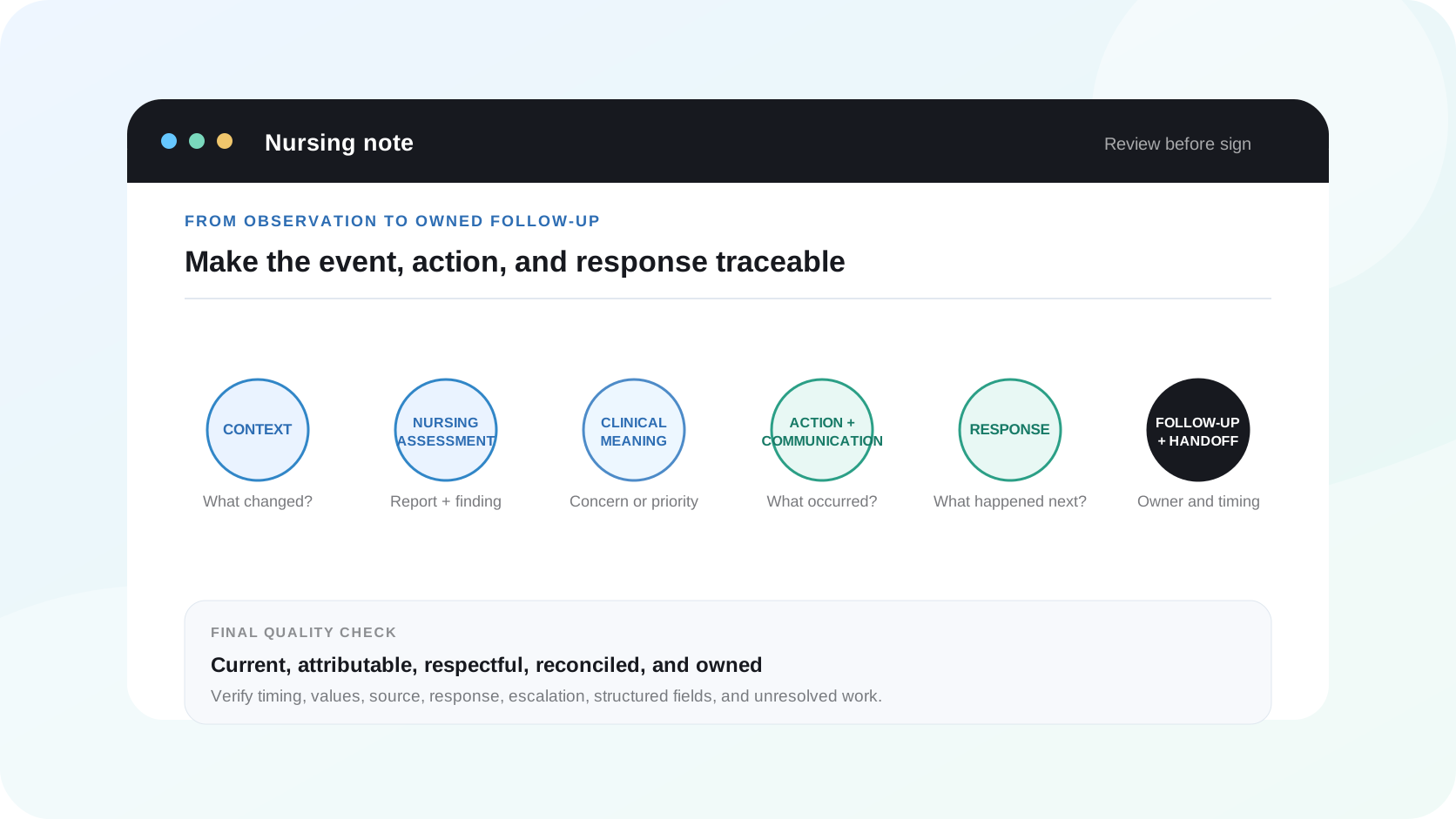
The six parts of a useful nursing note
Nursing documentation chain
Six parts from context to closure
A note may use narrative, SOAP, DAR, PIE, or another approved format. Whatever the layout, these six functions should remain traceable when they apply.
1 Context
Why is this entry being made now?
Time, setting, event, baseline, and source2 Assessment
What did the patient report and the nurse observe or measure?
Attributed symptoms, findings, trends, and limits3 Interpretation
What nursing concern, pattern, or priority follows?
Clinical meaning without unsupported certainty4 Intervention
What nursing action or communication occurred?
Action, timing, notification, and verified instruction5 Response
What happened after the action?
Reassessment, patient response, or inability to assess6 Closure
What happens next, by whom, and when?
Owner, time frame, escalation threshold, and handoff
1. Context
Context answers why the note exists. Identify the event, timing, setting, and relevant comparison point. “Routine note” tells the reader very little. “New dizziness during transfer at 10:15 compared with the earlier assessment” establishes a useful clinical sequence.
Context also includes the source of the trigger. Did the patient report a symptom? Did a family member describe a change? Did the nurse observe it? Did an alert, result, or another professional prompt the assessment? Source matters because a report is not the same as a direct observation.
2. Assessment
Assessment records what the patient or caregiver reported and what the nurse observed or measured. Use specific, respectful language. When a scale is used, name the scale or make the value understandable. Include the time, site, side, device, position, or trend when those details affect interpretation.
Do not turn reported information into an observed fact. “Family reports increased sleepiness” is different from “patient lethargic.” The second statement implies a professional assessment that may not have occurred. If the assessment is incomplete, say what is pending and who will complete it.
3. Nursing interpretation
Interpretation connects the evidence to the nursing concern or priority. It may identify a safety risk, a response pattern, a change from baseline, an unmet need, or uncertainty. It should not introduce a medical diagnosis or causal claim that the nurse did not establish.
For example, “new symptom with position change creates an immediate transfer-safety concern; cause not established” is traceable to the assessment. “Medication caused hypotension” is not supported unless the record contains the evidence and the responsible professional has made that determination.
4. Intervention and communication
Record what was done and when. Include the relevant nursing action, education, assistance, safety measure, specimen collection, procedure, escalation, or other intervention. If an action is already captured completely in a structured module, cross-reference it rather than creating conflicting details.
Communication should show more than “provider aware.” Identify the recipient, time, essential information communicated, and the response. If an instruction or order is received, use the authorized order workflow and document required read-back or verification. If no response was received, make the exception and escalation path visible.
5. Patient response
An intervention without a recorded response can leave the next reader unable to judge whether the issue improved, worsened, or remained unresolved. When a reassessment is clinically relevant, record the result at the appropriate time. The response may be a patient report, an observation, a measurement, a functional change, or a statement that reassessment could not be completed and why.
Avoid “good effect” without defining the effect. A time-stamped change from a symptom rating of 6/10 to 2/10 is more useful. So is a clear statement that there was no change, the patient declined reassessment, or the effect cannot yet be determined.
6. Closure
Closure records what happens next. Name the task, owner, expected timing, escalation threshold, and location where completion will be visible. “Continue to monitor” is incomplete unless the team knows what to monitor, how often, what change requires action, and who is responsible.
Closure also includes handoff. An unresolved concern, pending response, incomplete order, or follow-up assessment should not disappear when the shift changes. The record and handoff should direct the next nurse to the same outstanding work.
An eight-step nursing documentation workflow
The workflow below is Vero’s editorial synthesis of the professional and health-IT sources cited on this page. It is not an official regulator standard, a validated assessment instrument, or a substitute for the workflow approved by an employer.
Step 1: Confirm the patient, encounter, role, and note type
Before writing, verify the chart, date, time, location, assignment, and intended entry type. Wrong-chart and wrong-encounter errors are easier to prevent before text is entered than to repair after authentication.
Make the author and professional role clear. Each nurse is normally accountable for documenting the care they personally provide. If information comes from another nurse, caregiver, clinician, device, or record, preserve that attribution rather than implying personal observation.
Step 2: Identify the event or comparison point
Start with the reason for the entry. A useful opening often names a time and change: a new symptom, an intervention, a result, a transfer, education, a refusal, or an update since the last assessment.
Comparison is essential when using words such as improved, worse, unchanged, or stable. State what the current finding is compared with and over what period. If the baseline is unknown, document that limitation instead of manufacturing a trend.
Step 3: Record attributable assessment data
Separate subjective and objective sources. Patient and caregiver words can be quoted when wording matters, but quotes should be accurate and purposeful. Nursing observations should be concrete. Measurements should match the authorized structured source.
Select information that explains the concern, intervention, response, or follow-up. More data is not automatically safer. Long copied lists can hide the one current finding that changes the plan.
Step 4: Document the nursing interpretation
Ask what the assessment means for nursing priorities. Is there a new safety concern? Is a planned action not tolerated? Has the patient reached a goal? Is the evidence incomplete? Does the situation require escalation or a revised care plan?
Keep certainty proportional to the evidence. Distinguish observation, patient report, nursing interpretation, and medical diagnosis. This makes the record more useful to every profession and reduces the risk that an unverified statement will be copied forward as fact.
Step 5: Record interventions and communication
Document the action close to the event. Include the time and enough detail to understand what occurred. Link the action to the assessment rather than writing a task list with no rationale.
For escalation, use closed-loop communication. Identify the person contacted, the information sent, the response, and any read-back or verification. If a message is pending, record the timeout or escalation route. The ASTP/ONC SAFER Guide for Clinician Communication treats reliable communication and follow-up as system-level safety work, not merely individual memory.
Step 6: Capture the response and current status
Reassess when the intervention or patient state requires it. Record what changed and what did not. Link the response to the intervention without overstating causality.
Timing matters. The response to education may be teach-back during the encounter. The response to an intervention may need a later assessment. If the effect is not yet known, assign the next observation instead of implying success.
Step 7: Close the loop on follow-up
Every unresolved item needs an owner. This applies to repeat observations, pending clinician responses, new instructions, safety measures, referrals, specimens, education, and handoff tasks.
Use a visible completion state. “Order received” is not the same as “action completed.” “Message sent” is not the same as “recipient acknowledged.” A strong note shows the current state and the next transition.
Step 8: Reconcile, review, and authenticate
Before signing, compare the narrative with flowsheets, medication administration, orders, the care plan, safety indicators, task lists, and the encounter. Resolve contradictions. Remove copied text that no longer applies. Check dates, times, units, side, site, negation, and patient quotations.
Authenticate under the applicable standard and employer policy. If a correction is needed later, use the approved addendum or correction function so the original entry and audit history remain available. Never backdate or silently replace an authenticated note.
Nursing note examples: four fictional repairs
Replace vague charting with an attributable record
Original teaching examples Fictional scenarios, no patient data
These revisions demonstrate documentation structure only. They are not instructions for treating an individual patient.
Response after a nursing intervention
Fictional inpatient example
Source facts
At 09:10, the patient reported nausea rated 6 out of 10. The nurse completed the ordered intervention at 09:18. At 09:50, the patient reported nausea rated 2 out of 10 and tolerated several sips of water.
Weak draft
Patient nauseated. Medication given with good effect.
Revised record
09:10: Patient reports nausea 6/10. Ordered intervention completed at 09:18; see medication administration record for product and dose. At 09:50, patient reports nausea 2/10 and tolerated several sips of water. Will reassess with the next scheduled observation or sooner if symptoms increase.
Change in condition and escalation
Fictional acute-care example
Source facts
At 14:25, the nurse observed new confusion compared with the 12:00 assessment. The documented observations were repeated. The responsible clinician was reached at 14:34, read back the values, and gave new instructions. The nurse began those actions and assigned a repeat assessment for 15:00.
Weak draft
Patient confused. Doctor aware. Continue monitoring.
Revised record
14:25: New confusion observed compared with the 12:00 assessment. Repeat observations documented in the flowsheet. Responsible clinician notified at 14:34; current findings and change from baseline were read back. New instructions received, verified, and initiated as recorded in the order and task lists. Repeat assessment assigned for 15:00; escalate sooner for further change.
Patient declines a planned activity
Fictional rehabilitation example
Source facts
The patient declined the scheduled walk, saying they felt too tired after poor sleep. The nurse assessed for new symptoms; none were reported. The reason, education, alternative activity, and plan to reoffer later were discussed.
Weak draft
Patient refused ambulation. Noncompliant with plan.
Revised record
Patient declined the scheduled walk and stated, “I am too tired after sleeping poorly.” Patient denied new symptoms when asked. Discussed the purpose of mobility and offered a shorter assisted activity; patient chose seated exercises. Plan to reoffer walking this afternoon and hand off the response to the oncoming nurse.
AI draft changes source and certainty
Fictional AI-assisted documentation example
Source facts
A family member said the patient seemed sleepier than usual. The nurse had not yet completed a focused assessment. The draft stated that the patient was lethargic and deteriorating.
Weak draft
Patient lethargic and clinically deteriorating.
Revised record
Family member reports that the patient appears sleepier than usual. This is a reported change; focused nursing assessment was pending when the statement was documented. The nurse will assess now and record the findings and any escalation separately.
The stronger versions are not necessarily longer. They are more selective and traceable. Each one preserves the source, event time, nursing action, response, and next step that the weak version hides.
A complete fictional nursing note
One nursing note from assessment through handoff
Complete worked example Fictional scenario, no patient data
Every detail is invented to show how the sections connect. The example is not a care plan for an actual patient.
Setting
Fictional inpatient nursing entry
Trigger
Patient reports new dizziness when standing
Purpose
Record assessment, intervention, response, and handoff
Context and assessment
10:15: Patient reports new dizziness when standing to transfer to the chair. Patient returned to bed with assistance. No fall occurred. Patient denies chest discomfort and reports that the dizziness improved after lying down. Current observations and the repeat set are recorded in the flowsheet.
Nursing interpretation
New symptom with position change creates an immediate transfer-safety concern. The cause is not established by this nursing assessment. Additional assessment and communication are required before the next transfer attempt.
Intervention and communication
Patient advised to request assistance before getting out of bed; call bell placed within reach. Fall-prevention measures reviewed and status indicator updated under unit policy. Responsible clinician notified at 10:24 with the symptom, timing, comparison with the earlier assessment, and current observations. Instructions were read back and entered in the authorized order workflow.
Response
10:40: Patient resting in bed and reports no dizziness while lying down. Repeat observations are recorded in the flowsheet. No unassisted transfer was attempted during the reassessment period.
Follow-up and handoff
Assigned nurse will complete the next assessment at the ordered time and document the patient response. The next transfer will use the assistance level shown in the care plan. Escalate earlier for recurrence at rest, a fall, new symptom, or a change in observations under the unit protocol.
Reconciliation
Narrative, flowsheet, status indicator, order workflow, and care plan were checked for agreement before authentication. The oncoming nurse will receive the unresolved position-related symptom and next assessment time in handoff.
This example uses a narrative sequence because the timing and escalation matter. In an actual EHR, exact observations, orders, and safety status may live in structured modules. The narrative should agree with those modules and explain the event without duplicating unnecessary data.
How to document common nursing events
Change in condition
Record the baseline, new finding, time, relevant assessment, nursing concern, immediate action, recipient of escalation, verified instruction, patient response, and next assessment. Avoid “doctor notified” as the only evidence of communication. The next reader needs to know whether the message was received and what happened afterward.
Patient declines care or an activity
Use factual, nonjudgmental language. Record what was offered, the patient’s stated reason if provided, the relevant assessment, information or alternatives discussed, the decision, any required notification, and the follow-up plan. A label such as “noncompliant” does not explain the decision and can obscure barriers or preferences.
Education and teach-back
Document the topic, method, materials or interpreter used when relevant, who participated, the patient’s response, and what remained unclear. “Education provided” does not show whether communication was understood. If teach-back is used, record what the patient could explain or demonstrate and what needed clarification.
Wound, line, device, or procedure-related observation
Use the approved structured fields for measurements, site, device, dressing, output, and other recurring details. Use narrative for a meaningful change, unexpected finding, patient response, escalation, or deviation from the planned process. Keep laterality, location, time, and device identity consistent.
Medication-related event
The medication administration record should remain the primary administration record. A narrative may be needed for a declined medication, symptom, reaction concern, effectiveness assessment, education, escalation, or workflow exception. Cross-reference the authorized record rather than manually recreating dose details that can conflict.
Transfer or discharge
Document current status, relevant assessment, equipment or assistance needs, outstanding work, education, communication with the receiving team, and the transfer of responsibility. A transfer note should make unresolved risks visible. A discharge entry should agree with the medication, instruction, follow-up, and disposition records.
A copyable nursing notes template
Copy the nursing note structure
Reusable plain-text template
Copy the blank structure into an approved workspace, then adapt it to the nursing role, note type, setting, patient, organization, and jurisdiction.
NURSING NOTE

Encounter context
Date and time:
Setting and responsible nurse:
Reason for this entry or comparison point:

Assessment
Patient or caregiver report:
Nursing observations and measurements:
Relevant flowsheet, device, or result reference:
Important limits or information not yet assessed:

Nursing interpretation
Change, concern, priority, or uncertainty:

Intervention and communication
Action completed and time:
Person notified and information communicated:
Instruction or order received and verification method:

Response
Reassessment time:
Patient response and current status:

Follow-up and closure
Next action:
Owner and time frame:
Escalation threshold:
Handoff or completion location:

Final review
Narrative and structured fields reconciled:
Copied, templated, dictated, transcribed, or AI-generated text verified:
Authentication or correction status:
The template is deliberately format-neutral. It can support narrative documentation or be adapted to SOAP, DAR, PIE, or another approved structure. Delete sections that do not apply, but do not let the template erase source, timing, response, or follow-up ownership.
How to adapt the template without creating boilerplate
Start with the recurring decision the note must support. A post-intervention entry needs a response field. A change-in-condition note needs escalation and reassessment. An education note needs participation and understanding. A transfer note needs receiving-team communication and unresolved work.
Make required fields visible at the point of work. Avoid prefilled normal findings that can be carried forward without assessment. Review smart phrases and defaults after workflow changes. If a field is repeatedly empty, decide whether the team needs education, a better trigger, or removal of an unnecessary requirement.
Nursing note quality checklist
Twelve checks before authentication
Final-entry quality screen
Use this as a review prompt with the actual encounter, authorized sources, employer policy, and applicable professional standards.
Checked
0 / 12
The checklist is Vero’s editorial defect screen, not a validated assessment instrument or a substitute for professional judgment. A note can pass all twelve prompts and still be clinically incomplete if the template does not fit the event. Conversely, a brief note may be appropriate when it records a narrow event completely.
Use hard stops for meaning-changing defects
Not every defect has equal risk. Treat the following as high priority:
- wrong patient, encounter, author, time, site, or side;
- a reported statement presented as a nursing observation;
- omitted or invented assessment findings;
- incorrect medication, dose, unit, route, or allergy information;
- changed negation, such as turning “denies” into “reports”;
- a missed change from baseline;
- an intervention without a required response;
- escalation with no recipient or acknowledgment state;
- contradictory orders, narrative, flowsheets, or care plan; and
- unresolved work with no owner or time frame.
Track these separately from style issues. A polished sentence cannot compensate for a meaning-changing error.
Common nursing documentation defects and repairs
Vague conclusion without evidence
“Doing well” or “stable” is difficult to use without a comparison. Repair it by naming the current finding, relevant baseline, time window, and evidence source.
Task list without patient response
A list of completed tasks may prove activity but not outcome. Add the clinically relevant reassessment, patient report, or reason the response is not yet known.
Notification without closed-loop communication
“Provider aware” hides whether the message was received. Record recipient, time, essential content, verified response, and the next action. If unanswered, show the escalation route.
Copy-forward without current verification
Copied text can turn an old finding into a current one. Preserve provenance, verify every carried-forward statement, and delete content that was not reassessed or does not affect the current event.
Judgmental or ambiguous language
Words such as difficult, manipulative, or noncompliant usually do not describe the observable event. Replace them with the patient’s statement, observed behavior, offered alternatives, relevant assessment, and decision.
Narrative and structured fields disagree
When the narrative, flowsheet, order, medication record, or care plan conflict, the next clinician cannot know which source is correct. Reconcile the fields before authentication and use the approved correction process when an earlier entry is wrong.
AI-assisted nursing notes
AI tools can convert permitted audio, dictation, typed text, or record context into a draft. They may reduce clerical work, but they can also omit a patient response, confuse speakers, change time order, add a plausible finding, convert a family report into an observed fact, or smooth uncertainty into a diagnosis.
The CNO guidance on documentation and artificial intelligence says nurses remain accountable for AI-assisted documentation, should use employer-approved tools, must review generated content for accuracy, completeness, and appropriateness, and must follow privacy, security, and consent requirements. Those details are jurisdiction-specific, but the operational principle is broadly useful: a generated draft is not a verified record.
In Ontario, CNO says nurses must obtain informed consent when AI is used to record, transcribe, or document any part of a client encounter and must use employer-approved tools. BCCNM’s documentation standard requires organization or employer approval and AI policies, while keeping the nurse accountable for the accuracy, objectivity, and completeness of the entry. U.S. readers should verify applicable federal, state, board, organizational, and recording-consent requirements; the linked HHS Security Rule summarizes ePHI safeguards, not every consent obligation.
Review the draft against the encounter, not against plausibility
Use the source encounter and authorized record as the standard. Check:
- patient and speaker attribution;
- chronology and event times;
- symptoms, observations, measurements, units, side, and site;
- negation and uncertainty;
- medication and allergy details;
- nursing interpretation versus medical diagnosis;
- intervention timing and completion;
- communication recipient and response;
- patient response and reassessment;
- orders, tasks, and care-plan consistency;
- follow-up owner and escalation threshold; and
- unsupported additions or clinically important omissions.
Do not paste patient information into an unapproved public tool. In the United States, the HHS summary of the HIPAA Security Rule describes administrative, physical, and technical safeguards for electronic protected health information. In Canada, privacy requirements depend on the organization and jurisdiction. Employer approval, contracts, access controls, retention, audit logs, data location, secondary use, and incident response should be reviewed before a documentation tool enters the workflow.
How to audit nursing-note quality
Define the sample before reviewing notes
Choose the setting, note type, time period, unit, shift, or workflow change. State whether the sample is random, consecutive, event-triggered, or risk-based. Separate routine documentation from high-risk events such as escalation, transfer, or medication-related concerns.
Measure defects that matter to continuity
Useful measures include:
- percentage of sampled events with a recorded patient response;
- percentage of escalations with recipient, time, and acknowledgment;
- missing baseline or comparison point;
- source-attribution errors;
- narrative and structured-field contradictions;
- copied or stale findings;
- incomplete orders or follow-up tasks;
- late-entry and correction frequency;
- time from event to authentication;
- reviewer agreement on high-risk defects; and
- time required to correct a draft before signing.
Report numerator, denominator, sampling method, reviewer roles, and limitations. Do not hide a missed escalation inside an average completeness score.
Repair the workflow that produces the defect
Recurring errors often indicate a system problem:
- missing responses may mean the reassessment task has no trigger;
- vague escalation notes may reflect messaging that does not expose acknowledgment;
- contradictory values may come from duplicate fields;
- wrong times may result from delayed mobile access;
- stale text may come from a prefilled template;
- repeated AI attribution errors may indicate unsupported capture conditions; and
- missing handoff ownership may reflect a task with no receiving queue.
Use education for a knowledge gap, template changes for bad defaults, workflow redesign for ownership gaps, and technical testing for software defects. Then repeat the same audit method to see whether the repair worked.
Author and review status
Written by Sam Ellis, a Vero contributor covering AI-assisted documentation, patient-care workflows, and healthcare privacy and compliance. Sources checked September 3, 2026. This version has not received separate clinical review.
Sources and further reading
- College of Nurses of Ontario: Documentation practice standard, effective February 1, 2026
- College of Nurses of Ontario: Documentation and artificial intelligence
- British Columbia College of Nurses and Midwives: Documentation practice standard
- American Nurses Association: Principles for Nursing Documentation
- CMS State Operations Manual Appendix A: Hospitals
- National Council of State Boards of Nursing: Nursing regulation and Board of Nursing directory
- HHS: Summary of the HIPAA Security Rule
- AHRQ TeamSTEPPS communication tools
- ASTP/ONC 2025 SAFER Guide: Clinician Communication
- LOINC 34746-8: Nurse note
- LOINC 28623-7: Nurse progress note
Frequently asked questions about nursing notes
Direct answers about nursing-note purpose, templates, examples, timing, flowsheets, patient response, corrections, AI drafting, and quality review.
What are nursing notes?
Nursing notes are attributable entries in the health record that communicate nursing assessment, interpretation, interventions, communication, patient response, and follow-up. The exact content and format depend on the setting, nursing role, organization, and jurisdiction.
What is the purpose of nursing notes?
Their primary purpose is continuity and coordination of care. A useful entry helps another authorized reader understand what changed, what the nurse assessed, what was done, how the patient responded, and what still requires action.
What should be included in a nursing note?
Include the encounter context, attributable assessment findings, relevant nursing interpretation, interventions, communication, patient response, and an owned follow-up plan. Include only information relevant to the care or event being documented.
What is a good nursing note example?
A good example preserves source and chronology: “09:10: Patient reports nausea 6/10. Ordered intervention completed at 09:18. At 09:50, patient reports nausea 2/10 and tolerated sips of water. Reassess sooner if symptoms increase.” Actual notes must reflect the real encounter and local requirements.
What is a simple nursing notes template?
A concise template can use six sections: context, assessment, nursing interpretation, intervention and communication, response, and follow-up. Remove unused boilerplate and adapt the structure to the patient, note type, setting, and employer policy.
Are nursing notes the same as progress notes?
They overlap but are not identical terms. Progress note describes an update over time and can be authored by several professions. Nursing note identifies the nursing role and may document progress, an assessment, education, a procedure, transfer, escalation, or another nursing event.
Show all questions
Can nurses use SOAP notes?
Yes, when SOAP fits the setting and employer policy. SOAP organizes information into Subjective, Objective, Assessment, and Plan. A nursing entry still needs clear attribution, intervention timing, patient response, and follow-up even when those details are placed within SOAP.
What is narrative nursing documentation?
Narrative documentation records an event or episode in chronological prose. It is useful when a sequence, change in condition, escalation, response, or unusual event does not fit safely into isolated checkboxes. It should complement, not contradict, structured fields.
What is charting by exception?
Charting by exception records defined deviations from established norms while relying on approved flowsheets and policies for expected findings. Whether it is permitted and how it must be used depend on the organization, profession, setting, and jurisdiction.
How soon should a nursing note be written?
Document at the time of care or as soon as possible afterward under applicable standards and local policy. Record the actual event time when different from entry time, and use the approved late-entry process rather than making chronology appear contemporaneous.
How should a nurse correct a charting error?
Use the approved correction or addendum function so the original entry, correction, author, date, time, and audit history remain available. Do not silently overwrite, backdate, or delete an authenticated entry. Requirements vary by system and jurisdiction.
Can one nurse chart care completed by another nurse?
Normally, each nurse documents the care they personally provide. Exceptional circumstances and co-signing rules depend on professional standards and employer policy. If documenting information from another person, preserve its source and do not imply personal observation.
Should nursing notes repeat the flowsheet?
Not automatically. Use the narrative to explain a meaningful change, interpretation, intervention, response, communication, or unresolved work. Cross-reference the authorized structured location when useful instead of reproducing every value and creating contradictions.
How should patient refusal be documented?
Record what was offered, the patient’s stated reason when provided, relevant assessment, information or alternatives discussed, the patient’s decision, any escalation required, and the follow-up plan. Use respectful, factual language rather than labels such as noncompliant.
How should a change in condition be documented?
Record the change from baseline, relevant assessment findings, time, nursing action, who was notified, what was communicated, verified instructions, patient response, and the next reassessment or escalation threshold. Narrative and structured records should agree.
Can AI write nursing notes?
AI can assist with an authorized draft, but the nurse remains accountable for verifying that the final record accurately reflects their assessment, judgment, interventions, communication, and patient response. Employer approval, privacy safeguards, and any required consent also matter.
How should an AI-generated nursing note be reviewed?
Compare the draft with the encounter and authorized sources. Check speaker attribution, chronology, measurements, units, negation, medication details, nursing interpretation, intervention, response, notifications, orders, follow-up ownership, and any unsupported or omitted information.
How can a team audit nursing-note quality?
Sample notes under a defined method and measure high-risk defects separately. Useful measures include missing responses, attribution errors, contradictions, late entries, incomplete escalation loops, copied-text defects, correction time, and reviewer agreement. Report numerator, denominator, and limitations.