Clinical Documentation: Clinical Workflow, Examples, and Quality Checklist
 Lauren Bennett · August 25, 2026 · 20 min read · Published by Vero Scribe Inc.
Clinical documentation is the attributable record of a healthcare encounter: the relevant story, findings, assessment, decisions, actions, communication, and follow-up. A useful record lets another authorized reader answer five questions without guessing: What was known? What was observed? What did the clinician think? What was decided? What remains to be done?
That sounds straightforward. In practice, documentation is distributed across conversations, intake forms, medication lists, examination findings, results, orders, messages, referrals, and tasks. A note can be grammatically polished and still be unsafe if the source is unclear, a finding is copied forward, an assessment does not explain the decision, or a plan has no owner.
This guide presents a format-neutral workflow, four original fictional examples, and a transparent pre-authentication checklist. It also explains clinical documentation improvement, AI clinical documentation, ambient clinical documentation, privacy questions, and quality measures. The examples contain no patient information and demonstrate record structure rather than care for an individual.
The practical standard: the final record should preserve the meaning of the encounter and make the next safe action easy to find.
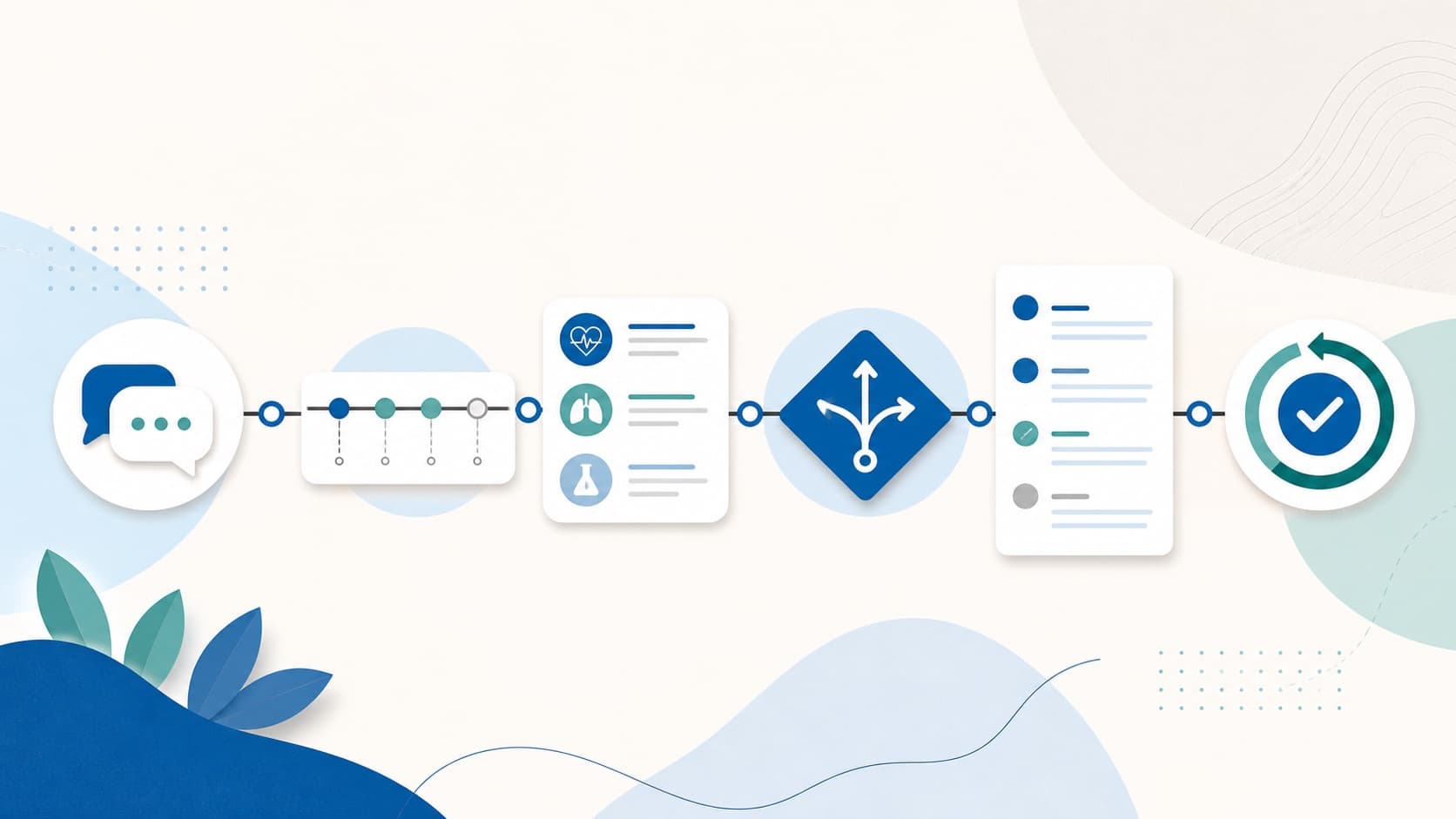
What is clinical documentation?
Clinical documentation records the information and reasoning needed to understand care. It may include progress notes, histories and physicals, consultation reports, procedure notes, discharge summaries, telephone advice, portal communication, medication reconciliation, orders, results, referrals, consent, and follow-up activity.
The exact content and format depend on the profession, setting, encounter, jurisdiction, and intended use. A brief result note is not expected to resemble a hospital discharge summary. A procedure note has different needs from a mental-health follow-up. A SOAP note is one useful structure, but SOAP is not the definition of clinical documentation.
Two current standards illustrate the common core:
- The College of Physicians and Surgeons of Ontario Medical Records Documentation policy requires records to be understandable, accurate, complete for the relevant care, unique to the encounter, identifiable, chronological, and systematic. It also requires documentation to support the treatment or procedure provided.
- The CMS Evaluation and Management Services booklet, updated May 2026, describes complete and legible records that include the reason for the encounter, relevant history and findings, assessment, plan, progress, response to treatment, and changes in diagnosis. CMS also says services should be documented during the encounter or as soon as possible afterward.
Neither source turns quality into a word count. More text is not automatically more complete. A short note that omits a changed medication, follow-up owner, or unresolved result is incomplete. A long note that buries the current assessment beneath copied material is also incomplete for practical use.
Clinical documentation is an evidence chain
Think of the record as a chain, not a transcript:
- Source: who supplied the information?
- Context: when, where, and for which problem does it apply?
- Findings: what was reported, observed, measured, or received?
- Reasoning: what interpretation and uncertainty shaped the decision?
- Action: what was ordered, prescribed, discussed, declined, or deferred?
- Closure: who owns the next step, and what proves it happened?
When one link is missing, the next reader is forced to infer. Inference is where a home reading described as “usually fine” becomes “normal,” a referral marked “sent” becomes “completed,” or an old exam finding becomes today’s finding.
The six layers of a useful clinical record
Six layers from source to closure
Documentation evidence chain
Each layer answers a different question. Combining them into one undifferentiated paragraph makes errors harder to detect and follow-up harder to own.
1 Source
Who said, observed, measured, or supplied this information?
Failure to catch: A reported symptom becomes an established finding, or copied history loses its date and source.2 Context
What encounter, time, setting, and problem does it belong to?
Failure to catch: A correct fact appears in the wrong encounter or without the timeline needed to interpret it.3 Findings
What relevant history, examination, measurement, or result was actually available?
Failure to catch: Blanket negatives, unperformed findings, or preliminary results are presented as complete facts.4 Reasoning
How did the available information change the assessment or decision?
Failure to catch: The assessment simply repeats the history or introduces a conclusion unsupported by the note.5 Action
What happens next, who owns it, and under what conditions?
Failure to catch: The plan lists tasks but leaves timing, ownership, or contingency unclear.6 Closure
How will the team know the action or communication is complete?
Failure to catch: Sent is mistaken for received, reviewed is mistaken for acted on, or an exception has no owner.
The layers can appear in different sections. A problem-oriented note might put the assessment and plan together under each active problem. A SOAP note separates subjective, objective, assessment, and plan. A discharge summary may organize the hospital course by diagnosis. The layout matters less than the boundaries.
Keep source and status attached to facts
Compare these sentences:
- “Blood pressure is normal.”
- “The patient reports that home readings are usually normal; no log was available today.”
- “Clinic blood pressure measured 126/78 mm Hg at 10:14.”
- “The home log supplied by the patient contains seven readings; the clinician reviewed the values recorded from August 18 to 24.”
Each sentence says something different. The first may be an unsupported conclusion. The next three preserve source, availability, and observation. Good documentation does not make every piece of information equally certain.
Status matters in the same way. Ordered, scheduled, collected, preliminary, final, corrected, acknowledged, communicated, and closed are not synonyms. The 2025 ONC SAFER Guide for Test Results Reporting and Follow-Up treats result management as a system of communication, ownership, and follow-up. A note that says only “labs reviewed” may not show whether action was needed or completed.
Make reasoning proportionate and traceable
Clinical documentation should not reproduce every thought. It should preserve enough reasoning for an authorized reader to understand the decision. That may include:
- the working diagnosis or problem;
- meaningful alternatives or uncertainty;
- important supporting and conflicting information;
- response to prior treatment;
- why an investigation, treatment, referral, or watchful approach was chosen;
- relevant patient preference or declined care; and
- the condition that would change the plan.
Traceability does not require defensive prose. One focused sentence can be more useful than a page of imported data. The goal is to connect the current evidence to the current decision.
An eight-step clinical documentation workflow
The workflow begins before the first paragraph and ends after the note is signed. It can be adapted to paper, EHR, dictation, human-scribe, or AI-assisted processes.
- Define the encounter and responsible author
Start with the correct patient, encounter, date, setting, note type, and author. Confirm whether the record belongs to an in-person visit, video encounter, telephone advice, result review, procedure, consultation, or another service.
Misfiled documentation is not repaired by better prose. Patient identification, encounter association, role, and time are foundational controls. The 2025 ONC SAFER guides include patient identification and organizational responsibility as explicit EHR safety areas.
- Capture the current story and source
State why the encounter is happening and what changed. Identify a caregiver, interpreter, prior record, device, or other source when the patient is not the only source. Preserve limitations such as an unavailable log, uncertain timing, conflicting accounts, or an incomplete outside record.
For a focused guide to the present-illness narrative, see HPI medical abbreviation and quality checklist. The same principle applies outside the HPI: information should remain attributable wherever it appears.
- Record findings without changing their meaning
Separate patient report, caregiver report, clinician observation, measurement, prior documentation, and available results. Check dates, doses, units, laterality, negation, and result status. Avoid converting “not asked,” “not measured,” or “not available” into a negative finding.
Templates can help prompt this work, but they can also create false completeness. CPSO requires physicians using templates to verify that populated entries accurately reflect the encounter and capture pertinent details. A practical medical documentation template should make relevant variation easier to record, not reward leaving defaults untouched.
- Make the assessment traceable
The assessment should interpret rather than repeat. Connect it to the evidence that matters. If uncertainty changes the plan, preserve it. If a problem is established and stable, document the interval evidence that supports that conclusion. If a new diagnosis is not yet established, do not rewrite it as a historical fact elsewhere in the note.
Traceability is especially important when multiple problems are addressed. Numbered problem-based assessment and plan sections can make the link visible:
Problem: current evidence and relevant change. Assessment: working interpretation and uncertainty. Plan: action, owner, timing, and contingency.
- Write an owned plan
A plan should show more than intent. For each relevant action, document:
- what will happen;
- who is responsible;
- timing or priority;
- what the patient or caregiver was told;
- declined or deferred options and relevant discussion;
- what should trigger escalation; and
- how completion will become visible.
“Refer to cardiology” describes an intention. “Referral sent to the cardiology intake queue; clinical support will confirm receipt within five business days and escalate an unacknowledged referral to the ordering clinician” describes a workflow.
- Reconcile the whole note
Read across sections. Does the medication list match the plan? Does the assessment explain the new order? Do instructions agree with the follow-up interval? Was an allergy checked before the prescription? Does an imported result have the right status and date?
Reconciliation is where many polished drafts fail. A note may contain every necessary fact but place them in contradictory states. Review the record as a system, not a set of independent text boxes.
- Review and authenticate
The responsible clinician reviews the final record against the encounter and authorized sources, corrects it, and authenticates it according to applicable requirements. The same standard applies whether the draft was typed, dictated, transcribed, copied from a prior note, prepared by a human scribe, or generated by software.
Avoid using the signature as the first quality check. High-risk details deserve deliberate review: identity, medications, allergies, numbers, units, laterality, negation, diagnoses, orders, follow-up, and any sentence that changes responsibility.
- Close the loop and improve the system
Signing a note does not complete an order, referral, test, patient message, or follow-up. Route outstanding work to an owned queue and preserve the state changes needed to reconstruct what happened.
When the same defect recurs, repair the workflow. A recurring wrong default is a template problem. Frequent speaker confusion is an ambient-tool or encounter-fit problem. Unsigned notes at the end of every clinic may be a scheduling, staffing, or interface problem. Improvement begins when defects are counted by cause instead of corrected silently one by one.
Four fictional clinical documentation examples
Make attribution, reasoning, and closure visible
Original teaching examples Fictional composites, no patient data
Each example uses invented facts to demonstrate record structure. The revision does not supply a diagnosis or treatment recommendation.
Follow-up note with an unclear interval
Fictional primary-care follow-up
Source facts
The patient reports three episodes since the last visit four weeks ago. Each lasted about ten minutes. No loss of awareness was reported. The patient stopped the new medication after two doses because of nausea.
Weak draft
Symptoms continue. Medication not tolerated. No concerning features. Continue monitoring.
Revised record
Since the visit four weeks ago, the patient reports three episodes lasting about ten minutes each, without reported loss of awareness. The patient took two doses of the newly prescribed medication and then stopped it because of nausea. The assessment and plan below address the ongoing episodes and reported adverse effect.
Exam finding mixed with patient report
Fictional same-day clinic encounter
Source facts
The patient reports swelling around the left ankle after a minor twist yesterday. The clinician observes mild lateral swelling. The patient can bear weight with discomfort. No imaging has been performed.
Weak draft
Left ankle sprain with mild swelling and no fracture. Walking okay.
Revised record
The patient reports left ankle swelling after a twisting event yesterday and can bear weight with discomfort. Examination shows mild lateral swelling. No imaging result was available at the time of documentation. The clinician assessment and rationale are recorded separately.
Result message without closure
Fictional outpatient result workflow
Source facts
A final laboratory result entered the inbox. The clinician reviewed it, changed the follow-up interval, and asked staff to contact the patient. Staff reached the patient and documented understanding of the new appointment date.
Weak draft
Labs reviewed. Follow up sooner.
Revised record
Final laboratory result reviewed on August 25, 2026. The clinician changed follow-up from twelve weeks to four weeks and routed a patient-contact task to the clinical support pool. Staff reached the patient, confirmed the new appointment date, and closed the task the same day.
Ambient AI draft adds unsupported certainty
Fictional AI-assisted documentation review
Source facts
During the conversation, the patient said a home reading was “usually fine” but did not provide a value. The draft stated that home readings were normal. The clinician had not independently reviewed a log.
Weak draft
Home readings are normal. Condition is well controlled. Continue current management.
Revised record
The patient reports that home readings are “usually fine”; no values or log were available for review today. The clinician assessment and management decision are based on the information documented in the final note.
The examples use the same discipline in different contexts: preserve the source, define the interval, separate observation from interpretation, and make action ownership visible. They are intentionally narrow. Real records also need the content required by the encounter, profession, setting, payer, organization, and jurisdiction.
Clinical documentation quality checklist
Twelve checks before authentication
Transparent final-note review
Apply the checks to the final record and the authorized sources. A completed list shows that a review was performed, not that every possible requirement has been met.
Checked
0 / 12
Use the checklist as a defect screen
The twelve items are not equally risky in every note. A wrong medication dose or missed result owner may require immediate correction. A repeated sentence may mainly reduce usability. Separate defects into categories so the team can respond proportionately:
| Defect class | Examples | Immediate response | System response |
|---|---|---|---|
| Meaning-changing | Wrong patient, dose, laterality, negation, diagnosis, result status, or plan | Stop authentication or amend promptly under policy | Trace the source and add a preventive control |
| Missing decision context | No rationale, uncertainty, response, or link from problem to plan | Add the clinically relevant context | Improve prompts, training, or note structure |
| Ownership and closure | No responsible queue, timing, escalation, or completion evidence | Assign and route the work | Redesign handoff and reporting states |
| Provenance | Copied, imported, dictated, or generated text lacks verification or source | Verify, correct, or remove it | Change defaults, access, attribution, or review workflow |
| Usability | Duplication, stale history, excessive imported data, unclear headings | Remove noise without hiding required history | Measure copy-forward and reader burden |
Meaning-changing
- Examples
- Wrong patient, dose, laterality, negation, diagnosis, result status, or plan
- Immediate response
- Stop authentication or amend promptly under policy
- System response
- Trace the source and add a preventive control
Missing decision context
- Examples
- No rationale, uncertainty, response, or link from problem to plan
- Immediate response
- Add the clinically relevant context
- System response
- Improve prompts, training, or note structure
Ownership and closure
- Examples
- No responsible queue, timing, escalation, or completion evidence
- Immediate response
- Assign and route the work
- System response
- Redesign handoff and reporting states
Provenance
- Examples
- Copied, imported, dictated, or generated text lacks verification or source
- Immediate response
- Verify, correct, or remove it
- System response
- Change defaults, access, attribution, or review workflow
Usability
- Examples
- Duplication, stale history, excessive imported data, unclear headings
- Immediate response
- Remove noise without hiding required history
- System response
- Measure copy-forward and reader burden
This approach prevents one composite “quality score” from hiding a critical error. A note with excellent formatting and one wrong medication is not 92 percent safe.
Clinical documentation improvement
Clinical documentation improvement and clinical documentation integrity usually describe organized efforts to make the health record accurately represent clinical status and care. CDI is not simply adding diagnoses, increasing note length, or maximizing reimbursement. A sound program improves the fidelity and usability of the record while keeping queries compliant and clinically grounded.
The final 2026 ACDIS/AHIMA practice brief, published August 20, 2026, describes compliant provider-query practice as a documentation-clarification process intended to help the health record accurately represent the patient’s clinical status. It applies across healthcare settings and is relevant to the clinicians, coding and CDI, compliance, quality, revenue-cycle, informatics, and technology teams involved in that process.
What a useful CDI program changes
A mature improvement loop has five parts:
- Define quality. Agree on explicit criteria for accuracy, attribution, completeness, timeliness, reasoning, consistency, professionalism, and closure.
- Sample real work. Review representative note types, roles, sites, and workflow states rather than only easy or high-performing cases.
- Classify defects. Separate missing information, unsupported additions, contradictions, source errors, workflow failures, and usability problems.
- Repair the cause. Use education for a knowledge gap, a template change for a bad default, routing redesign for an ownership gap, and technical validation for a software defect.
- Retest. Confirm that the change reduced the target defect without creating new burden or hiding information elsewhere.
Queries should clarify the record, not pressure the clinician toward a predetermined answer. Preserve the clinical indicators, available options, response, and audit trail under the organization’s compliant process.
Avoid the volume trap
Adding required headings can improve consistency. Adding words without information gain creates note bloat. A 2024 study on copying in medical documentation describes the risk of inaccurate copied material and dilution of relevant information. Its lesson is not that all reuse is unsafe. Reuse needs provenance, patient-specific verification, and a clear reason to remain in the current note.
Useful CDI measures ask whether the next reader can find and trust the current information. Character count and template completion rate can support analysis, but they are weak substitutes for meaning.
AI and ambient clinical documentation
AI clinical documentation covers software that transforms permitted inputs into draft clinical text or structured fields. Ambient clinical documentation is a subset that captures a permitted conversation and produces a transcript, summary, or note draft. An ambient system does more than speech-to-text because it may select, reorganize, and infer structure from the conversation.
The CPSO advice on using AI in clinical practice says physicians should review AI-generated information for accuracy and completeness, remain accountable for its use, protect patient information, assess bias, be transparent, and obtain consent before recording conversations using AI.
What current evidence does and does not show
Recent randomized evidence is promising but not uniform:
- A 238-physician randomized trial across 14 outpatient specialties compared two ambient AI scribes with usual care. One product reduced time in notes relative to control, both groups showed potential improvements in several practitioner-experience measures, and clinicians reported occasional clinically significant inaccuracies. The authors called for larger multicentre confirmation of secondary outcomes.
- A 66-practitioner stepped-wedge randomized trial found reduced work exhaustion and documentation time, but not a significant increase in professional fulfilment under the prespecified threshold. The study evaluated one real-world implementation across ambulatory clinics.
- A 2026 randomized study in a single-surgeon adult-reconstruction practice reported shorter physician and office-processing times and favorable patient ratings. The senior author identified 19 medical-information errors in the AI-scribe group and nine in the conventional group; that difference was not statistically significant (
P = .072). Because information accuracy was assessed by the treating surgeon and other language-quality review was unblinded or AI-assisted, the result should not be generalized beyond the studied workflow.
These studies do not establish that every tool improves every clinic. Product, version, specialty, encounter type, accent, audio conditions, user behavior, integration, and outcome definition can change the result. Evidence about time saved does not prove accuracy, privacy, patient benefit, or financial value.
A safer ambient documentation workflow
Use a draft boundary:
- obtain any required notice or consent before capture;
- confirm the correct patient and encounter;
- capture only the permitted data needed for the task;
- keep the generated note visibly in draft state;
- compare the draft with the encounter and authorized source;
- check high-risk details and unsupported certainty;
- reconcile orders, instructions, medication changes, and follow-up;
- authenticate only after clinician review; and
- monitor corrections, failed sessions, omissions, additions, and use by encounter type.
Do not measure acceptance alone. A clinician can use a tool often and still spend substantial time repairing drafts. Track correction minutes, clinically significant defect rates, failed-session recovery, after-hours work, and the percentage of attempted encounters that produce an acceptable finalized note.
For a deeper comparison of people and software in the same workflow, see medical scribes for doctors. The broader medical AI guide covers evidence, governance, risk classification, and implementation beyond documentation.
Privacy, security, and jurisdiction
Clinical documentation contains sensitive health information. Before adding a transcriptionist, human scribe, ambient tool, AI model, integration, or new storage service, map the actual data flow:
- What is collected, including audio, transcript, prompt, note, metadata, and logs?
- Is capture continuous or controlled by the clinician?
- Where is each copy transmitted, processed, stored, backed up, and deleted?
- Which vendor, subprocessor, support user, or model provider can access it?
- Is information used for product improvement, model training, analytics, or secondary purposes?
- Which identities, roles, audit logs, encryption, retention, recovery, incident, and deletion controls apply?
- What happens when a device, connection, or integration fails?
- Can the organization obtain and verify a usable record and audit history at exit?
In the United States, organizations subject to HIPAA should assess the specific arrangement under the applicable Privacy, Security, and Breach Notification requirements. HHS Security Rule guidance emphasizes administrative, physical, and technical safeguards plus risk analysis for electronic protected health information.
In Canada, privacy and professional requirements vary by province, territory, organization, and role. Ontario physicians should evaluate PHIPA duties and current CPSO expectations. A single North American checklist cannot establish compliance in every setting.
The clinical documentation workflow and the privacy workflow should meet at the draft boundary. If the product cannot explain what is captured, where it goes, and how it is removed, the clinical review checklist does not solve the underlying information-governance problem.
How to measure documentation quality
Choose measures that connect to a decision. A clinic introducing an ambient tool may need different measures from a hospital improving discharge summaries or a CDI team reducing unsupported queries.
Build a reproducible sample
Document:
- the note types, specialties, sites, and encounter dates included;
- the product and version when technology is involved;
- who reviewed the notes and how disagreements were resolved;
- the exact defect definitions and severity levels;
- the authorized reference sources;
- whether reviewers were blinded to the workflow;
- the numerator, denominator, exclusions, and missing data; and
- the limits on generalizing the result.
Use fictional or appropriately authorized, protected data in development and testing. Keep patient identifiers out of ordinary spreadsheets and ad hoc evaluation tools.
Measure defects and work
Useful measures can include:
| Measure | Definition to fix before testing | Why it matters |
|---|---|---|
| Clinically significant omission | Required source fact absent from the final note and capable of changing understanding or action | Detects missing meaning, not only missing words |
| Unsupported addition | Final-note statement not supported by the encounter or authorized source | Detects hallucination, copy-forward, and inference risk |
| Cross-section contradiction | Two final-record fields or sections place the same fact in incompatible states | Tests reconciliation |
| Correction time | Clinician minutes from opening the draft to acceptable authentication | Measures repair burden |
| Acceptable finalized note rate | Notes meeting all hard-stop criteria divided by attempted eligible encounters | Prevents successful drafts from hiding failed sessions |
| After-hours documentation | Documentation time outside the organization’s defined scheduled period | Measures workload displacement |
| Timely authentication | Eligible notes authenticated inside the defined standard | Tests completion without rewarding premature signatures |
| Closure rate | Actionable results, referrals, or messages with verified completion inside the target interval | Connects the note to care continuity |
Clinically significant omission
- Definition
- Required source fact absent from the final note and capable of changing understanding or action
- Why it matters
- Detects missing meaning, not only missing words
Unsupported addition
- Definition
- Final-note statement not supported by the encounter or authorized source
- Why it matters
- Detects hallucination, copy-forward, and inference risk
Cross-section contradiction
- Definition
- Two final-record fields or sections place the same fact in incompatible states
- Why it matters
- Tests reconciliation
Correction time
- Definition
- Clinician minutes from opening the draft to acceptable authentication
- Why it matters
- Measures repair burden
Acceptable finalized note rate
- Definition
- Notes meeting all hard-stop criteria divided by attempted eligible encounters
- Why it matters
- Prevents successful drafts from hiding failed sessions
After-hours documentation
- Definition
- Documentation time outside the organization’s defined scheduled period
- Why it matters
- Measures workload displacement
Timely authentication
- Definition
- Eligible notes authenticated inside the defined standard
- Why it matters
- Tests completion without rewarding premature signatures
Closure rate
- Definition
- Actionable results, referrals, or messages with verified completion inside the target interval
- Why it matters
- Connects the note to care continuity
Report results by note type, encounter type, clinician, language, and other relevant dimensions only when group size and privacy controls permit meaningful interpretation. An average can hide a workflow that works well for routine follow-up and poorly for multi-problem or interpreter-assisted encounters.
Turn findings into controlled changes
Every recurring defect should have an owner and a response:
- change a prompt when the missing fact is predictable;
- change a template when the default creates stale or false text;
- retrain when the rule is known but not applied;
- redesign the queue when follow-up has no owner;
- adjust eligible encounter types when a tool fails in a specific context;
- pause or roll back when a safety threshold is crossed; and
- retest after product, model, interface, or policy changes.
Clinical documentation improvement is finished only when the revised system performs better on the same defined measure.
Common documentation failures and practical repairs
The note reads well but cannot be traced
Failure: polished sentences obscure whether information came from the patient, examination, old record, or generated draft.
Repair: add source and date where they change meaning. Preserve uncertainty instead of smoothing it away.
The assessment repeats the history
Failure: the reader sees symptoms twice but cannot tell how they informed the decision.
Repair: remove repetition and state the interpretation, meaningful uncertainty, and rationale that connect evidence to action.
The plan contains unowned verbs
Failure: “monitor,” “follow,” “refer,” and “recheck” appear without an owner, interval, or completion state.
Repair: identify who does what, by when, what triggers escalation, and where closure is documented.
Copy-forward hides today
Failure: a long prior narrative makes the current change hard to find or carries forward resolved findings.
Repair: preserve durable history in the appropriate longitudinal location. Rewrite the interval change for the current encounter and verify every retained element.
The AI draft sounds more certain than the encounter
Failure: reported or ambiguous information becomes a diagnosis, normal result, complete negative review, or definitive plan.
Repair: compare the draft with the source, restore attribution, remove unsupported additions, and check for omitted qualifiers and negation.
Sources and verification
This guide was source checked on August 25, 2026. Professional and regulatory claims are linked to current primary guidance from CPSO, CMS, HHS, ASTP/ONC, and ACDIS/AHIMA. Evidence claims are linked to PubMed records for the cited studies. Vendor marketing claims were not used as independent evidence.
Core references:
- CPSO Medical Records Documentation policy
- CPSO Advice to the Profession: Medical Records Documentation
- CMS Evaluation and Management Services, May 2026
- ASTP/ONC 2025 SAFER Guides
- Final ACDIS/AHIMA Guidelines for Achieving a Compliant Query Practice, August 20, 2026
- CPSO Using Artificial Intelligence in Clinical Practice
- HHS Security Rule guidance material
- Randomized trial of two ambient AI scribes
- Pragmatic randomized trial of ambient AI and practitioner well-being
- Randomized AI-scribe workflow and documentation-quality trial
- Copying in medical documentation study
Key takeaway
Good clinical documentation is not the longest note or the cleanest transcript. It is a traceable record that preserves source, context, findings, reasoning, action, and closure. Templates, CDI programs, human scribes, and ambient AI can help only when the final workflow keeps those boundaries visible and the responsible clinician reviews the authenticated record.
Frequently asked questions about clinical documentation
Direct answers about clinical documentation quality, improvement, templates, note bloat, AI and ambient drafting, privacy, clinician review, and measurement.
What does clinical documentation mean?
Clinical documentation is the attributable record of a healthcare encounter, including relevant history, findings, assessment, decisions, actions, communication, and follow-up. It should help an authorized reader understand what was known, what was decided, what happened next, and who was responsible.
What is the purpose of clinical documentation?
Its primary purpose is to support safe, continuous care. The record also supports communication, patient access, quality improvement, coding, payment, audit, research, and legal or regulatory processes, but those secondary uses should not replace an accurate clinical account.
What should good clinical documentation include?
Content varies by setting, but a useful note identifies the encounter and author, records the current story and relevant findings, makes the assessment traceable, documents the plan and communication, and shows how outstanding work will be followed to completion.
What makes clinical documentation high quality?
High-quality documentation is accurate, attributable, relevant, complete for its purpose, timely, internally consistent, professional, and easy for the next authorized reader to use. Length alone is not a quality measure.
What is clinical documentation improvement?
Clinical documentation improvement, often called clinical documentation integrity or CDI, is a structured effort to make the health record accurately represent the patient’s clinical status and the care delivered. It can include clinician education, compliant queries, template design, workflow repair, audit, and measurement.
Is clinical documentation the same as medical coding?
No. Documentation records the clinical encounter and reasoning. Coding translates supported diagnoses, services, and other facts into applicable code sets for defined uses. Coding should follow the authenticated record and qualified review, not drive unsupported language into it.
Show all questions
How soon should a clinical note be completed?
The responsible professional should document during the encounter or as soon as possible afterward under applicable standards and organizational policy. CMS and CPSO both emphasize prompt documentation because delay increases the chance that details, chronology, and decisions will be lost.
How long should a clinical note be?
Long enough to communicate the encounter and support the decisions, but no longer. A short note can be unsafe if it omits reasoning or follow-up, while a long note can be unsafe if copied text hides current information. Relevance and traceability matter more than word count.
What is the difference between subjective and objective documentation?
Subjective documentation records what the patient or another identified source reports. Objective documentation records observations, measurements, examination findings, and available results. Attribution prevents a report or assumption from being mistaken for a verified finding.
Can clinical documentation use templates?
Yes, but templates should fit the encounter, permit clinically relevant detail, and be verified before authentication. Pre-populated, copied, or default text can create contradictions and false findings when it is not actively reviewed.
What is note bloat?
Note bloat is excessive or repetitive documentation that makes current, decision-relevant information harder to find. Common causes include indiscriminate copy-forward, oversized templates, imported data, duplicated results, and text added mainly to satisfy a perceived billing rule.
How should a correction to a clinical record be documented?
Requirements vary, but the original information generally needs to remain traceable. Use the EHR correction or addendum function, identify the change and author, date it, and follow the applicable policy rather than silently overwriting an authenticated entry.
What is AI clinical documentation?
AI clinical documentation uses models to transform permitted inputs such as conversation audio, dictation, typed context, or existing records into text, summaries, or structured draft notes. The output is a draft that still requires verification, correction, and authentication by the responsible clinician.
What is ambient clinical documentation?
Ambient clinical documentation captures a permitted encounter conversation and uses speech recognition plus language models to produce a draft transcript or note. It differs from simple dictation because it may select, reorganize, and summarize the conversation.
Can an AI scribe replace clinician review?
No. AI systems can omit facts, confuse speakers, change negation or numbers, import stale context, or add plausible details that were never established. Current professional guidance keeps accountability for the final record with the responsible clinician.
How should an AI-generated clinical note be reviewed?
Compare it with the encounter and permitted source material. Check identity, attribution, chronology, medications, allergies, numbers, units, laterality, negation, unsupported certainty, omissions, assessment-plan consistency, orders, instructions, and follow-up before authentication.
Does ambient clinical documentation improve workflow?
It can in some settings, but results vary by tool, specialty, user, adoption, and outcome. Recent randomized trials found improvements in some documentation-time and practitioner-experience measures, while also reporting occasional inaccuracies or more medical errors in a studied workflow. Local testing and ongoing review remain necessary.
What privacy questions apply to AI clinical documentation?
Map what is captured, whether audio is retained, where data moves, who can access it, which suppliers process it, whether it is used to improve models, how long it is kept, and how it is deleted. Consent, contracts, safeguards, and permitted uses depend on jurisdiction and setting.
How can a clinic measure documentation quality?
Use a defined sample and explicit criteria. Useful measures include clinically significant omissions or additions, source-attribution errors, contradictory sections, unsigned or late notes, correction time, after-hours work, result or referral closure, copied-text defects, and reader ability to find the current plan.
Who is responsible for the final clinical note?
Responsibility follows the applicable professional, organizational, payer, and jurisdictional rules. When a clinician authenticates a note created with a template, transcriptionist, scribe, or AI tool, that clinician should verify that the final record accurately reflects the encounter and required work.