Medical AI: Use Cases, Risks, Evidence, and Implementation

Medical AI is software that uses machine learning, language models, computer vision, or related methods to perform or support a medical task. It can help interpret an image, estimate clinical risk, draft a note, monitor a signal, organize evidence, or answer a bounded health question.
That definition does not tell you whether a tool is accurate, regulated, private, or suitable for a real patient. A free medical AI app that generates symptom suggestions, an authorized mammography system, and a language model drafting a discharge summary can all carry the same label while requiring very different evidence and oversight.
The useful question is specific: Does this version of this medical AI tool improve a defined decision or workflow for the intended users and population, while keeping its characteristic failures detectable and controllable?
This guide is written for clinicians, healthcare leaders, patients evaluating apps, and teams responsible for AI governance. It separates independent evidence from vendor claims, explains the limits of human review, and provides a practical implementation path. Regulatory and evidence sources were checked on August 14, 2026.
What is medical AI?
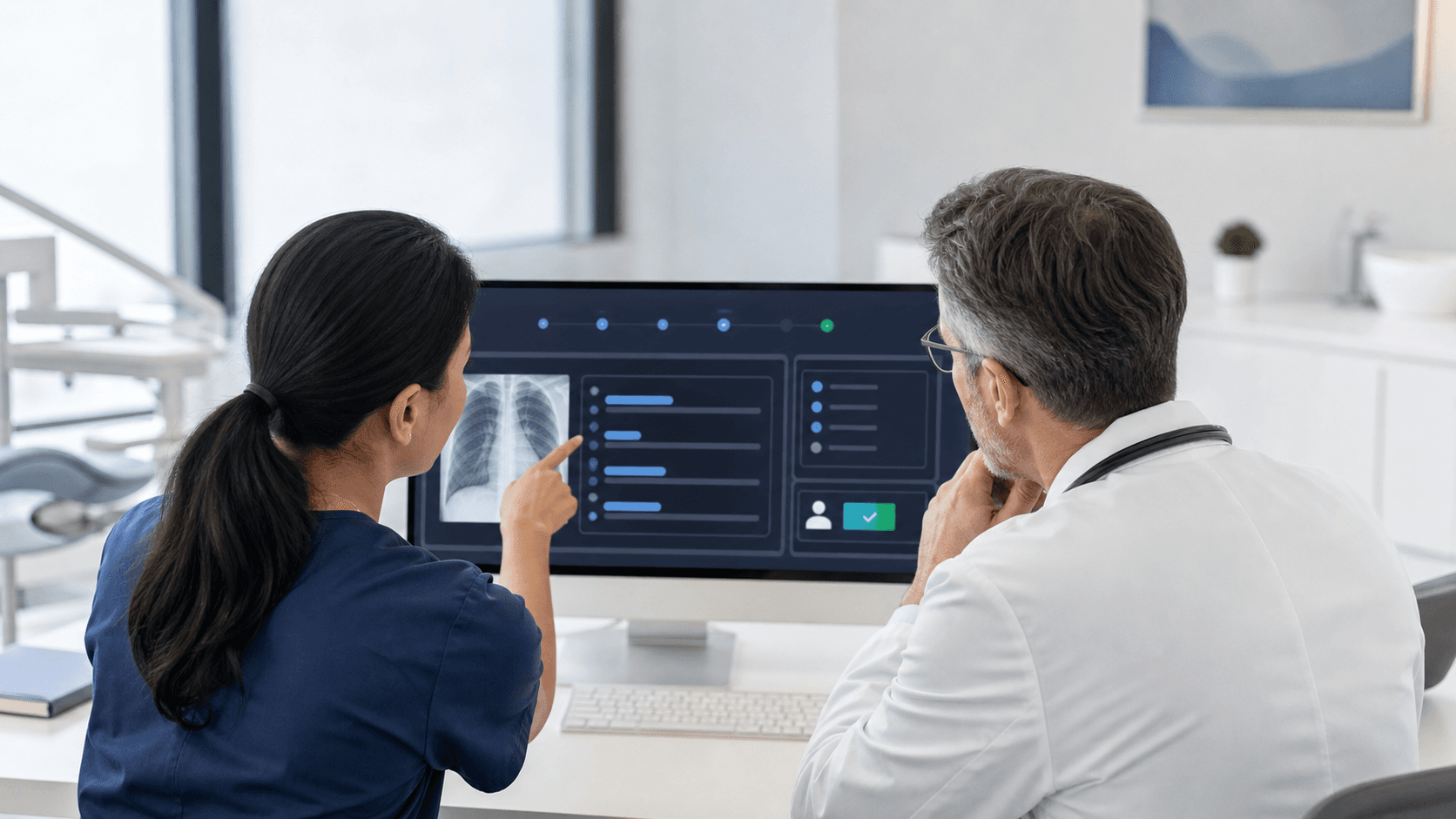
Medical AI is artificial intelligence applied to a medical purpose or workflow. The system may classify, predict, retrieve, generate, measure, prioritize, or recommend. Its output can be a highlighted image region, risk score, draft clinical narrative, ranked list, alert, monitoring signal, or patient-facing explanation.
The International Medical Device Regulators Forum definition is narrower. It describes a machine learning-enabled medical device as a medical device that uses machine learning, in whole or in part, to achieve its intended medical purpose. Not every product marketed as medical AI meets a regulator's medical-device definition, and regulatory treatment varies by function and jurisdiction.
Three questions clarify the category:
- What is the intended use? Is the tool organizing text, supporting a clinician's judgment, producing a diagnosis, controlling a device, or guiding a patient?
- What happens after the output? Does a person review a draft, does an alert change priority, or does the system directly trigger an action?
- What happens when it is wrong or unavailable? The answer determines which failure controls and fallback are needed.
The model architecture is secondary to those questions. A rules-based calculator can influence care more directly than a large language model used to reformat approved text. Conversely, a general-purpose model becomes clinically consequential when its output is used for diagnosis, treatment, triage, or an authoritative medical record.
Medical AI versus AI in healthcare
The terms overlap, but they serve different search and decision needs. Medical AI usually refers to systems close to clinical medicine, patient information, diagnosis, treatment support, monitoring, or medical research. AI in healthcare also includes scheduling, staffing, claims, revenue cycle, supply chains, and other health-system operations.
This page focuses on evaluating a medical function at the point of use. Our broader guide to AI in healthcare covers organization-wide governance across clinical, administrative, research, and patient-facing workflows.
Medical AI is a system, not just a model
A deployed tool includes more than an algorithm. It includes the data pipeline, user interface, threshold, prompt, retrieval source, integration, user, policy, staffing, response process, monitoring, and vendor update path. A strong model can still fail if an input is missing, the interface hides uncertainty, an alert has no owner, or the product changes after validation. For systems that exchange clinical data, the EHR interoperability guide explains how to test authorization, status transitions, acknowledgements, exceptions, and conformance rather than relying on an API claim.
This system view is consistent with the FDA, Health Canada, and MHRA transparency principles, which emphasize the performance of the human-AI team and the information users need to understand and act on outputs.
Six medical AI use cases
The phrase medical AI use case should describe an action, not a technology. “Uses a transformer” says little about safety. “Drafts a radiology impression for radiologist review” identifies a user, output, and control point.
Use-case map
Match the evidence and oversight to the action
Two products can both be called medical AI while making completely different decisions. Begin with what the output changes in care.
Medical task
Medical imaging and physiological signals
Detect, segment, prioritize, or quantify a finding in mammography, radiology, pathology, ophthalmology, ECG, or another defined signal.
- Evidence reality
- Some products have prospective, comparative, and regulatory evidence for a narrow intended use.
- Characteristic failure
- Unreadable inputs, equipment differences, prevalence shifts, or threshold choices can change false-negative and false-positive rates.
- Oversight boundary
- A named clinical pathway handles positive, negative, uncertain, and failed outputs within the authorized or validated use.
Medical task
Prediction and clinical decision support
Estimate deterioration, readmission, treatment response, or another event so a clinician can prioritize assessment or action.
- Evidence reality
- Retrospective discrimination is common; external validation, prospective testing, calibration, and demonstrated response are less common.
- Characteristic failure
- A model may transport poorly, optimize a distorted proxy, or create alerts that no team can act on.
- Oversight boundary
- Clinicians can inspect the basis, disagree, escalate, and use a defined alternative when the output is unavailable or implausible.
Medical task
Clinical language and documentation
Draft notes, summarize records, classify messages, retrieve source-grounded information, or prepare patient communication.
- Evidence reality
- Workflow and usability evidence is growing, but results remain product, version, specialty, and implementation specific.
- Characteristic failure
- A fluent draft can omit a material fact, add unsupported content, mishandle negation, or conceal a weak source.
- Oversight boundary
- The responsible clinician compares the output with its source and verifies all consequential facts before use.
Medical task
Patient-facing medical AI apps
Explain approved information, navigate services, collect symptoms, or support a regulated monitoring or decision function.
- Evidence reality
- Bounded, source-grounded tasks are easier to validate than open-ended diagnosis or treatment advice.
- Characteristic failure
- The app can sound certain, miss urgency, expose sensitive information, or operate outside the population it was designed for.
- Oversight boundary
- Urgent and uncertain cases reach a person, sources and limits are visible, and users can understand how their data is handled.
Medical task
Monitoring and connected care
Identify a meaningful change in home, wearable, bedside, or population-level data and route it for follow-up.
- Evidence reality
- Value depends on the sensor, target, alert threshold, response capacity, and whether earlier action changes an outcome.
- Characteristic failure
- Missing data, device non-use, alert fatigue, or inequitable access can make the apparent service perform differently from the model.
- Oversight boundary
- The service defines alert ownership, response time, contact attempts, escalation, and what happens when data stops arriving.
Medical task
Biomedical research and therapeutic development
Search evidence, identify cohorts, analyze multimodal data, generate candidates, or support protocol and trial work.
- Evidence reality
- AI can accelerate selected discovery tasks, but a useful research signal is not evidence of clinical benefit.
- Characteristic failure
- Data leakage, non-reproducible analysis, hidden confounding, or a plausible generated explanation can overstate a finding.
- Oversight boundary
- Methods are reproducible, outputs are independently validated, and clinical claims follow the normal evidence and regulatory path.
1. Imaging and physiological signals
AI can help detect, segment, measure, reconstruct, or prioritize findings in mammograms, CT scans, pathology slides, retinal images, ECGs, ultrasound, and other signals. This area contains many of the medical AI products with public regulator records because the input and intended output can often be specified precisely.
The FDA's AI-enabled medical device list identifies authorized devices and links to public decision records. FDA also states that the list is not comprehensive. Presence on the list supports the specific authorized function. It does not validate every feature from the manufacturer or performance outside the labelled conditions.
Image and signal tools require an explicit plan for unreadable inputs, unexpected anatomy, equipment differences, prevalence, threshold selection, and referral capacity. A model cannot create a benefit if a positive result reaches no one or if the service cannot manage the extra work produced by false positives.
2. Prediction and clinical decision support
Predictive medical AI estimates an event such as deterioration, readmission, treatment response, or a missed diagnosis. Clinical decision-support systems may combine person-specific data with guidelines, reference material, or model outputs.
The score is only one part of the intervention. Teams need to know when it appears, which action it suggests, who sees it, what competing alerts exist, and whether the user can independently review its basis. A model with good retrospective discrimination can still provide little value when it arrives too late or creates a queue that exceeds team capacity.
The FDA's January 2026 clinical decision-support guidance explains that some CDS functions are excluded from the US device definition while others remain device software functions. The boundary depends on statutory criteria and the actual function. Calling a feature “decision support” does not settle its status.
3. Clinical language, documentation, and retrieval
Language models can draft clinical notes, summarize records, prepare messages, translate approved material, classify requests, and retrieve evidence from a controlled source. These uses can be lower risk when the output remains a draft and the responsible clinician has the source, time, and authority to correct it.
The main generative failure is not awkward wording. It is plausible content without adequate support. A draft can omit an important negative, convert uncertainty into fact, mix two patients, invent a citation, or place a plan statement inside the history. Our guide to medical scribes for doctors compares human and AI documentation workflows and their different failure paths.
4. Patient-facing medical AI apps
A medical AI app may explain approved information, guide navigation, collect symptoms, monitor a regulated signal, or generate open-ended health advice. These are not interchangeable.
A source-grounded answer about preparation for a scheduled test is easier to constrain than diagnosis or medication selection. Patient-facing systems need an obvious path for urgent symptoms, uncertainty, accessibility needs, and human contact. Their privacy terms also matter because a consumer app may sit outside the relationships people normally associate with clinical privacy law.
5. Monitoring and connected care
Medical AI can analyze home measurements, bedside streams, wearable signals, or longitudinal records. The possible benefit is earlier recognition of a meaningful change.
Operational design decides whether that signal becomes care. A safe service specifies device non-use, missing data, response time, contact attempts, escalation, documentation, and the person accountable for closing an alert. Evaluation should include people who cannot maintain a continuous data stream, not only those who produce complete inputs.
6. Research and therapeutic development
AI can search literature, identify cohorts, analyze medical images and molecular data, generate candidate structures, or help design a study. These tools may reduce search time or surface patterns that deserve testing.
The output is a research hypothesis or analytical result, not a shortcut around validation. Reproducibility, data provenance, independent confirmation, research ethics, and the applicable clinical and regulatory pathway remain necessary. The WHO guidance on large multi-modal models treats scientific research and therapeutic development as distinct uses with their own governance risks.
What does medical AI evidence prove?
Evidence belongs to a product, version, task, population, setting, user, comparator, and endpoint. It does not belong to the words “AI powered.”
Evidence ladder
Strong claims need evidence close to real care
These levels are cumulative. A clinical trial does not remove the need for technical validation, and authorization does not remove the need for monitoring.
Evidence becomes more useful for a care decision as it moves toward the intended users, workflow, comparator, and outcomes.
Level 1
Technical and benchmark performance
Can the model complete a defined task on a selected dataset?
What it can establish
Useful for development and comparison under controlled conditions. It does not establish live clinical value.
Level 2
Independent external validation
Does the locked system perform on data from a different site, time, device, or population?
What it can establish
Tests transport beyond development data, while still leaving workflow, user behaviour, and patient impact unanswered.
Level 3
Prospective workflow evaluation
What happens when intended users apply the system to incoming cases in the real workflow?
What it can establish
Reveals failed inputs, latency, alert burden, review behaviour, usability, and operational effects.
Level 4
Comparative clinical study
Does AI-supported care outperform or preserve an appropriate comparator on a meaningful endpoint?
What it can establish
Supports a defined causal claim when the design, population, product version, and endpoint match the intended use.
Level 5
Post-deployment outcomes and monitoring
Does performance remain acceptable after updates, data shifts, staffing changes, and routine use?
What it can establish
Shows whether benefit and risk remain stable in service, including incidents, subgroup effects, overrides, and drift.
Benchmarks answer a narrow question
A benchmark can test whether a model recognizes images, extracts concepts, answers examination questions, or generates an expected response. These tests are useful for development. They often provide clean inputs, complete information, fixed prompts, and a reference answer.
Live medicine adds missing data, uncommon cases, interruptions, competing priorities, changing prevalence, equipment variation, delayed follow-up, and uncertain ground truth. A benchmark result should therefore be described as benchmark performance, not clinical accuracy or patient benefit.
Two randomized language-model studies reached different conclusions
A randomized clinical vignette study of 50 physicians found no significant improvement in median diagnostic-reasoning score when physicians had GPT-4 plus conventional resources rather than conventional resources alone. The adjusted difference was 1.6 percentage points, with a 95% confidence interval from -4.4 to 7.6. The work used simulated cases, not live treatment decisions.
A separate randomized trial of 92 physicians used five sequential management cases based on de-identified encounters. Physicians with GPT-4 scored 43.0% versus 35.7% with conventional resources, an adjusted difference of 6.5 percentage points. They also spent more time on the cases. The authors called for rigorous validation in real clinical settings.
These results are not contradictory proof that language models either work or fail in medicine. They show that outcome, task design, user behaviour, model access, scoring, and workflow change the effect. A team should not generalize either trial to another model, specialty, patient population, or live deployment.
The MASAI trial shows what use-specific evidence looks like
The MASAI randomized mammography screening study compared AI-supported screening with standard double reading across four Swedish sites. Among 105,915 analyzed participants, AI-supported screening detected 338 cancers versus 262 in standard screening and reduced screen-reading workload by 44.2%, without a statistically significant increase in the reported false-positive rate.
That is meaningful evidence for one version of one system inside a defined screening protocol. It does not establish mortality benefit, validate unrelated imaging models, or justify replacing radiologists in other workflows. The product version, sites, population, protocol, endpoint, and follow-up period remain part of the finding.
A 2026 protocol-defined analysis of the trial's primary outcome reported interval-cancer rates of 1.55 per 1,000 participants with AI-supported screening and 1.76 per 1,000 with standard double reading. The proportion ratio was 0.88, with a 95% confidence interval from 0.65 to 1.18, meeting the prespecified 20% non-inferiority margin. Sensitivity was 80.5% versus 73.8% (p=0.031), while specificity was 98.5% in both groups.
These findings still apply to the tested Transpara version 1.7.0 workflow in Swedish population screening. They do not establish mortality benefit or transfer automatically to other products, populations, or settings.
Evidence claims should expose limitations and interests
Peer review does not make every study independent. Product developers may fund a trial, supply a system, design an analysis, employ authors, or hold equity. Those roles do not automatically invalidate the work, but they should be visible.
A careful evidence summary records:
- product and model version;
- intended use and user;
- study design and comparator;
- enrollment and exclusions;
- setting, language, equipment, and prevalence;
- reference standard and uncertainty;
- primary endpoint and confidence interval;
- failed inputs, subgroup results, and missing outcomes;
- funding, author roles, and conflicts;
- whether the same result has been reproduced independently.
Claim audit
Convert a vendor promise into eight answerable questions
What exact clinical or workflow decision does the claim describe?
Which product, model, prompt, threshold, integration, and version were tested?
Was the evidence independent, peer reviewed, prospective, and comparative?
Did the study population, setting, equipment, language, and prevalence match intended use?
Was the endpoint technical performance, workflow, clinician behaviour, patient experience, or health outcome?
Were failed inputs, false positives, false negatives, overrides, incidents, and subgroup results reported?
Who funded the study, who supplied the system, and which conflicts or vendor roles were disclosed?
What local test and monitoring evidence would be needed before relying on the claim?
How to evaluate a medical AI app
Searches for a medical AI app, medical AI free, and free medical AI often mix four categories:
- regulated medical-device functions;
- clinician-facing support that may or may not be a device;
- consumer health or general-wellness apps;
- general-purpose chatbots being used for a medical question.
The app store category, price, or use of medical vocabulary does not establish which category applies. Start with the developer's intended use and claims, then verify them against the relevant regulator and the actual data flow.
Free does not describe the clinical or privacy model
A free medical AI app can be useful for a low-risk task, but its business model still has a cost. It may limit security features, retain prompts, use content to improve services, share data with analytics providers, show advertising, restrict export, or change terms with little notice. A paid tool can have the same problems.
In the United States, HHS explains that HIPAA often does not protect information entered into a personal app unless the app is provided by or on behalf of a covered entity or business associate. The FTC Health Breach Notification Rule can apply to many health apps outside HIPAA, but breach notification is not a substitute for evaluating collection, use, security, and medical claims before use.
Canadian organizations should examine the applicable federal or provincial privacy framework and the role of each organization. The Office of the Privacy Commissioner of Canada's AI resources emphasize that generative AI relies on large-scale data use and that privacy requirements continue to apply.
App review
Ten checks before a medical AI app sees health data
Use the same questions for a paid product, a free medical AI app, and a time-limited trial.
- 1
The app names its developer, current version, intended users, and exact intended use.
- 2
A medical claim is linked to evidence for the same product and version, not to AI in general.
- 3
Regulatory status can be verified in the relevant regulator database when the function is a medical device.
- 4
The app explains what it cannot do, which inputs it rejects, and when a person should take over.
- 5
Sources are visible and current when the app generates medical information.
- 6
The privacy notice explains collection, purpose, recipients, training use, retention, deletion, and cross-border processing.
- 7
A clinic has approved the tool before patient information enters it, including any free or trial account.
- 8
The output can be corrected, rejected, exported, and traced to a user and product version.
- 9
The workflow has an emergency path, a downtime path, and an accountable human owner.
- 10
Free pricing is not being subsidized by unexpected advertising, data reuse, limited security, or an unusable export path.
Questions a patient can answer before using an app
Look for a real developer identity, current privacy notice, intended use, evidence, regulator record where relevant, deletion process, source display, and clear escalation. Do not assume a medical-looking interface means a clinician is monitoring the output.
If the app asks for symptoms, images, medications, lab results, or records, first check who receives that information, whether it is used to train models, how long it is retained, and how it can be deleted. An emergency message should route the user to an established emergency service rather than simulate ongoing clinical care.
Questions a clinic must answer before a free trial
A free account is still a vendor relationship and data flow. The clinic should approve the exact account type, terms, privacy and security controls, retention, subprocessors, training use, integration, support, incident process, and deletion evidence before patient information enters the product.
The pilot should use synthetic or properly authorized data until those reviews are complete. Test results should be tied to the same product version and settings that will be used in practice.
Where medical AI fails
Medical AI can fail at input, model, interface, review, action, monitoring, or governance. The most dangerous error is not always a wrong prediction. It may be a correct warning that no one owns, a fluent summary that hides an omission, or a product update that changes behaviour without a local reassessment.
Failure-to-control map
Human oversight is a chain, not a checkbox
A reviewer can only manage errors that the workflow makes visible and gives them time and authority to act on.
- 1
Oversight stage
Input
Failure and warning signal
Missing, low-quality, or unrepresentative data
High rejection rates, quality warnings, subgroup gaps, or unfamiliar equipment and formats
Control before the next stage
Validate input quality, expose failed inputs, test relevant subgroups, and keep a non-AI path available.
- 2
Oversight stage
Model output
Failure and warning signal
False prediction, unsupported statement, or hidden uncertainty
Material false positives, false negatives, hallucinations, omissions, or poor calibration
Control before the next stage
Use task-specific metrics, source grounding, uncertainty display, and predetermined acceptance thresholds.
- 3
Oversight stage
Human review
Failure and warning signal
Automation bias or superficial approval
Low override rates despite known errors, short review times, or repeated acceptance of plausible mistakes
Control before the next stage
Show source context, require review of consequential fields, train disagreement, and audit corrections and near misses.
- 4
Oversight stage
Clinical action
Failure and warning signal
Correct output with no timely or appropriate response
Unowned alerts, delayed escalation, duplicate work, or a queue larger than team capacity
Control before the next stage
Define owner, response window, escalation, acknowledgement, closure, and downtime before launch.
- 5
Oversight stage
Product change
Failure and warning signal
Model, prompt, threshold, integration, or subprocessor changes
Output style, latency, error pattern, or version changes after the original evaluation
Control before the next stage
Require change notice, version traceability, regression tests, release approval, pause, rollback, and exit rights.
- 6
Oversight stage
Data governance
Failure and warning signal
Unexpected collection, reuse, retention, or disclosure of health information
Unclear data flows, broad training rights, advertising use, uncontrolled exports, or missing deletion evidence
Control before the next stage
Map and minimize data, approve every recipient and purpose, contract retention, log access, and test deletion and export.
Wrong output and missing uncertainty
Predictive systems can be miscalibrated, meaning a reported risk does not correspond to observed frequency. Generative systems can produce unsupported statements, citations, or instructions. Image systems can fail on poor-quality or unfamiliar inputs.
An overall accuracy score can hide the error that matters most. Medical AI evaluation should separate false positives, false negatives, unreadable inputs, hallucinations, material omissions, wrong-patient content, and unsafe escalation. It should also measure uncertainty and abstention when the system provides them.
Bias is more than an unbalanced dataset
Bias can enter through labels, proxy outcomes, threshold selection, missing data, equipment, documentation quality, and access to follow-up. A dataset may represent a population numerically while the target still reflects unequal care.
Subgroup reporting is necessary, but teams should also trace service allocation. Who is offered the tool? Whose inputs fail? Who receives a false alert? Who gets follow-up? Who can opt out or reach a person? A model metric cannot answer those workflow questions alone.
Drift and silent product change
Performance can shift because patients, disease prevalence, coding, devices, clinical practice, or input pipelines change. A vendor can also change the base model, prompt, threshold, retrieval source, interface, or subprocessor.
Health Canada's April 2026 guidance explicitly addresses version traceability, testing, clinical validation, transparency, post-market monitoring, and degradation or input-distribution shifts for machine learning-enabled medical devices. Those lifecycle habits are useful for non-device medical AI too, with depth adjusted to risk.
Privacy and security failures can change clinical safety
Privacy is not separate from safety when people avoid care, withhold information, or lose trust because a tool handles data unexpectedly. Security failure can also interrupt a service, alter an output, or expose an integration that writes to the record.
Map the full flow: device, browser, mobile app, API, model provider, retrieval store, logging service, support access, analytics, export, backup, and deletion. Review the purpose and minimum necessary input at each step. A vendor's security page is useful evidence, but it does not describe the clinic's configuration or every downstream recipient. The same identity, proxy-access, release, and audit questions appear in patient portal privacy and access workflows, where a technically valid account can still expose information to the wrong person or at the wrong time.
What meaningful human oversight looks like
“Human in the loop” is often presented as a complete safeguard. It is not. Review works only when the person can detect the relevant failure and has enough time, source context, competence, interface support, and authority to intervene.
The reviewer needs the source, not only the answer
A clinician cannot efficiently verify a long summary without access to the underlying encounter, record section, image, or reference. Source-linked output reduces search cost and makes disagreement possible. For generative content, the interface should help distinguish copied facts, transformations, and generated interpretation.
Oversight belongs at the consequential point
Reviewing a dashboard once a month does not control a treatment recommendation used today. Each use needs a named checkpoint:
- before a draft enters the legal record;
- before a result reaches a patient;
- before an alert changes clinical priority;
- before an automated action is executed;
- after an incident, override pattern, or material update triggers reassessment.
Measure whether humans actually intervene
Track corrections, overrides, response time, escalations, near misses, and disagreements. An override rate near zero may indicate an excellent tool, but it may also indicate automation bias or a difficult interface. Audit a representative sample against source evidence rather than treating acceptance as proof of correctness.
The American Medical Association describes AI as augmented intelligence, emphasizing an assistive role and physician involvement in oversight, transparency, privacy, and implementation. That framing is useful when the workflow makes human judgment real rather than ceremonial.
Medical AI regulation in the United States and Canada
There is no single approval for medical AI as a category. Regulation follows intended use, claims, risk, user, autonomy, and jurisdiction. Privacy, professional standards, consumer protection, cybersecurity, human rights, and medical-device rules can apply at the same time.
United States
FDA regulates device software functions that meet the device definition and fall within its oversight. Its AI-enabled device list is a transparency resource, not a complete catalogue. Public authorization records should be read for the specific indication, user, limitations, performance, and version.
Some clinical decision-support functions can be excluded from the device definition under the 21st Century Cures Act when they meet the statutory criteria. FDA's current final guidance and clinical decision-support FAQs explain that many other software functions remain devices or follow another digital-health policy.
Privacy analysis depends on the relationship and data flow. HIPAA may apply to a covered entity or business associate, while consumer-selected apps can fall outside that relationship. The FTC Act and Health Breach Notification Rule can apply to health apps outside HIPAA. State privacy, professional, insurance, and AI rules may add requirements.
Canada
Health Canada considers software a medical device when it has an intended medical purpose under applicable Canadian legislation and performs that purpose without being part of a hardware device. The 2026 machine learning-enabled medical-device guidance addresses Class II, III, and IV applications and lifecycle evidence, while Class I through IV devices remain subject to applicable post-market oversight.
Privacy requirements vary by organization, activity, and province. A clinic may need to consider provincial health-information law, private-sector privacy law, professional-college expectations, contracts, cross-border handling, and breach duties. Medical-device licensing and privacy compliance answer different questions, so one does not replace the other.
International and voluntary frameworks
WHO's health-specific guidance addresses autonomy, safety, transparency, accountability, equity, sustainability, and governance. The NIST Generative AI Profile is a voluntary cross-sector resource organized around governance, content provenance, pre-deployment testing, and incident disclosure.
These frameworks help teams organize a review. They do not replace the regulator, applicable law, professional duty, a quality system, or evidence for the intended medical use.
How to implement medical AI safely
Implementation should start with a problem that can be described without naming a product. A team that starts with a model demo is likely to retrofit the clinical problem around the tool. The healthcare software requirements checklist provides a companion procurement framework for translating that problem into testable requirements, security evidence, workflow demonstrations, and contract terms.
Establish a one-sentence intended use
Write the user, setting, input, output, and action. For example:
In adult primary-care visits, the tool creates a draft history and assessment from permitted encounter information for the treating clinician to verify before signing.
That sentence still needs exclusions, but it is testable. “Use AI to improve documentation” is not.
Set acceptance and stop criteria before testing
Choose metrics that match the characteristic failure. A documentation tool needs material omission, unsupported addition, correction time, wrong-patient risk, and note completion measures. An imaging tool may need sensitivity, specificity, false positives, unreadable input rate, reader workload, and time to follow-up. A prediction tool needs calibration, missed cases, alert volume, lead time, acknowledgement, and completed response.
Define when the pilot pauses. Examples include a serious incident, error rate above threshold, unexpected data disclosure, unannounced material update, failed deletion test, or subgroup result outside the approved limit.
Test the full workflow before influencing care
Begin with synthetic, retrospective, or silent prospective evaluation as appropriate. Include common cases, difficult cases, poor-quality inputs, unsupported languages, uncommon presentations, conflicting source information, missing data, and downtime.
Then test the human path: can the user see the source, identify uncertainty, correct the output, escalate, and complete the task when the AI is unavailable? Record time and workload. An extra verification layer can consume more time than the system removes.
Monitor the deployed service, not only the model
Monitor output errors and the actions around them. Include adoption, failed inputs, corrections, overrides, alerts, response, incidents, complaints, workload, subgroup effects, and outcome measures. Record the product and model version with each evaluation period.
Implementation path
Move from a bounded task to a monitored medical service
Each step should leave behind an owner, decision, evidence record, test result, or operating control.
- 01
Define the task and decision boundary
State the user, input, output, clinical or operational decision, setting, and what the system must never do. Keep the first use narrow enough to evaluate.
- 02
Classify risk and regulatory status
Determine whether the function is a medical device, non-device decision support, administrative software, research software, or a consumer app in each relevant jurisdiction.
- 03
Map data and accountability
Document every input, recipient, purpose, storage location, retention period, subprocessor, user role, and accountable clinical, privacy, security, and operational owner.
- 04
Audit the evidence claim by claim
Match each promised benefit to a study or regulator record for the same product version, intended use, population, comparator, workflow, and endpoint.
- 05
Write acceptance and stop criteria
Set thresholds for material errors, failed inputs, false alerts, missed cases, correction burden, response time, subgroup performance, incidents, and user workload before the pilot begins.
- 06
Run silent and adversarial tests
Test representative cases without influencing care first, then add poor-quality inputs, uncommon cases, language variation, conflicting evidence, downtime, and known failure conditions.
- 07
Design meaningful human oversight
Show reviewers the source and uncertainty they need, define which elements require verification, and make reject, correct, escalate, and fallback actions usable under real time pressure.
- 08
Pilot with bounded users and scope
Train a small group, preserve the comparator, collect correction and outcome data, invite patient and staff feedback, and give the owner authority to pause use immediately.
- 09
Monitor, control changes, and reassess
Track performance, workload, overrides, incidents, complaints, subgroup effects, model versions, and input drift. Repeat validation after material changes and keep rollback and exit tested.
Implementation worksheet
Use this compact record for every proposed medical AI function:
Reusable worksheet
Record the decision before the pilot begins
Complete the fields in your browser, then copy or download the record. Entries stay in this browser tab and are not submitted to Vero. Do not include patient information.
| Field | Decision to record |
|---|---|
| Intended use | |
| Exclusions | |
| Baseline | |
| Evidence | |
| Regulation | |
| Data | |
| Human oversight | |
| Acceptance | |
| Stop criteria | |
| Change control |
How to separate evidence from vendor claims
A vendor can be the best source for product documentation and still be the wrong source for an independent benefit claim. Use vendor material for features, intended use, architecture, security controls, integrations, support, pricing, and change terms. Use independent studies and regulator records for clinical performance and authorization, while checking whether the study actually evaluated the current product.
Translate broad claims into measurable statements:
- “Improves accuracy” becomes “reduces material false negatives from the baseline without an unacceptable false-positive increase.”
- “Saves time” becomes “reduces median total completion time, including review, correction, exception handling, and failed sessions.”
- “Reduces burnout” becomes a defined, validated measure with a comparator and follow-up period.
- “Improves care” becomes a patient, clinical, or service outcome rather than a proxy chosen because it is easy to collect.
Ask the vendor to identify which claims are supported by independent peer-reviewed evidence, regulatory review, internal validation, customer data, or product assumptions. Keep those categories separate in the decision record.
Questions to ask a medical AI vendor
- What exact intended use, user, and population does this version support?
- Which functions are medical devices in the United States or Canada, and where can we verify the record?
- Which model, prompt, retrieval source, threshold, and version produced the evidence you cite?
- What were the primary endpoint, comparator, failed-input rate, confidence interval, and subgroup results?
- Which important outcomes were not measured?
- What health information is collected, retained, logged, reused, or sent to subprocessors?
- Can customer data, prompts, corrections, or metadata be used for model training?
- How does the interface show source, uncertainty, limitations, and failed inputs?
- What changes can occur without customer approval, and how are versions recorded?
- How can we pause, roll back, export records, verify deletion, and leave the service?
Where Vero fits
Vero publishes this guide and sells AI-assisted clinical documentation software. That commercial interest is relevant when reading product-related content on this site.
The evidence standards above apply to Vero too. A feature description can explain what Vero is designed to do. It cannot prove a clinical, safety, workload, or financial outcome without evidence that measures that outcome for the relevant product version and workflow. Clinics evaluating AI documentation can review Vero's workflow on the medical scribe product page and test it against the same source fidelity, correction, privacy, change-control, and monitoring questions used for any vendor.
The practical conclusion
Medical AI is most useful when the task is bounded, the evidence matches the intended use, the characteristic failures are visible, and a monitored workflow connects output to accountable action. Fluency, benchmark performance, authorization, and human review each answer only part of the safety question.
For clinicians and patients choosing a medical AI app, begin with intended use, evidence, privacy, escalation, and version. For healthcare organizations, add local validation, acceptance criteria, change control, incident response, subgroup monitoring, and an exit path. The goal is not to prove that medical AI works in general. It is to decide whether one defined system improves one defined service under conditions the organization can sustain.
Sources and further reading
- World Health Organization: ethics and governance of large multi-modal models for health
- FDA: Artificial Intelligence-Enabled Medical Devices
- FDA: Clinical Decision Support Software, final guidance
- FDA: Good Machine Learning Practice guiding principles
- Health Canada: pre-market guidance for machine learning-enabled medical devices
- IMDRF: machine learning-enabled medical-device terms and definitions
- NIST: Generative AI Profile
- HHS: health information and personal mobile apps
- FTC: Health Breach Notification Rule basics
- Office of the Privacy Commissioner of Canada: privacy and artificial intelligence
- Lancet Digital Health: MASAI randomized mammography screening trial
- The Lancet: MASAI primary interval-cancer, sensitivity, and specificity analysis
- JAMA Network Open: LLM influence on diagnostic reasoning
- Nature Medicine: GPT-4 assistance on patient-care management tasks
- Communications Medicine: systematic review of LLMs in patient care
- American Medical Association: augmented intelligence in medicine
Plain-language answers
Frequently asked questions about medical AI
Direct answers about medical AI apps, free tools, evidence, regulation, privacy, human oversight, failure modes, and implementation in the United States and Canada.
What is medical AI?
Medical AI is software that uses machine learning, language models, computer vision, or related methods to perform or support a medical task. Examples include interpreting images, estimating risk, drafting clinical text, monitoring signals, and answering bounded health questions. Evidence and regulation depend on the exact function and intended use.
How is medical AI different from AI in healthcare?
Medical AI usually refers to tools close to medicine, such as diagnosis, treatment support, clinical documentation, monitoring, and patient information. AI in healthcare is broader and also includes scheduling, billing, staffing, operations, and research administration. The terms overlap, so the function matters more than the label.
What is a medical AI app?
A medical AI app is a mobile or web application that applies AI to a health or medical function. It might be a regulated medical device, non-device clinical support, a general wellness app, or a general-purpose chatbot. Users should verify intended use, evidence, regulatory status, privacy terms, and escalation before relying on it.
Are free medical AI apps safe?
Free pricing does not establish safety. A free medical AI app may be appropriate for a low-risk, source-grounded task, or it may lack suitable evidence, privacy controls, support, change notice, and clinical escalation. Do not enter patient information until the organization has approved the actual product, account type, data flow, and contract.
Is there a free medical AI that can diagnose illness?
Some free tools generate diagnostic suggestions, but availability is not proof of authorization, validation, or fitness for an individual case. A consumer should check whether the specific diagnostic function is regulated in the relevant jurisdiction and follow its intended use. Urgent or worsening symptoms require an established clinical pathway, not open-ended chatbot output.
Can a medical AI app replace a doctor?
Current medical AI can support bounded tasks, but it does not assume the full clinical, ethical, relational, and legal responsibilities of a physician. Even strong benchmark performance does not reproduce examination, longitudinal knowledge, uncertainty management, communication, or accountability across real care.
What are the main medical AI use cases?
Major use cases include imaging and signal interpretation, prediction and clinical decision support, clinical language and documentation, patient-facing apps, monitoring and connected care, and biomedical research. Each use requires different evidence, human oversight, privacy controls, and failure handling.
What evidence should support a medical AI tool?
Evidence should match the product version, intended use, users, population, setting, input, comparator, and endpoint. Strong evaluation often progresses from technical testing to independent external validation, prospective workflow testing, comparative clinical studies, and post-deployment monitoring. A vendor demo or benchmark alone is not clinical evidence.
Does FDA authorization mean a medical AI app is accurate for every patient?
No. FDA authorization applies to a specific device, indication, user, and set of conditions. It does not authorize every feature from the company or prove performance outside the intended population and workflow. Read the public decision record, indications, limitations, performance information, and current version.
How does Health Canada regulate medical AI?
Health Canada regulates machine learning-enabled medical devices under applicable Canadian legislation and the Medical Devices Regulations when the software has a medical purpose. Its April 2026 guidance addresses risk classification, evidence, data, testing, clinical validation, transparency, post-market monitoring, and predetermined change control plans.
What is a hallucination in medical AI?
A hallucination is generated content that is not adequately supported by the input or a reliable source. In a medical context it may be an invented symptom, citation, diagnosis, contraindication, or instruction. Source grounding and human review reduce risk, but neither makes a generative model error-free.
What is automation bias in medical AI?
Automation bias occurs when a person gives too much weight to a system output or stops searching after the system suggests an answer. It is more likely when outputs are fluent, reviewers are rushed, or disagreement is difficult. Effective oversight preserves source context, uncertainty, time, authority, and an easy reject or escalation path.
How can bias enter a medical AI system?
Bias can enter through the people represented in data, missing data, labels, proxy outcomes, thresholds, equipment, access patterns, and the actions taken after an output. Subgroup metrics help, but teams must also examine who receives the tool, whose inputs fail, who gets follow-up, and who carries the burden of false alerts.
Can medical AI be HIPAA compliant?
A medical AI workflow can be operated under HIPAA when the involved covered entity or business associate meets applicable obligations, but the phrase is not a complete product assessment. HIPAA often does not cover a consumer-selected app in the same way it covers a provider or business associate, so the relationship and actual data flow matter.
Does a free medical AI app protect health data under HIPAA?
Not necessarily. HHS explains that data entered into a personal app is often outside HIPAA unless the app is provided by or on behalf of a covered entity or business associate. Other laws, including the FTC Act and Health Breach Notification Rule, may apply. Read the privacy terms before entering identifiable health information.
What does human oversight mean for medical AI?
Human oversight means a named, qualified person has the source information, time, authority, and interface needed to verify or challenge the output at a defined point. It also includes escalation, fallback, documentation, and monitoring. Simply placing a person after the model in a diagram is not meaningful oversight.
How should a clinic test a medical AI tool?
Start with a narrow intended use and baseline, then define acceptance and stop criteria. Run the locked product on representative and difficult cases, measure task-specific errors and workflow effects, test downtime and failed inputs, review subgroup performance, and pilot with limited users before wider deployment.
Which medical AI metrics matter most?
Metrics depend on the task. Imaging and prediction may require sensitivity, specificity, calibration, false alerts, missed cases, and lead time. Generative systems need material omission, unsupported addition, correction time, source fidelity, and escalation rates. All implementations should track workflow, subgroup, incident, version, and outcome measures.
How often should medical AI be reevaluated?
Reevaluation should occur on a defined schedule and after material model, prompt, threshold, integration, data-source, subprocessor, or workflow changes. Monitoring should also trigger review when error patterns, inputs, subgroup results, latency, overrides, incidents, or user behaviour move outside expected limits.
How should a medical AI vendor claim be checked?
Translate the claim into a measurable outcome, then match it to evidence for the same product version, intended use, population, setting, comparator, and endpoint. Separate independent research from vendor-funded or vendor-authored material, read limitations and conflicts, and define the local evidence needed before adoption.