Progress Notes: Clinical Workflow, Examples, and Quality Checklist
 Sam Ellis · August 31, 2026 · 20 min read · Published by Vero Scribe Inc.
Progress notes are dated clinical entries that explain what changed since a prior encounter or baseline, what evidence is available now, what the clinician thinks it means, what action follows, and who owns the next step. A useful progress note lets another authorized reader understand the current state without reconstructing it from several old notes, result screens, orders, and messages.
The word progress does not imply improvement. A note may document improvement, deterioration, stability, a new concern, an incomplete assessment, or uncertainty. The essential feature is comparison over time. “Stable” alone is not an update unless the reader can see what remained stable and what evidence supports that conclusion.
This guide provides an eight-step workflow, four short fictional repairs, one complete fictional note, a responsive note-type comparison, and a transparent 12-point quality checklist. The examples contain invented facts and demonstrate documentation structure, not care for an individual.
The practical test: a strong progress note makes the interval change and the next owned action easy to find.
What is a progress note?
A progress note is a record of a patient encounter that updates health status, relevant findings, clinical assessment, decisions, treatment response, and follow-up. It is usually read in relation to an earlier note or established baseline. In structured terminology, LOINC 11506-3 identifies “Progress note” as a clinical document type, but LOINC does not prescribe one universal layout.
The term is used broadly. In outpatient care, a progress note may document a scheduled follow-up, a same-day problem, a result discussion, or a medication review. In hospital care, daily progress notes track active problems, new events, response, support needs, and discharge barriers. Behavioral health, rehabilitation, nursing, allied health, and other services use progress notes suited to their professions and workflows.
That variation matters. A progress note is not a universal form and no single checklist can replace profession-specific, setting-specific, payer, organizational, and jurisdictional requirements. The framework on this page focuses on the common clinical logic underneath those variations.
Two current sources illustrate that logic:
- The College of Physicians and Surgeons of Ontario Medical Records Documentation policy expects physician documentation to be understandable, accurate, complete for the relevant care, unique to the encounter, identifiable, chronological, and timely. Its clinical-note requirements include relevant history, assessment, focused examination, diagnosis or differential, treatment and response, and management and follow-up.
- The CMS Evaluation and Management Services booklet, dated May 2026, describes complete, legible, chronological records that include the reason for the encounter, relevant history and findings, assessment or diagnosis, plan, progress, treatment response, and changes in diagnosis. CMS also says to document during the encounter or as soon as possible afterward.
These sources apply in different jurisdictions and contexts. Neither makes SOAP mandatory for every note, and neither turns note quality into a target word count.
Progress means an evidence-based comparison
Compare four phrases:
- “Doing better.”
- “Pain improved.”
- “The patient reports pain decreased from daily to two episodes during the past week.”
- “The patient reports two episodes during the past week, compared with daily episodes recorded at the visit three weeks ago; no symptom diary was available today.”
Each sentence adds a layer. The last identifies the source, outcome, current period, comparison point, and evidence limitation. It does not claim that every clinically relevant dimension improved. The note can then connect that change to the clinician’s assessment and plan.
Useful comparisons can be quantitative, such as frequency, duration, dose, measurement, distance, intake, or functional capacity. They can also be qualitative when a number would be artificial: new nighttime symptoms, a caregiver’s observation, tolerance of an activity, change in appearance, or a new barrier to follow-up. The note should preserve how the conclusion was reached.
Progress note vs other clinical notes
Progress note describes a function: updating the record over time. SOAP describes a structure. A history and physical establishes a broad initial picture. A procedure note records a defined intervention. A discharge summary transfers an episode-of-care story and outstanding work.
Progress note
- Purpose
- Update status and decisions since a prior point
- Core content
- Interval change, current evidence, updated assessment, action, follow-up
- Boundary
- Does not need to retell the complete history at every encounter
SOAP note
- Purpose
- Organize an encounter into four information categories
- Core content
- Subjective, Objective, Assessment, Plan
- Boundary
- A structure that can be used for a progress note, not a separate care event
History and physical
- Purpose
- Establish a broad initial clinical picture
- Core content
- Comprehensive history, examination, assessment, and initial plan
- Boundary
- Usually establishes baseline rather than a brief interval update
Consultation note
- Purpose
- Respond to a referral question or request for expertise
- Core content
- Question, relevant evidence, consultant assessment, recommendations, communication
- Boundary
- Should identify the referral context and intended recipient
Procedure note
- Purpose
- Record a procedure and its immediate outcome
- Core content
- Indication, consent, participants, technique, findings, complications, disposition
- Boundary
- Procedure-specific requirements cannot be replaced by a generic progress update
Discharge summary
- Purpose
- Transfer the episode-of-care story and outstanding work
- Core content
- Course, diagnoses, reconciliation, follow-up, pending items, recipients
- Boundary
- Summarizes an episode and handoff, not only the latest day
The boundaries are important because copying a complete history into every progress note can bury the interval change. The opposite error is using a brief progress entry where a procedure, consultation, transfer, discharge, or consent record needs its own required content.
Is a SOAP note a progress note?
It can be. The CPSO documentation advice describes SOAP as a widely recommended method for documenting encounters. Subjective captures patient-reported information, Objective captures measurable or observed findings, Assessment records the clinician’s impression, and Plan records management.
SOAP works when the boundaries remain meaningful. If yesterday’s examination is copied into Objective, the note creates a false current finding. If Assessment only repeats Subjective, the reasoning is missing. If Plan lists tasks without a problem, owner, timing, or contingency, the structure is present but the workflow is not.
For a detailed format and complete worked example, see how to write a SOAP note. For the history component, the HPI medical abbreviation guide shows how chronology, source, modifiers, and function form a usable narrative.
The six-part anatomy of a useful progress note
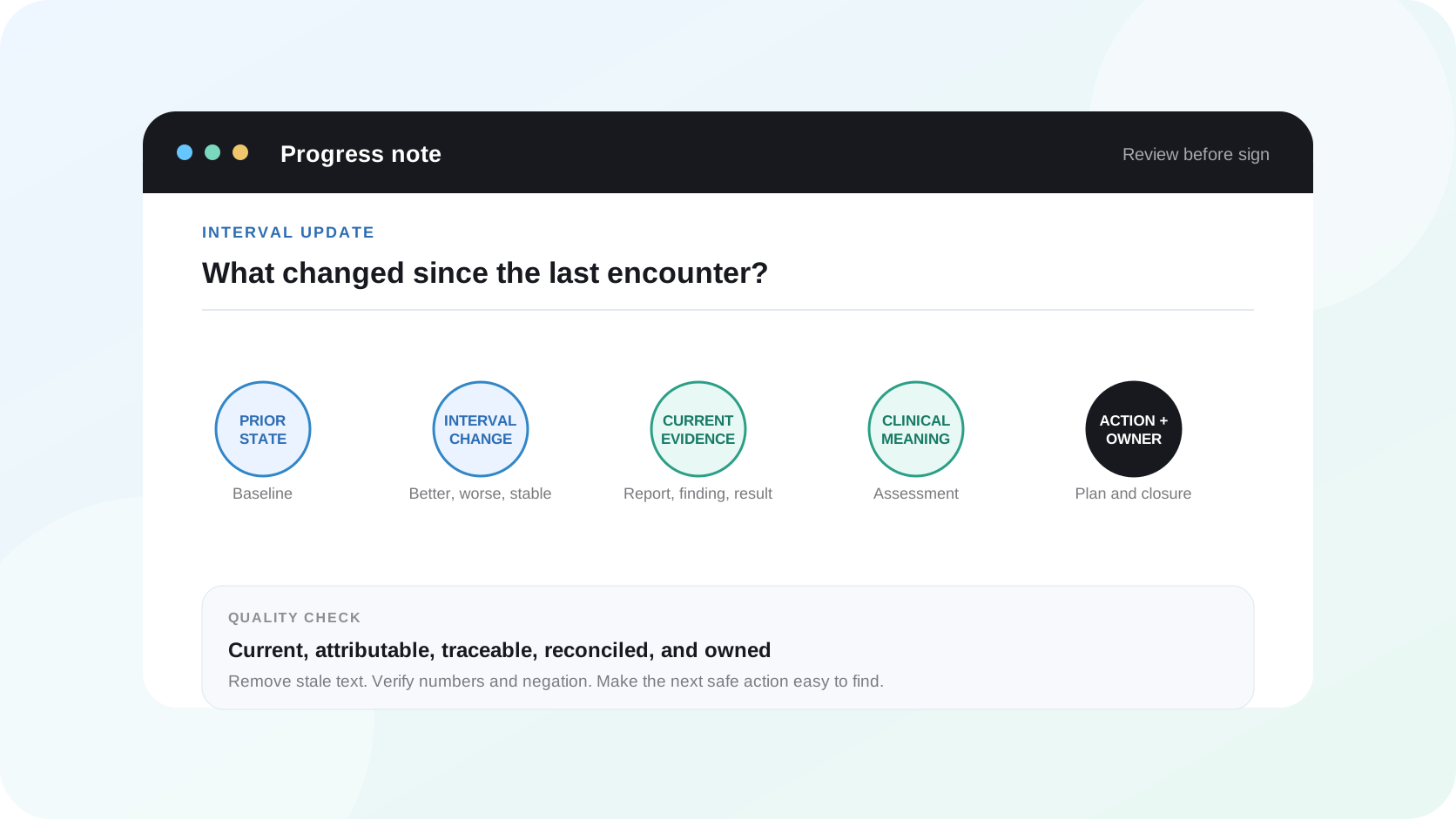
Six links from prior state to closure
Progress-note evidence chain
The note should show the change, the evidence for it, the interpretation, and the next owned action. A template can rearrange these links, but it should not erase them.
1 Prior state
What was the relevant baseline or last plan?
Failure to catch: The reader cannot tell what today is being compared with.2 Interval change
What changed, and over what period?
Failure to catch: Stable, better, or worse appears without supporting detail.3 Current evidence
What was reported, observed, measured, or received now?
Failure to catch: Old, reported, and current findings become indistinguishable.4 Interpretation
What does the clinician think the evidence means?
Failure to catch: The assessment repeats facts or introduces unsupported certainty.5 Action
What was continued, changed, ordered, discussed, or deferred?
Failure to catch: The plan does not connect to the problem or decision.6 Closure
Who owns the next step, when, and how will completion be known?
Failure to catch: A referral, result, or follow-up disappears after the note is signed.
The six links can appear in different orders. APSO places assessment and plan near the top. A problem-oriented note may repeat current evidence, assessment, and plan beneath each active problem. A concise outpatient follow-up may use a short interval history followed by examination and assessment. What matters is that the reader can move from prior state to current action without guessing.
Keep source, time, and status attached to information
Clinical facts do not all have the same provenance. A symptom reported by a patient, a finding observed by a clinician, a value copied from an outside report, and a result measured today may all be valid, but they are not interchangeable.
Use language that preserves the distinction:
- “The patient reports...” for the patient’s account.
- “The caregiver observed...” when another person supplied the information.
- “Examination today shows...” for a current clinician finding.
- “The outside report dated...” for an external source.
- “Preliminary result...” or “final result...” when status changes interpretation.
- “Not assessed today” when a domain was not evaluated.
Avoid turning “not mentioned” into “negative,” “usually fine” into “normal,” or “ordered” into “completed.” Those changes often appear small at sentence level, but they change what the record claims.
Separate unchanged context from current work
Some background needs to remain available, especially when it changes risk or interpretation. The goal is not to delete useful history. It is to keep the current update visible.
A practical rule is to ask of every carried-forward element:
- Is it still accurate?
- Is it relevant to today’s decision?
- Is its original date and source still clear?
- Is it already available in a problem list, medication list, or another appropriate record section?
- Will repeating it help the next reader, or make the current change harder to find?
The systematic review on safe copy and paste practices in EHRs found risks including note bloat, internal inconsistency, error propagation, and wrong-chart documentation. It recommended identifiable copied material, accessible provenance, staff education, and ongoing monitoring. A later health-system report on monitoring copy and paste shows why this is a workflow and measurement problem, not only an individual writing habit.
An eight-step progress note workflow
The workflow begins before the first sentence and ends when the note and its outstanding tasks are reconciled. It can be used with typing, dictation, a human scribe, an EHR template, or an AI-generated draft.
1. Confirm the encounter and comparison point
Verify the correct patient, date, location, encounter, note type, and responsible author. Then decide what comparison makes the current change meaningful: the last clinic visit, yesterday’s hospital status, the start of a medication, a procedure date, a baseline assessment, or another explicit point.
If the comparison is uncertain, say so. “Since the last available note dated...” is more reliable than implying a complete interval when outside records are missing. If the documentation date differs from the encounter date, preserve both dates according to applicable requirements.
2. Lead with the interval change
State what improved, worsened, remained stable, appeared, resolved, or could not be assessed. Place the most decision-relevant change near the beginning. A progress note should not make the reader scan several screens of imported history to find today’s reason for action.
Useful interval statements answer some combination of:
- Since when?
- Compared with what?
- In which symptom, function, measurement, or support need?
- Based on whose report or which source?
- With what degree of certainty?
Do not force every change into a number. A precise number is useful only when it was actually measured and is meaningful.
3. Preserve the source of each fact
Separate subjective reports from observations, measurements, prior records, and results. Identify interpreters, caregivers, devices, or documents when they materially shape the account. Preserve uncertainty when accounts conflict or information is incomplete.
Attribution becomes especially important in team care. A statement entered by a trainee, nurse, assistant, transcriptionist, scribe, or software system may still need review or authentication by another responsible professional. The record should make authorship and responsibility visible instead of implying that every sentence came from the same source.
4. Select current decision-relevant evidence
Include the history, examination, measurements, and available results needed to understand the current assessment and plan. Check dates, doses, units, laterality, negation, allergies, and result status. Do not import every available result merely because the EHR makes it easy.
Current evidence should answer the decision, not decorate the note. If a prior finding remains important, identify it as prior. If an examination element was not performed today, do not leave a template default that implies it was. If a result is pending, do not document it as reassuring or abnormal before it is final.
The Joint Commission guidance on abbreviations and dose designations is a useful reminder that standardized terminology and numeric formats reduce interpretation risk. Its prohibited list applies to orders and medication-related documentation. Local approved and prohibited terminology still needs to be followed.
5. Update the assessment by problem
The assessment should synthesize the interval and current evidence. It may record a diagnosis, differential, problem status, response, unresolved question, or reason for continued observation. The amount of reasoning should be proportionate to the decision.
For several active problems, a problem-oriented format can make the evidence chain easier to follow:
Problem 1: interval change and relevant current evidence. Assessment: interpretation and uncertainty. Plan: action, owner, timing, and contingency.
Avoid labels such as stable, improving, or controlled unless the note shows what supports them. Avoid converting a working diagnosis into an established fact elsewhere in the record. If the assessment changes, make the change visible instead of silently replacing the prior interpretation.
6. Connect every action to a problem
Document what was continued, changed, ordered, prescribed, discussed, declined, or deferred. A reader should be able to tell why each action follows from the assessment.
Reconcile the plan with structured parts of the record. If a dose changed in the narrative but not the medication list, the record contains incompatible instructions. If a test is ordered but the note does not identify the question it is intended to answer, the next reader may not understand how to interpret or follow it. If a patient declines an action, preserve the relevant discussion and resulting plan under applicable requirements.
7. Assign timing, ownership, and contingencies
“Follow up” is incomplete when no one knows who will act, when, or how failure becomes visible. For each outstanding action, record:
- the responsible clinician, person, team, or queue;
- expected timing or priority;
- what completion looks like;
- how the patient or caregiver was informed;
- what should trigger earlier review; and
- where an exception returns when the normal path fails.
The 2025 ONC SAFER Clinician Communication guide focuses on reliable electronic communication among clinicians, care teams, and patients. The Test Results Reporting and Follow-Up guide treats result management as a loop that includes communication and follow-up. A signed note can describe that loop, but signing does not complete it.
8. Reconcile, review, and authenticate
Read the final note as a complete record. Does the current history match the assessment? Do medications, orders, instructions, and follow-up agree? Are reported and observed facts labeled correctly? Is stale copy-forward visible? Could another clinician find the current problem status and next action quickly?
Review high-risk details deliberately: identity, medications, allergies, numbers, units, laterality, negation, diagnoses, orders, result status, escalation, and responsibility. Use the EHR correction or addendum process when an authenticated note needs to change. Do not silently overwrite the original record where traceability is required.
Four fictional progress note examples
Make the interval and the next action visible
Original teaching examplesFictional composites, no patient data
Each revision demonstrates documentation structure. It does not provide a diagnosis or a treatment plan for an individual.
Fictional primary-care follow-up
Outpatient follow-up with an unclear interval
Source facts
At the prior visit three weeks ago, a new medication was started. The patient reports taking it for five days, then stopping because of nausea. Two episodes occurred this week, compared with four in the week before treatment. No symptom diary was available.
Weak draft
Doing better overall. Medication not tolerated. Continue to monitor.
Revised record
Since the visit three weeks ago, the patient reports taking the new medication for five days and then stopping it because of nausea. Two episodes occurred during the past week, compared with four during the week before treatment; no diary was available for verification. Assessment and next steps are documented below.
Fictional hospital day update
Inpatient daily note that only repeats yesterday
Source facts
The prior note described oxygen at 2 L/min and poor oral intake. Today, the flow rate is unchanged, the documented saturation is 95 percent, breakfast intake was approximately half, and the patient reports less shortness of breath while walking to the bathroom.
Weak draft
Stable on oxygen. Poor intake. Continue current plan.
Revised record
Compared with yesterday, oxygen remains at 2 L/min with a documented saturation of 95 percent. The patient reports less shortness of breath when walking to the bathroom. Breakfast intake was approximately 50 percent, improved from the limited intake described yesterday. Current assessment, active barriers, and plan follow by problem.
Fictional outpatient result workflow
Result follow-up without an owner
Source facts
A final imaging report entered the inbox. The clinician reviewed it, requested a specialist opinion, and asked the referral team to confirm receipt within five business days. The patient was reached and informed of the plan.
Weak draft
Results reviewed. Refer to specialist. Patient aware.
Revised record
Final imaging report reviewed on August 31, 2026. A specialist referral was submitted for the reason documented in the assessment. The referral team will confirm receipt within five business days and return an unacknowledged referral to the ordering clinician. The patient was reached today and informed of the referral and follow-up plan.
Fictional AI-assisted note review
AI draft that changes the source and certainty
Source facts
The patient said home readings were usually lower but supplied no values or device log. The draft stated that home measurements were normal and the condition was controlled.
Weak draft
Home measurements are normal. Condition remains controlled.
Revised record
The patient reports that home readings are usually lower than clinic readings; no values or device log were available for review today. The clinician assessment is based on the information and measurements documented in the final note.
These examples are intentionally narrow. A real record also needs the elements required by the profession, setting, encounter, payer, organization, and jurisdiction. Their shared lesson is structural: define the interval, preserve source and uncertainty, update the assessment, and make follow-up operational.
One complete fictional progress note
One progress note from context through closure
Complete worked exampleFictional composite, no patient data
The details below are invented to show how the parts connect. They are not a treatment recommendation for an individual.
Encounter
Fictional outpatient follow-up on August 31, 2026
Comparison point
Prior visit on August 10, 2026
Reason
Review the symptom interval and medication tolerance
Interval history
Since the August 10 visit, the patient reports starting the new medication on August 11, taking it for five days, and then stopping because of nausea. The nausea resolved after the medication was stopped. Two episodes occurred during the past seven days, compared with four during the seven days before the prior visit. No symptom diary or home measurements were available for review.
Current evidence
The medication list was reviewed and updated to show that the new medication is not being taken. No diary, device log, new outside report, or final test result was available for review today.
Assessment
Episode frequency is lower by patient report, but the short observation period and missing diary limit comparison. The relationship between the change and the medication is uncertain because exposure was brief. Nausea occurred during the medication trial and resolved after stopping; its cause is not established by this encounter.
Plan and rationale
The medication remains recorded as stopped. The prescribing clinician will review options before any restart or replacement. The patient agreed to record episode date, duration, relevant context, and any available measurement for 14 days so the next comparison uses a consistent source.
Follow-up and closure
The clinic nurse owns a follow-up call within two business days after the clinician review, and the resulting decision will be recorded in the patient portal. Follow-up is planned in two weeks, with earlier contact if episode frequency increases or a new concern develops.
Final reconciliation
The medication list and narrative agree. No new order, referral, or pending result was created in this fictional encounter. The follow-up call has a named owner and time frame. The note was reviewed against the fictional source facts before authentication.
The complete example uses the same evidence chain as the shorter repairs. It begins with a named comparison point, keeps patient-reported information distinct from reviewed evidence, shows what remains uncertain, and ends with an action that has an owner and time frame.
Progress note quality checklist
Twelve checks before authentication
Final-note quality screen
Apply these checks to the final note and its authorized sources. Completing the list records a review step; it does not replace local requirements or clinical judgment.
Checked
0 / 12
Use hard stops and review items differently
Not every defect carries the same risk. A repeated phrase may mainly affect readability. A wrong dose, laterality, negation, result status, or patient identity can change meaning and should stop authentication or prompt correction under policy. A missing referral owner may not change the clinical assessment, but it can break continuity.
Classify findings during quality review:
- Meaning-changing error: unsupported diagnosis, wrong patient, dose, unit, laterality, negation, or result status.
- Clinically significant omission: a source fact or decision absent from the note that could change understanding or action.
- Attribution error: reported, observed, measured, imported, copied, or generated information assigned to the wrong source.
- Assessment-plan disconnect: the action does not follow from the documented problem or evidence.
- Ownership defect: no responsible person, queue, timing, completion state, or exception path.
- Usability defect: copied history, duplication, or imported data hides the current update.
A composite score should not allow several formatting successes to cancel one meaning-changing error. Track hard-stop defects separately.
Common progress note defects and repairs
“Stable” without a reference point
Defect: “Patient stable. Continue plan.”
Repair: identify which problem, what time period, what current evidence, and which plan continues. If no meaningful change was assessed, state that limitation rather than manufacturing stability.
A copied examination presented as current
Defect: yesterday’s or last month’s examination remains in today’s note with no date or source.
Repair: document only the examination performed today as current. Move relevant prior findings into dated context, and remove template defaults that imply unperformed observations.
A plan without clinical reasoning
Defect: a new order or referral appears without the problem or question it addresses.
Repair: connect the action to the current assessment. The note does not need an essay, but it should preserve enough rationale for the next reader to understand the decision.
The same fact in incompatible states
Defect: the narrative says a medication was stopped, the medication list says active, and the instructions say continue.
Repair: reconcile every location that drives care or communication. If the systems cannot be aligned immediately, make the discrepancy and owner visible.
“Referral sent” treated as closure
Defect: the note records an outgoing referral but no receipt, scheduling, or exception process.
Repair: assign a queue or person, a confirmation interval, and a path for unacknowledged referrals. Sending is one status; completion is another.
More copy than current information
Defect: the daily update is one sentence surrounded by several pages of unchanged history and imported data.
Repair: surface interval change, current evidence, and decisions. Keep only background that changes interpretation, risk, or action. Preserve the full history in the appropriate longitudinal parts of the record.
AI-generated progress notes
An AI scribe can transform a permitted conversation, dictation, typed context, or selected record data into a draft. It may reduce typing, but it also introduces a transformation step. The draft can omit a qualifying phrase, confuse speakers, change chronology or negation, import stale context, or add a plausible conclusion that was never established.
The CPSO advice on AI in clinical practice says physicians should review AI-generated information for accuracy and completeness, remain accountable for its use, protect patient information, evaluate bias, be transparent, and obtain consent before recording conversations using AI.
Current evidence should be interpreted carefully. A 238-physician randomized trial across 14 outpatient specialties found that one of two studied ambient products reduced time in notes relative to control, while clinicians still reported clinically significant inaccuracies occasionally. Evidence from one product, specialty, implementation, or outcome should not be generalized to every setting.
A deliberate review order for AI drafts
Reviewing an AI draft from the first word to the last can make fluent text feel trustworthy. A risk-based sequence is often more effective:
- Verify patient and encounter identity.
- Compare interval change with the source conversation and record.
- Check medications, allergies, numbers, units, laterality, and negation.
- Look for missing facts that changed the decision.
- Look for added certainty, diagnoses, findings, or actions not established by the source.
- Confirm the assessment is the clinician’s actual interpretation.
- Reconcile orders, instructions, and structured fields.
- Confirm ownership, timing, contingencies, and closure states.
- Remove irrelevant copied or generated language.
- Authenticate only when the final note is acceptable.
For a broader comparison of documentation models, see medical scribes for doctors. The clinical documentation guide covers the wider record, CDI, privacy, ambient tools, and system-level quality measures beyond progress notes.
How to audit progress note quality
A note audit should answer a defined question. “Are our notes good?” is too broad. “Can the next clinician find the interval change, current assessment, and follow-up owner in a sample of chronic-care follow-ups?” is testable.
Build a reproducible sample
Define the period, setting, note type, eligible roles, inclusion and exclusion criteria, sample size, and reviewer process before reading the notes. Use de-identified or appropriately authorized review methods. Sample more than one clinician, day, location, and encounter type when the goal is system improvement.
Separate source comparison from readability review. A polished note can contain unsupported information that only source comparison reveals. A source-faithful note can still be difficult to use if the current action is buried.
Define measures before scoring
Useful measures include:
- clinically significant omissions per reviewed note;
- unsupported additions per reviewed note;
- attribution or chronology errors;
- cross-section contradictions;
- stale copied-text defects;
- correction minutes before authentication;
- percentage authenticated within the organization’s standard;
- percentage of actionable results or referrals with an owner and completion state; and
- reader time to locate the current assessment and plan.
Do not combine all measures into a single percentage without preserving hard-stop defects. Report the numerator, denominator, sampling method, reviewer agreement, and limitations. If a template, workflow, or tool changes, repeat the same test so the comparison remains meaningful.
Repair the system that produces the defect
Recurring defects often point to design, not motivation:
- a copied examination may come from a bad default;
- missing intervals may come from a template that starts with a complete history;
- contradictory medication instructions may come from disconnected fields;
- missing referral owners may come from a workflow with no acknowledgment state;
- repeated AI speaker errors may come from an unsupported encounter type or poor capture conditions.
Use education for a knowledge gap, template changes for bad defaults, workflow redesign for ownership gaps, and technical validation for software defects. Then retest. Silent correction of every note hides the pattern that should be fixed.
A concise progress note template
Copy the progress note structure
Reusable plain-text template
Copy the blank structure into an approved workspace, then adapt it to the encounter, profession, organization, payer, and jurisdiction.
PROGRESS NOTE

Encounter and comparison point
Date and setting:
Responsible author:
Reason for encounter:
Relevant prior state or comparison date:

Interval change
What improved, worsened, remained stable, appeared, resolved, or was not assessed:

Current evidence
Patient or caregiver report:
Clinician observations or measurements:
Available results and their status:
Important source or evidence limitations:

Assessment by problem
Problem 1:
Current interpretation, response, uncertainty, and unresolved questions:

Actions and rationale
What was continued, changed, ordered, discussed, declined, or deferred:
Why the action follows from the assessment:

Follow-up and closure
Owner:
Timing:
How completion will be recorded:
Trigger for earlier review:

Final reconciliation
Medication, allergy, order, instruction, and structured-field check:
Copied or generated text reviewed:
Authentication or correction status:
The template is intentionally concise. Add the content required by the actual encounter, profession, organization, payer, and jurisdiction. Remove headings that create empty or misleading boilerplate, but do not remove the evidence chain they are meant to protect.
Author and review status
Written by Sam Ellis, a Vero contributor covering AI-assisted documentation, patient-care workflows, and healthcare privacy and compliance. Sources checked August 31, 2026. This version has not received separate clinical review.
Sources and further reading
- CPSO Medical Records Documentation policy
- CPSO Advice to the Profession: Medical Records Documentation
- CMS Evaluation and Management Services, May 2026
- LOINC 11506-3: Progress note
- ASTP/ONC 2025 SAFER Guide: Clinician Communication
- ASTP/ONC 2025 SAFER Guide: Test Results Reporting and Follow-Up
- The Joint Commission: Abbreviations, acronyms, symbols, and dose designations
- Safe practices for copy and paste in the EHR
- A practical approach for monitoring copy and paste in clinical notes
- CPSO: Using Artificial Intelligence in Clinical Practice
- Ambient AI Scribes in Clinical Practice: A Randomized Trial
Frequently asked questions about progress notes
Direct answers about progress-note purpose, structure, timing, SOAP, problem-oriented notes, copy-forward, AI drafting, corrections, and quality review.
What is a progress note?
A progress note is a dated clinical record that updates a patient’s status, relevant new evidence, clinician assessment, actions, and follow-up since a prior encounter or baseline. Its useful feature is the interval change, not a particular template.
What is the main purpose of progress notes?
Progress notes support continuity of care. They let an authorized reader see what changed, what the clinician currently thinks, what was done, and what still needs follow-up without reconstructing the entire record.
What should be included in a progress note?
Content depends on setting, but a useful progress note identifies the encounter and author, states the interval change, records decision-relevant subjective and objective information, updates the assessment, documents the plan, and assigns follow-up ownership and timing.
What is the difference between a progress note and a SOAP note?
Progress note describes the function of the record: an update over time. SOAP describes one structure for organizing that update into Subjective, Objective, Assessment, and Plan. A progress note can use SOAP, APSO, problem-oriented, or narrative organization.
Is a progress note the same as a medical record?
No. A progress note is one entry within the broader medical record. The record may also contain histories and physicals, consultation reports, procedure notes, discharge summaries, orders, results, medication lists, messages, referrals, consent, and administrative information.
How long should a progress note be?
Long enough to preserve the clinically relevant change, assessment, decisions, and follow-up, but no longer. A short note can omit necessary reasoning; a long copied note can hide the current state. Relevance and traceability matter more than word count.
Show all questions
When should a progress note be completed?
Complete it during the encounter or as soon as possible afterward under applicable professional, organizational, payer, and jurisdictional requirements. Delay increases the chance that chronology, source, and decisions will be recorded inaccurately.
Can progress notes be written in SOAP format?
Yes. SOAP works well when each section preserves its boundary and the assessment synthesizes the evidence. For several active problems, a problem-oriented assessment and plan may make the connection between evidence and action easier to follow.
What is a problem-oriented progress note?
A problem-oriented progress note groups the current assessment and plan under each active problem. It can reduce cross-referencing when several conditions are addressed, provided the interval history and findings still remain attributable and current.
How do progress notes differ in outpatient and inpatient care?
Outpatient notes often compare with a previous visit and emphasize response, adherence, decisions, and follow-up. Inpatient notes may update several active problems daily, including overnight events, current support, new results, response, discharge barriers, and team responsibilities.
Can a progress note include copied information?
Information reuse can be appropriate, but copied content needs visible provenance and patient-specific verification. Remove stale or contradictory text. Research on copy and paste describes risks including note bloat, error propagation, internal inconsistency, and wrong-chart documentation.
How should a late entry or correction be handled?
Use the EHR function and policy that preserve the original entry, author, date, reason, and audit trail. Do not silently overwrite an authenticated progress note. Specific correction and late-entry requirements vary by jurisdiction and organization.
Who can write a progress note?
Authorized roles depend on profession, setting, scope, organization, payer, and jurisdiction. The entry should identify its author and role, and any required supervising or authenticating professional must review it under the applicable rules.
Can an AI scribe write a progress note?
An AI scribe can create a draft from permitted inputs, but it cannot establish that the final record is accurate. The responsible clinician should verify source, chronology, medications, numbers, negation, assessment, plan, and follow-up before authentication.
How should an AI-generated progress note be reviewed?
Compare the draft with the encounter and authorized sources. Check for omissions, unsupported additions, speaker errors, wrong time frames, copied context, altered negation, medication or unit errors, assessment-plan contradictions, and missing follow-up ownership.
What are common progress-note mistakes?
Common defects include no comparison point, vague statements such as stable, copied examinations, reported facts presented as observed, an assessment that repeats history, a plan unrelated to the active problem, and follow-up without an owner or time frame.
Should every active diagnosis appear in every progress note?
Not necessarily. Include problems that are evaluated, managed, clinically relevant to the encounter, or required by the setting. A complete problem list belongs in the appropriate summary area; repeating every diagnosis can obscure what changed today.
How can a clinic audit progress-note quality?
Use a defined sample, explicit criteria, and more than one measure. Track clinically significant omissions or additions, attribution errors, contradictions, copied-text defects, correction time, timely authentication, and whether orders, referrals, results, and follow-up reach closure.