Averbis Review: Medical Dialog, Workflow, Privacy and Pricing
 Lauren Bennett · October 9, 2026 · 20 min read · Published by Vero Scribe Inc.
Averbis offers hospital-focused AI for organizing existing records and creating documentation. For buyers searching for an Averbis AI scribe, Medical Dialog is the relevant conversation-documentation module; Medical Summary addresses the wider task of navigating patient records. The current offering is broader than a standalone recording app. Averbis product overview
The buying decision starts with the input: a live conversation, a collection of existing reports, or text that needs conversion into structured data. Those jobs can share technology, but they need different acceptance tests. A good transcript does not prove that a historical diagnosis will stay historical when it reaches a structured list.
Sources checked October 9, 2026. This comparison draws on vendor documentation and published research. Vero publishes this guide and sells AI documentation software.
Which Averbis product fits the job?
Averbis’s homepage positions Medical Summary for hospitals. Its Health Discovery technology also appears in current technical material and research, so older references to Averbis do not necessarily describe the current conversation module. Averbis homepage
| Offering | Documented input and output | Buyer’s acceptance question |
|---|---|---|
| Medical Summary | Existing documents become a chronological overview, with record questions, summaries and source passages. Product description | Can the reviewer identify which document supports each important statement and which records are missing? |
| Medical Dialog | Smartphone or dictation-microphone capture produces a transcript and structured conversation information. Module description | Do speaker, uncertainty and action state survive both generation and transfer? |
| Medical-report module | Available clinical documentation supports report drafting. Product description | Does the draft reconcile conflicting records or merely select one? Can the reviewer correct and release the intended version? |
| Health Discovery | NLP extracts medical entities from documents and text; Averbis names terminology and interoperability standards including SNOMED CT, ICD-10, LOINC and FHIR. Health Discovery description | Are the extracted value, source span, context and terminology version suitable for the destination? |
Confirm the exact classification and release required by the receiving workflow. The vendor’s generic “ICD-10” statement does not establish support for U.S. ICD-10-CM diagnosis coding or ICD-10-CA in applicable Canadian workflows; these are not interchangeable. Classification sources checked October 9, 2026.
This distinction matters for procurement. A hospital’s records team may need batch extraction and source traceability; an outpatient clinician may chiefly need an editable encounter draft. Ask for the exact module, deployment and destination in the proposal. A demonstration of one does not establish the functionality of the others.
From source document to reviewed record
Meierhofer’s April 16, 2026 announcement describes Medical Summary, Medical Dialog and AI-assisted physician-letter drafting within M-KIS. Generated letters pass through professional checking, correction and release. Confirm which modules are enabled in your installation. Meierhofer announcement
For a local demonstration, follow one item through four stages:
- Select the source. Confirm patient and encounter association, document version, language and date. Establish whether an imported document contains selectable text or needs an additional recognition step.
- Inspect the intermediate result. Compare the transcript or extracted entities with the source. A phrase can be recognized correctly while being assigned to the wrong person or time period.
- Review the proposed record. Check both the prose and any structured fields. Correct the source if appropriate, then establish whether existing generated content changes automatically or requires regeneration.
- Inspect the saved destination. Reopen the receiving record. Confirm that corrections, source references and unresolved work remain intact, and that saving has not silently signed or released the draft.
For technical teams, Averbis’s public Python client documents connecting to a server, selecting a project and pipeline, starting the pipeline and analyzing text. The client is labeled open alpha. Implementation requires compatible client/server versions and an agreed receiving schema. Averbis Python API
If your purchasing question concerns the broader interface rather than Averbis specifically, the EHR integration guide explains how to separate transport success from a usable receiving record.
What the published evidence shows
Published Averbis-based extraction studies are more informative than a universal “AI accuracy” score. Their scope is also narrower than today’s complete documentation workflow.
Ophthalmology extraction: a customized task
Grundel and colleagues’ retrospective study, published online in July 2020 and in a 2021 journal issue, used Averbis Health Discovery with added rules and German terminology. The available corpus contained 3,683 patients and 40,485 letters; selected structured data provided the comparison. Reported F1 scores were 94.7% for visual acuity, 98.3% for intraocular pressure and 94.7% for accompanying diagnoses. Original study
Those are task-specific extraction findings, not transcript accuracy or a current Medical Dialog benchmark. The available corpus is not the denominator of fully adjudicated observations for every field. Differences between letter and database content explained about half the examined discrepancies. The paper discloses Averbis employment and ownership interests among authors. A buyer should ask whether its own document types, terminology and reference standard resemble the tested setup.
Medication extraction: follow the conditional denominator
A 2021 proof-of-concept study evaluated 10 discharge letters against manual annotation. It reported F1 of 0.852 for medication phrases and 0.936 for medication names within correctly identified phrases. The second value therefore cannot be read as end-to-end medication-list accuracy. The small sample and the authors’ call for further validation matter. Coauthors Stefan Schulz and Philipp Daumke list Averbis GmbH affiliations, so this is not wholly independent validation. Medication extraction study and affiliations
F1 combines precision and recall; it is not the percentage of complete notes that are safe to sign. A missed phrase can disappear before a later medication-name check even begins. Include missing information in evaluation, not only errors in what the system produced.
Current demonstrations and marketing claims
Meierhofer’s March 13, 2025 account describes a staged conversation with Averbis, a near-real-time transcript, a structured history form and editable content. It supplies a concrete workflow example, but not a controlled error rate or independently timed implementation result. Partner demonstration account
Averbis’s May 29, 2026 article claims five-times-faster access to documentation and up to 50% less report-drafting time. The post does not provide sufficient study methods, denominators or a complete correction-and-transfer comparison to treat those figures as validated expectations for a buyer. Request the underlying protocol and results before using them in a business case. Vendor performance claims
Use these task-specific findings to choose what to evaluate locally: extraction quality, source context, correction effort and the saved record.
AV-01: a worked context-and-correction example
Fictional evaluation example. Compare the supplied source packet with the flawed candidate and corrected summary to see how extraction and summarization can change meaning.
Fixed source packet
- Document A, September 18, 2026: “Asthma is being considered; no confirmed diagnosis is recorded. Spirometry has been requested; the result is not yet available.”
- Document B, September 25, 2026: “The patient reports that their mother has asthma. The patient reports no wheeze today. The requested spirometry report remains unavailable.”
- Workflow instruction, September 25: “Records coordinator to request the missing report today. Reviewing clinician to check receipt on September 28; if still unavailable, contact the coordinator and decide the next step. No report review has been completed.”
Deliberately flawed candidate
Asthma confirmed. No wheeze. Spirometry reviewed. No further follow-up needed.
Every important noun appears plausible. The failure is in the relationships: whose condition it is, whether it is confirmed, what was actually done and what remains outstanding.
| Source fact | Required meaning | Failure to catch |
|---|---|---|
| Asthma considered in Document A | Possible condition; source dated September 18; not a confirmed patient diagnosis | An active problem-list entry that removes uncertainty |
| Mother has asthma in Document B | Patient-reported family history; experiencer is the mother | Adding the mother’s diagnosis to the patient’s conditions |
| No wheeze today | Patient-reported negative on September 25 | Turning the statement into a normal examination or a permanent absence of symptoms |
| Spirometry requested; report missing | Requested investigation, unavailable result, review not completed | Converting an order mention into a completed result review |
| Coordinator and clinician have separate tasks | Request today; clinician recheck September 28 and escalation if still missing | Accurate clinical wording accompanied by a lost follow-up task |
Show the corrected summary and completed example assessment
Corrected summary: The September 18 document records asthma as a possibility, not a confirmed diagnosis. On September 25, the patient reported maternal asthma and no wheeze that day. The requested spirometry report is still unavailable; no report review is documented.
Outstanding work: Records coordinator to request the report on September 25. Reviewing clinician to check receipt on September 28 and, if it remains unavailable, contact the coordinator and decide the next step.
Structured destination: Keep the possible patient condition separate from family history. Preserve the symptom’s patient-reported source and date. Keep the report and review tasks open. Map these meanings to the receiving system’s configured fields.
Completed example assessment: Candidate fails certainty, attribution, action-state and follow-up checks. Corrected text satisfies the supplied facts. Next demonstration steps: capture product output, measure editing time and inspect the saved destination and task list before approval.
A second candidate could get every clinical sentence right and still omit the coordinator’s task. That is a separate omission failure. Score facts retained and unsupported claims separately, then verify the receiving workflow. Otherwise a polished summary can conceal unfinished work.
A reproducible demonstration pack
Start with an authorized synthetic-data environment and freeze the source packet before testing. Record the module, server/model/pipeline versions, language, template, connector and receiving-system version. For Medical Dialog, use this fixed conversation variant of AV-01, set on September 25, 2026:
- Clinician: “The September 18 document says asthma is being considered. No confirmed diagnosis is recorded.”
- Patient: “My mother has asthma. I have no wheeze today.”
- Clinician: “Spirometry was requested, but the report is still unavailable. No report review has been completed. The records coordinator will request the report today. I will check receipt on September 28. If it is still unavailable, I will contact the coordinator and decide the next step.”
Read those lines without improvisation. For AV-04, interrupt capture immediately before the final clinician turn and resume after that turn has finished. Keep the recording, including the unavailable segment’s reference script, only under the agreed test permissions.
Use the same microphone, placement and room for the baseline. Record device model, operating system, capture route, distance, competing speakers and background noise. Do not label a condition “quiet” without describing it. Repeat the test after changing one condition, not several at once.
| Test | Controlled change | Expected result and evidence |
|---|---|---|
| AV-01: context | Use the fixed packet above without additions. | Preserve all five ledger rows. Retain raw output, corrections and a screenshot of the receiving record and open tasks. |
| AV-02: correction | Replace Document B with version 2: “Correction: father, not mother, has asthma.” Keep the other facts unchanged. | The current summary and family-history field use father; the superseded source remains traceable. No duplicate family-history fact survives unnoticed. |
| AV-03: patient boundary | Offer a separate synthetic report belonging to test patient B while test patient A is selected. | Block association and downstream use, or surface an explicit mismatch for review. Evidence must include the destination, not only a warning banner. |
| AV-04: missing audio | In an approved conversation test, interrupt capture before the follow-up instruction and resume afterward. | Do not invent the missing instruction. Record the capture state, available transcript and recovery work; absence of an error alert is not a pass. |
| AV-05: stale destination | Save an initial draft, correct the family-history attribution, then repeat the earlier transfer. | The old version must not silently replace the reviewed version. Record any overwrite, duplicate, conflict warning and recovery steps. |
For extraction, record correct facts, omissions, unsupported additions and context errors by category. For a transcript, calculate word error rate against the fixed spoken script separately; do not apply word-for-word scoring to a deliberately rewritten summary. Count failed or abandoned attempts as well as completed ones. Time active correction, destination checking and recovery separately from processing wait.
Copy this evaluation record into a clinic-controlled workspace and link it to your test evidence.
Averbis pricing and total implementation cost
Pricing checked October 9, 2026: the current product and contact pages do not publish a list price, per-clinician tariff or self-serve trial entitlement. Request a tailored proposal specifying currency, tax, billing unit and minimum commitment. Averbis sales contact
Ask the supplier to itemize the base platform, selected modules, document or audio usage, hosting, model services, interface work, training and support. Determine who pays for an additional environment, terminology updates and connector changes after an EHR upgrade. Separate a one-time implementation fee from recurring charges.
The contract should also resolve renewal notice, early termination, data return, export assistance and access after expiry. Those terms were not established by the reviewed public product pages. Test an export containing a corrected source, reviewed summary and outstanding task before accepting “data export” as an adequate exit promise.
For a transparent internal calculation, use:
Monthly workflow cost = recurring supplier charges + infrastructure + amortized setup + staff review and transfer time + support and recovery effort.
As a hypothetical workload calculation, 1,000 records requiring three active review minutes each consume 50 hours. At an assumed loaded labor rate of €60/hour, that is €3,000 in review effort before any software or infrastructure charge. Five minutes per record would consume about 83.3 hours and €5,000.
Compare both scenarios with the same manual baseline and document mix. Faster extraction is valuable only if the complete job—including checking sources and repairing failed transfers—becomes easier without moving uncounted work to another team.
Privacy: local operation and cloud processing
Deployment details checked October 9, 2026: Averbis describes Medical Summary as operating within hospital IT, with some functions using temporary cloud processing. The German page describes optional cloud components, EU/German servers and cloud providers with ISO 27001 certification and C5 attestation. The certification and attestation refer to the cloud providers. Deployment description
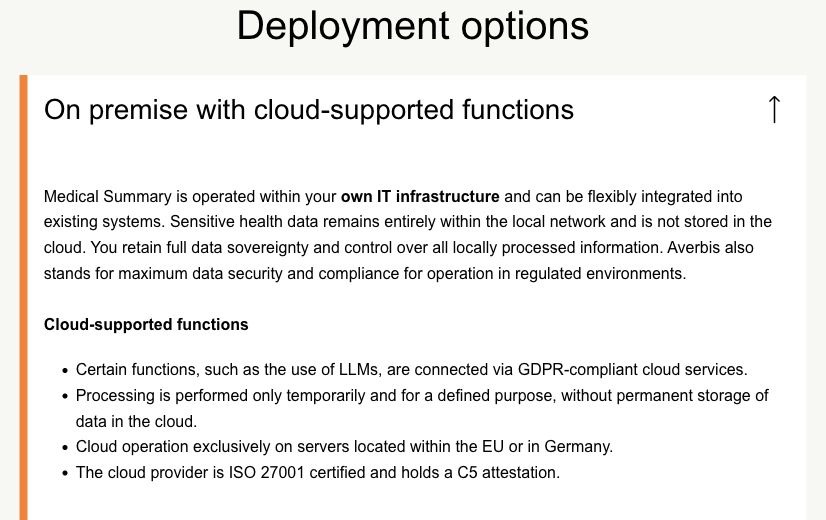
Averbis product-page screenshot, October 9, 2026: the expanded deployment panel describes cloud-supported LLM functions and temporary processing. Open the full-size screenshot or read the vendor deployment details.
Which functions need cloud processing?
The English page connects some LLM functions to cloud services; the German page calls cloud components optional. Module-level data flows and the full feature list for cloud-disabled operation remain open purchasing questions. Documented means stated by the vendor; unconfirmed marks details to resolve with the supplier. English deployment details; German deployment details. Checked October 9, 2026.
On smaller screens, scroll the table horizontally to compare all four columns.
Module or function | Documented processing route | What leaves the local network? | With cloud components disabled |
|---|---|---|---|
| Medical Summary: record overview | Operated within hospital IT; consolidates existing documents. | Unconfirmed: no field-level inventory of outbound content, identifiers or telemetry. | Unconfirmed feature boundary. Demonstrate import, timeline and source access independently of external services. |
| Medical Summary: generated summaries and Q&A | GenAI is documented; the deployment section names LLM use among cloud-supported functions. | Unconfirmed: whole documents versus selected passages, prompts, identifiers and returned outputs are not mapped. | Unconfirmed: no published guarantee of local-model fallback or identical functionality. Test each enabled generation function. |
| Medical Dialog: audio, transcription and extraction | Audio becomes a transcript and structured entities; the processing location of each stage is unconfirmed. | Unconfirmed: whether audio, transcript, extracted entities or metadata leave the network, and to which processor. | Unconfirmed: smartphone capture does not establish offline transcription or generation. Test capture and processing separately. |
| Medical-report module: drafting and checks | Existing documentation supports report generation; the module-specific local/cloud split is unconfirmed. | Unconfirmed: source excerpts, draft text and inputs to content checks are not specified per service. | Unconfirmed: verify whether drafting, checks and review/export remain usable or are explicitly unavailable. |
Deployment decision: if policy prohibits any external processing, require a function-by-function architecture and demonstration of the permitted configuration before approval. Proposed acceptance test: in an authorized synthetic environment, ask IT to disable the proposed cloud components, rerun AV-01, and retain outbound-connection logs alongside results for import, transcription, generation and saving. A missing answer should be visibly unavailable—not a silent fallback to an unapproved service.
No permanent cloud storage does not mean no cloud processing. Ask for a data-flow diagram covering source documents, recordings, transcripts, prompts, outputs, logs, caches, support access and backups. For each copy, identify the processor, purpose, region, access controls, retention period and deletion behavior. Establish the model-training policy contractually rather than inferring it from storage language.
Averbis’s public website privacy policy addresses website-related processing. Obtain product-specific processing terms and a clinical-audio retention schedule separately. Website privacy policy
For EU deployments, map controller/processor responsibilities, health-data processing grounds and security controls to the actual workflow. GDPR Articles 9, 28 and 32 address these distinct issues; Article 35 governs impact assessment where processing is likely to create high risk. Record evidence for each requirement alongside the hosting region. GDPR text
For a U.S. HIPAA-regulated workflow, HHS explains that cloud use requires an appropriate business associate agreement and compliance with the other applicable HIPAA requirements. The reviewed Averbis pages did not establish a BAA offering. Obtain the agreement and service scope before processing ePHI; a European privacy statement is not a substitute. HHS cloud guidance
For Canadian deployments, assess the proposed service under the federal, provincial or territorial privacy rules that apply to your organization and health information. PIPEDA alone does not govern every Canadian hospital workflow; the OPC identifies distinct provincial and territorial privacy laws and oversight. Have your privacy lead review processing locations, contracts, access, retention and incident handling. The sources reviewed here do not establish Averbis’s Canadian availability or contractual suitability; EU hosting or a U.S. BAA would not settle that assessment. Canadian sources checked October 9, 2026.
Make recording choice operational too: define how staff explain capture, handle a declined recording and continue documentation without it. Set role-based permissions for records retrieval and release, then test that an unauthorized user cannot access another service’s source documents through the summary interface.
Averbis, Vero or an existing workflow?
Compare the hospital conversation-to-note task
For Medical Dialog buyers, Dragon Copilot for physicians and Abridge Inside Epic are relevant alternatives for conversation-derived clinical documentation. This table focuses on the conversation-to-note task; evaluate Medical Summary’s wider records-overview functions separately. The comparison uses vendor documentation checked October 9, 2026.
On smaller screens, scroll the table horizontally to compare all four columns.
Decision field | Averbis Medical Dialog / Medical Summary | Dragon Copilot for physicians | Abridge Inside Epic |
|---|---|---|---|
| Hospital integration | M-KIS is a named partner route; establish enabled modules and connector scope. Partner announcement | Partner-embedded workflows can deliver summaries inside the EHR. Standalone apps require manual transfer; integration depends on the partner. Workflow documentation | Haiku capture and Hyperspace note review are documented, including an inpatient route. Confirm the hospital’s enabled experience. Product; inpatient release |
| Source traceability | Medical Summary shows supporting document passages. Equivalent Medical Dialog statement-to-audio links and persistence after export are unconfirmed. Product description | “Summarize evidence” references transcript and draft-note evidence for assessment/plan content; versioning is documented. Confirm the embedded interface and saved provenance. Transparency note | Linked Evidence connects generated outputs with source information in the review workflow. Verify what remains accessible after filing or export. Linked Evidence |
| Deployment options | Local hospital installation with optional cloud components. A fully local Medical Dialog path is unconfirmed; use the module table above. Deployment | Cloud processing includes encounter audio. Microsoft lists U.S. and Canadian storage-at-rest regions by customer location; that is not an on-premise option. Privacy documentation | The product page states U.S.-based cloud processing and storage. A customer-hosted deployment is not established by this source. Deployment statement |
| Language support | A current module-specific spoken-language list is unconfirmed in the reviewed pages. German extraction studies do not establish multilingual conversation performance. | Admin documentation lists 50+ recording languages. In Multilingual mode, transcripts lack speaker identification and notes use the interface language; verify available settings. Language configuration | The June 2025 announcement states 28+ languages. Obtain the current input/output-language list for the contracted workflow; a count does not establish performance for each language. Language claim |
| Implementation responsibilities | Buyer should assign hospital IT and supplier owners for interfaces, cloud permissions, terminology mapping and clinical acceptance. The reviewed pages do not provide a complete responsibility matrix. | The EHR vendor owns the overall embedded workflow and support; the customer needs a separate EHR agreement. Clinicians still review and file the note. Partner responsibilities; clinical responsibilities | Enterprise controls cover access and governance. Buyer should name owners for Epic configuration, templates, training and final-note review; the precise project split remains contractual. Enterprise controls |
Use the integration constraint to narrow the shortlist. An M-KIS hospital can start with Averbis’s named route; an Epic hospital can evaluate Abridge Inside or Dragon Copilot’s separate Epic integration. For a strict no-cloud requirement, request function-level deployment evidence. For every candidate, supply the same AV-01 conversation, required destination and review rules; compare omissions, correction effort and saved provenance before choosing.
Averbis is worth shortlisting for a hospital information workflow that combines existing documents, structured data and conversation-derived documentation, particularly when the organization can evaluate a named integration route. Its documented breadth and task-specific published extraction work are strengths. Public price transparency, configuration-specific performance evidence and unresolved local contract details are the main buying limitations.
Vero is a different starting point for encounter-note drafting. Its instructions describe adding context, generating a note, reviewing the result and copying or exporting it. A clinician whose main need is that bounded workflow can evaluate it without assuming it replaces a hospital-wide extraction or records platform. Vero note workflow
An existing EHR view or approved template may be sufficient when the task uses a small, stable set of fields. Compare it with the same source packet and correction requirements. Adding generation is worthwhile when it reduces the complete job, not merely when it produces a more polished first draft.
For a purchase decision, insist on one demonstrated path: source → intermediate result → clinician correction → saved destination. If that path preserves uncertainty, source dates and unfinished work in your actual configuration, proceed to a bounded pilot with named owners. Use the healthcare software requirements matrix to carry those acceptance conditions into procurement, and the clinical notes software guide for version-control and receiving-record checks.
Questions about Averbis and clinical documentation
Product scope, implementation, evidence and purchasing decisions.
Does Averbis offer an AI scribe for healthcare?
Medical Dialog is the relevant conversation-documentation module. Evaluate that module specifically rather than assuming evidence about a records-extraction pipeline also measures encounter recording.
How is Medical Summary different from Medical Dialog?
Medical Summary organizes existing records; Medical Dialog handles conversations. Select the input and required output first, then compare review effort for that particular job.
What is Health Discovery’s role?
Health Discovery is the NLP platform described in Averbis technical material and extraction research. Ask which pipeline, terminology and version your proposal includes; a historical study is not a current configuration specification.
Can an individual clinician buy a published monthly plan?
The reviewed product pages did not establish an individual monthly tariff. Request current eligibility, pricing and implementation requirements, including whether access depends on an institutional agreement.
Is there a free Averbis trial?
A self-serve trial entitlement was not established on the current product pages reviewed. A demo request is not the same as a free production account; clarify duration, data permissions and expiry access.
Which languages should a buyer test?
Test every language and mixed-language pattern used in the proposed workflow. Obtain the supported-language list for the specific module, then report findings separately instead of applying German extraction results to all languages.
Show all questions
Will Averbis work with our EHR?
M-KIS is a named documented route; other configurations need their own confirmation. Establish the connector version, fields, review permissions and saved-record behavior before treating integration as complete.
Does correcting a transcript also correct an existing summary?
Do not assume so. Test whether regeneration is required and whether it preserves manual edits. Reopen the final destination and check its source version, not only the text in the editing screen.
What should happen to conflicting source documents?
Keep the conflict visible until an authorized reviewer resolves it. Preserve dates, provenance and the reason for selecting a current value; silently choosing the newest imported file can be wrong.
Does an F1 score measure complete-note safety?
No. F1 summarizes a defined extraction task’s precision and recall. It does not establish that a whole note has no missing plan, wrong attribution, unsupported statement or transfer error.
Does on-premise operation exclude cloud processing?
Not in the documented hybrid arrangement. Confirm which functions leave the local environment and what each processor retains; temporary processing and permanent storage are different questions.
Is the website privacy policy enough for procurement?
No. Obtain product-specific processing terms, retention schedules, subprocessors, access controls and incident arrangements. Website analytics and a hospital’s clinical-data workflow have different purposes and data copies.
Can extracted diagnoses be accepted directly into a problem list?
Set an explicit review rule before doing so. Check whether each mention concerns the patient, a relative, a historical episode or an unconfirmed possibility, and retain the supporting source.
What should a completed demonstration record include?
Keep the authorized setup, fixed input, raw output, actual corrections, failed attempts, measured effort and reopened destination. Label unexecuted tests as not run rather than converting expected behavior into a result.
How should a hospital compare Averbis with Vero?
Compare a shared task, not the brand names alone. Use the same permitted source and required destination for note drafting; evaluate broader record extraction separately when that is part of the hospital’s requirement.