EHR Integration: Capabilities, Security, and Selection Guide
 Jordan Reeves · September 1, 2026 · 32 min read · Published by Vero Scribe Inc.
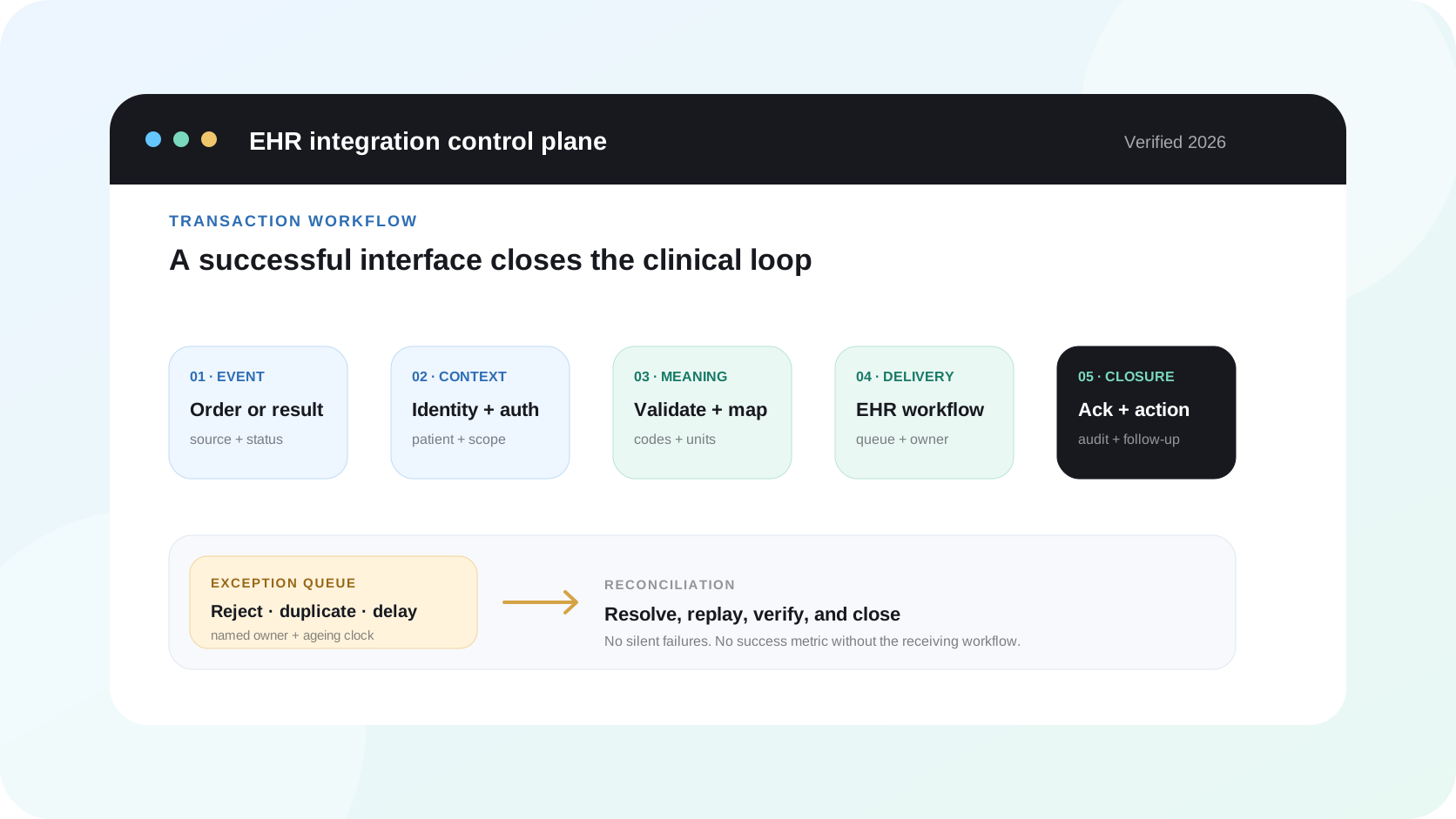
EHR integration connects an electronic health record with another application, device, organization, or data service. The connection is useful only when it moves the right information, preserves its meaning, places it in the intended workflow, exposes failures, and gives someone responsibility for closing them.
That is a higher bar than “we support FHIR” or “we have an interface.” A technically accepted message can still attach to the wrong record, lose a correction, land outside the clinician’s queue, duplicate an order, or wait without an owner. Good EHR integration software makes those states visible and testable.
This guide shows clinical, health-IT, security, and procurement teams how to define requirements, compare integration patterns, test a real workflow, evaluate vendor evidence, and score a proposed solution. Standards, regulatory sources, and vendor technical documentation were last verified on September 1, 2026.
What is EHR integration?
EHR integration is the technical and operational connection between an electronic health record and another system. The other system might be a laboratory, imaging service, pharmacy, payer, patient portal, registry, scheduling platform, medical device, documentation tool, analytics environment, health information exchange, or a second EHR.
An integration has several jobs. It must identify the people and organizations involved, authorize the connection, move information, preserve meaning, place the result where work occurs, acknowledge what happened, and manage exceptions. The transport may be an API, message, document, file, event, embedded application, or combination of those patterns.
The broader EHR interoperability guide explains how information remains usable across organizations and standards. This page is narrower. It focuses on the integration layer and the buying decision: what the connection needs to do, what constraints need testing, what security evidence to request, and how to distinguish a working demonstration from a general capability claim.
Integration, interface, interoperability, and migration are not synonyms
- An interface is a defined connection that sends or receives information between systems.
- An integration combines interfaces, applications, identity, mapping, workflow placement, monitoring, and operating responsibility.
- Interoperability is the broader ability to exchange information and use it correctly across people, systems, and organizations.
- A migration moves data during a system change; it is not necessarily an ongoing connection.
These terms overlap in vendor materials, so requirements should describe the operation instead of relying on the label. “Laboratory integration” is incomplete. “Deliver preliminary, final, corrected, and cancelled results to the correct patient and ordering workflow, with acknowledgement, escalation, and reconciliation” is testable.
EHR integration capabilities and standards
The most useful architecture is rarely “FHIR for everything” or “replace every interface.” Healthcare organizations often run a mixed environment in which APIs support app launch and data access, HL7 v2 carries established event traffic, C-CDA or FHIR documents move summaries, DICOM supports imaging, X12 supports administrative exchange, and files cover bounded legacy cases.
Match the clinical operation to a testable pattern
Capability crosswalk
A standard name is a starting point. Procurement evidence must identify the direction, operation, version, workflow, and behavior that the organization will actually use.
Contextual app launch
Common pattern
SMART App Launch with OAuth 2.0 and FHIR
What to prove
Patient-level data access
Common pattern
FHIR REST APIs and jurisdictional profiles
What to prove
Write or update clinical data
Common pattern
FHIR create, update, patch, or transaction operations
What to prove
Orders, results, and admissions
Common pattern
HL7 v2 messages, FHIR, or both
What to prove
Documents and summaries
Common pattern
C-CDA, FHIR DocumentReference, CA:FeX, or files
What to prove
Imaging
Common pattern
DICOM, DICOMweb, HL7 orders/results
What to prove
Claims and administrative exchange
Common pattern
X12, NCPDP, payer APIs, or files
What to prove
Population export and analytics
Common pattern
FHIR Bulk Data, database extracts, reports, or controlled files
What to prove
FHIR defines resources and interactions
HL7 FHIR R4 models health information as resources and defines RESTful interactions. A server can publish a CapabilityStatement describing supported resources, operations, search parameters, formats, and other behavior. That document is necessary evidence, but it is not a substitute for a transaction against the proposed product, version, configuration, and partner.
In the United States, US Core 9.0.0 is the current published HL7 US Core release as of the source-check date. It is STU 9, has trial-use status, and is based on FHIR R4. A current published standard and the version required by a certification criterion, payer program, partner, or contract may differ. Record all of them instead of writing “latest FHIR.”
In Canada, CA Core+ defines a national core set of FHIR profiles aligned with the Canadian Core Data for Interoperability. CA:FeX focuses on FHIR RESTful document exchange patterns that can sit over FHIR and non-FHIR infrastructure. These resources support consistency; provincial and territorial production services, privacy duties, onboarding, and implementation versions still need local verification.
SMART App Launch governs app authorization and context
The current published SMART App Launch 2.2.0 guide describes OAuth-based patterns for applications that connect to FHIR systems. A user-facing app may launch inside or outside an EHR; a backend service can operate without a person present. The guide covers discovery, authorization, tokens, scopes, launch context, and FHIR access.
Procurement still needs specific answers. How is the app registered? Which patient, user, encounter, and organization context is supplied? Which scopes are requested and granted? Can access be narrowed by resource and operation? What happens when a token expires, a user changes roles, consent limits access, or an app is revoked? How are test and production clients separated?
HL7 v2 remains important for event-driven workflows
Laboratory, admission-discharge-transfer, order, result, and scheduling connections often use HL7 v2 messages. Their maturity is an advantage only when the local implementation is understood. Segment optionality, local codes, acknowledgements, retries, batch rules, and downstream behavior can differ significantly.
Do not treat an application acknowledgement as proof of clinical completion. It may confirm only that a message was received or parsed. The test must continue into the receiving application and the responsible person’s work queue.
Certification and public API documentation narrow the claim
The United States ONC API Condition and Maintenance of Certification requires certified API developers to publish business and technical documentation, including material terms, limitations, registration requirements, and fees. The page was updated in 2026 and makes clear that certification companion guidance does not replace the regulation.
Use the Certified Health IT Product List to verify the exact product, version, modules, criteria, status, surveillance, and nonconformities. Certification supports a defined claim. It does not prove that the customer has licensed the required module, that a partner supports the same operation, or that the end-to-end workflow is safe and usable.
How to choose an EHR integration architecture
Architecture selection is an operating-model decision, not only a transport decision. A native connection may reduce custom build work while increasing reliance on two vendor roadmaps. A point-to-point interface may be efficient for one stable transaction and expensive to repeat across a portfolio. An interface engine centralizes routing and monitoring but also becomes infrastructure that needs skilled operation and recovery. A managed platform can extend partner reach while creating shared-service and exit dependencies. Custom development offers control only if the organization can own its code, infrastructure, tests, security, support, and upgrades.
Use the matrix below to decide where each workflow belongs. A healthcare organization may use several approaches at once, but every connection still needs a named owner, failure boundary, monitoring path, change process, and exit package.
Compare ownership and failure before features
Architecture decision matrix
No architecture removes accountability. The useful question is where responsibility, operational work, shared failure, and switching cost will sit for the proposed scope.
| Approach | Best fit | Ownership and failure | Dependency, scale, and exit |
|---|---|---|---|
| Native or vendor interface | Best fitA well-defined workflow already supported by both products, especially when the organization wants one accountable commercial path. | Ownership: The EHR vendor, connected vendor, and customer divide configuration, testing, monitoring, and escalation duties.Failure domain: A vendor module, customer configuration, partner release, or shared service can interrupt the bounded workflow. | Vendor dependency: High. Capability, timing, pricing, and upgrades can depend on both product roadmaps and contract terms.Scalability: Efficient for supported patterns; repeated one-off connections can become difficult to govern across many partners.Exit risk: Confirm export of configuration, mappings, logs, unresolved work, and transition support before signing. |
| Point-to-point connection | Best fitA small number of stable endpoints with a narrow transaction set and clearly assigned internal ownership. | Ownership: The customer and endpoint owners maintain transport, mapping, credentials, monitoring, and regression tests.Failure domain: Each connection fails independently, but troubleshooting and change management are duplicated across the portfolio. | Vendor dependency: Medium to high. Both endpoints still control supported operations, versions, and change windows.Scalability: Simple at low volume; complexity rises quickly as endpoint pairs, mappings, and support paths multiply.Exit risk: Source code alone is insufficient. Preserve deployment instructions, secrets ownership, mappings, tests, and operating history. |
| Interface engine | Best fitOrganizations that need centralized routing, transformation, queues, monitoring, and reuse across multiple interfaces. | Ownership: An internal or contracted integration team owns the engine while application and clinical owners approve each workflow.Failure domain: The engine can concentrate outages or backlog, so isolation, capacity, recovery, and reconciliation need deliberate design. | Vendor dependency: Medium. The platform matters, but local channels, mappings, scripts, deployment practices, and staff expertise also create dependency.Scalability: Can reuse services and governance across many connections when standards, environments, and release practices are controlled.Exit risk: Require portable mappings, channel exports, test fixtures, queue state, logs, documentation, and a proven migration path. |
| Managed integration platform or aggregator | Best fitTeams that need broader partner reach or managed operations without staffing every connection and after-hours escalation internally. | Ownership: The provider operates shared services; the healthcare organization still owns requirements, risk acceptance, user workflow, and oversight.Failure domain: A shared platform, upstream partner, subprocessor, or provider support process can affect multiple customer workflows. | Vendor dependency: High. Network coverage, partner relationships, mapping rules, observability, pricing, and exit support depend on the provider.Scalability: Potentially strong across supported partners, but unsupported workflows or local variations may still require custom work.Exit risk: Test whether another operator can use exported data, mappings, audit history, identifiers, and unresolved transactions. |
| Custom integration development | Best fitA differentiated or unsupported workflow for which the organization can fund engineering, validation, security, and long-term operation. | Ownership: The organization or development partner owns design, code, infrastructure, tests, monitoring, support, and technical debt.Failure domain: The custom service, its dependencies, deployment pipeline, staffing, or undocumented assumptions can become the failure point. | Vendor dependency: Endpoint dependency remains, while custom frameworks, cloud services, and individual expertise add new dependencies.Scalability: Flexible when built as governed reusable services; expensive to scale when each connection becomes a separate codebase.Exit risk: Preserve source, build process, infrastructure definitions, test data, runbooks, licenses, credentials, and replacement rights. |
Build, buy, or manage is not one decision
Separate at least four decisions: who supplies the connection pattern, who configures it, who operates it after hours, and who owns the clinical or operational outcome. Buying a managed connection does not transfer the healthcare organization’s responsibility for requirements, access approval, workflow testing, user training, reconciliation, and risk acceptance. Building custom code does not remove dependency on EHR endpoints, partner versions, cloud services, or specialist staff.
For each architecture finalist, draw the data path and support path together. Mark every credential, queue, transformation, manual handoff, subprocessor, alert, escalation, and recovery step. Then ask whether the organization could diagnose a delayed correction at 2 a.m. and move the workflow to another operator at contract exit.
A realistic EHR integration workflow example
The workflow below is a fictional but realistic laboratory-result example, not evidence from a Vero or customer deployment. It begins with an order, receives a preliminary result, receives a final result, then receives a correction. No patient information is used. The purpose is to show how a team can test whether an integration preserves one coherent clinical episode when information changes.
A corrected laboratory result from order to closure
Transaction-level workflow
The map treats acknowledgement, user action, exception ownership, and correction as part of the integration—not work that happens somewhere else.
- 1
Order created
The EHR assigns the patient, encounter, ordering clinician, destination, test, priority, and correlation identifiers.
Acceptance evidence
Visible outbound order, audit event, and destination acknowledgement. - 2
Identity and authorization checked
The connection validates the sending organization, service identity, patient identifiers, order reference, and permitted operation.
Acceptance evidence
Successful match plus a rejected wrong-patient or unauthorized synthetic case. - 3
Preliminary result received
The laboratory sends a preliminary status with codes, values, units, ranges, timestamps, performer, and source identifiers.
Acceptance evidence
Preliminary status remains visible and cannot be mistaken for a final result. - 4
Content validated and mapped
The integration applies required profiles and local mappings, then routes unsupported codes, units, or references to review.
Acceptance evidence
Mapped value plus an unmapped-value exception with an owner and ageing clock. - 5
Result reaches EHR work
The receiving EHR accepts the transaction, associates it with the order, displays it in the chart, and routes it to the intended pool or clinician.
Acceptance evidence
Transport acknowledgement, receiving status, user queue, and audit trail agree. - 6
Final result replaces the preliminary state
The final status remains linked to the same episode and triggers the required review, communication, and follow-up workflow.
Acceptance evidence
The user can identify the current result and the preliminary history without duplication. - 7
Correction changes the interpretation
A corrected result retains provenance, supersedes the earlier final value, and returns to the accountable workflow even if the first item was already reviewed.
Acceptance evidence
Visible correction relationship, renewed notification, acknowledgement, and documented action. - 8
Exceptions reconciled and closed
Rejected, delayed, duplicated, or unmatched work is resolved, replayed where appropriate, and reconciled against both systems.
Acceptance evidence
No silent backlog; the exception, resolution, responsible person, and closure time remain auditable.
What the acceptance evidence should show
For each stage, capture the input, output, timestamp, system identifier, patient and provider matching result, code and unit mapping, status, acknowledgement, user display, audit entry, exception owner, and final reconciliation. A screenshot of an endpoint response is only one piece of evidence.
The corrected-result test is especially valuable. The earlier final result must not remain clinically active without a visible relationship to the correction. The responsible workflow should receive the correction, and the organization should be able to show how users distinguish the current interpretation from the superseded one.
The 2025 ONC SAFER Guides explicitly cover system-to-system APIs, patient identification, test-result reporting, clinical communication, and contingency planning. Their structure reinforces the practical point: interface management, clinical workflow, and organizational responsibility cannot be evaluated separately.
Eight integration constraints to test
An EHR integration project is constrained by versions, permissions, identifiers, terminology, workflow, infrastructure, vendors, and operating capacity. Constraints are not automatically defects. They become risks when they are hidden, unowned, or untested.
Turn every constraint into a test
Integration constraints
Version and profile
Requirement question
Which FHIR release, implementation-guide version, HL7 v2 version, document template, and vendor edition are in production?
Acceptance test
Compare the declared CapabilityStatement and implementation documentation with a production-relevant transaction.
Direction and operation
Requirement question
Is the connection read-only, write-only, bidirectional, event-driven, batch, or user-launched?
Acceptance test
Exercise every required create, read, search, update, notify, acknowledge, reconcile, and export operation.
Patient and provider identity
Requirement question
How are local, enterprise, provincial, payer, and partner identifiers matched and corrected?
Acceptance test
Use similar names, changed demographics, duplicates, inactive providers, and a reversed merge.
Terminology and units
Requirement question
Where do code, display, unit, status, and local-to-standard mappings live, and who approves changes?
Acceptance test
Send mapped, unmapped, deprecated, and conflicting values and inspect both the user display and exception queue.
Latency and volume
Requirement question
What limits, page sizes, batch windows, queues, retries, and peak-volume assumptions apply?
Acceptance test
Run expected and peak load, rate limiting, delayed acknowledgements, and backlog recovery without losing order.
Workflow placement
Requirement question
Where does the result appear, who acts, and how does unresolved work return to an accountable queue?
Acceptance test
Observe the intended role completing the task, then repeat with absence, reassignment, and rejection.
Amendment and provenance
Requirement question
How are source, author, status, correction, replacement, and superseded content preserved?
Acceptance test
Send a preliminary item, a final item, and a correction; confirm the receiving interpretation stays coherent.
Environment and change
Requirement question
How closely do sandbox, test, certification, and production environments match?
Acceptance test
Record configuration differences, release windows, certificate rotation, regression scope, and rollback evidence.
Do not hide manual work
A coordinator may resolve a patient mismatch. A nurse may reconcile an outside medication. An interface analyst may map a local code. A clinician may decide whether a corrected result changes the plan. A help desk may coordinate a certificate failure with two vendors.
Put that work on the map. Measure it during the pilot. If an integration eliminates re-entry but creates a high-volume exception queue, the business case and staffing plan should show both sides.
Treat the sandbox as evidence with limits
A sandbox may use synthetic patients, simplified authorization, different modules, smaller data volumes, newer endpoints, and fewer partner dependencies than production. Record those differences beside every demonstration result. Before go-live, repeat the critical tests in the closest permitted production-like environment and document what remains untested.
Security and privacy review
An EHR connection expands the number of identities, credentials, routes, logs, services, and organizations that can affect health information. The security review should follow the actual data path through every gateway, queue, temporary store, support tool, backup, analytics service, and subprocessor.
The HHS risk-analysis guidance and NIST SP 800-66 Revision 2 can structure a United States review for organizations subject to the HIPAA Security Rule. They do not turn a vendor report into the organization’s risk analysis. Canadian organizations need to apply the federal, provincial, territorial, professional, contractual, and health-system duties that govern the actual data and organization.
Inspect the proposed data path, not a generic control list
Security evidence request
Each answer should identify evidence for the exact systems, partners, identities, and environments in scope.
Authorization
Can every app and service identity be limited to the people, patients, resources, operations, and time it needs?
Evidence to request
Service identities
Who owns each client, account, key, certificate, and secret throughout its lifecycle?
Evidence to request
Data path
Where does health information travel, wait, replicate, log, and persist?
Evidence to request
Audit and detection
Can the organization reconstruct who or what accessed which record and what the receiving system did?
Evidence to request
Integrity and replay
How are duplicate, reordered, altered, incomplete, stale, and replayed transactions recognized?
Evidence to request
Resilience
What happens when the EHR, partner, identity provider, network, or integration service is unavailable?
Evidence to request
Vendor operations
How are privileged support, remote access, incidents, vulnerabilities, and subprocessors controlled?
Evidence to request
Data exit
Can the organization obtain usable data, configuration, mappings, logs, and open work at transition?
Evidence to request
Least privilege must survive production workflow
Test authorization from both directions. Confirm that a permitted request works and that an overbroad, expired, revoked, wrong-patient, wrong-organization, and unsupported request fails visibly. Review whether filtering or redaction changes the meaning of a response and how the application tells the user that data may be incomplete.
Backend services deserve particular scrutiny because no person is present for each transaction. Use asymmetric authentication where the applicable implementation supports it, scope the client to its purpose, assign an owner, rotate keys, alert on expiry, monitor behavior, and prove emergency revocation.
Logs need enough context without becoming a second clinical record
Operational logs should support detection, debugging, audit, and reconciliation. They often need a client or service identity, operation, patient reference, time, response, correlation identifier, and error category. They usually do not need the full clinical payload copied into every monitoring system.
Specify log content, access, retention, location, export, and deletion. During an exercise, reconstruct one successful transaction, one rejected transaction, and one correction across organizational boundaries.
Compare vendor integration evidence
Vendor technical documentation is evidence about a vendor’s own interfaces, not independent proof of clinical performance. It is still essential because it shows what the vendor publicly describes, which resources and operations appear in the catalogue, how errors are represented, and where version-specific constraints live.
The comparison below normalizes public starting points for Epic, Oracle Health Millennium, MEDITECH, athenahealth, and NextGen Healthcare. It is dated September 1, 2026 and is not a ranking. A public route can prove that documentation exists; it cannot prove customer entitlement, local configuration, implementation quality, production readiness, or support performance.
Normalize the public starting point, then test the customer configuration
Vendor evidence comparison
Last verified September 1, 2026. This is not a capability ranking. Public documentation does not establish that a particular customer has licensed, configured, or approved the same operation.
| Vendor | Public evidence and access routes | Capabilities to verify | Test and onboarding |
|---|---|---|---|
| Epic | Public evidence and access routesEpic on FHIR publishes resource-level specifications, supported interactions, error examples, registration material, customer endpoints, and a Try It experience. | Patterns: FHIR APIs and SMART application patterns are publicly documented. Treat other interface and operational capabilities as separate evidence requests.Write and events: Interactions vary by resource and workflow. Verify the exact create, update, event, correction, and user-placement behavior required. | Test environment: Epic documents one developer Sandbox, quarterly upgrades, weekly refreshes, and removal of written test data during refresh.Onboarding: Confirm client registration, customer-specific endpoint and configuration, applicable terms, production approval, support, and licensed dependencies. |
| Oracle Health Millennium | Public evidence and access routesOracle publishes FHIR R4, EHR API, SMART, authorization, service-root, public-endpoint, pricing, and provisioning documentation. | Patterns: FHIR R4, SMART, backend authorization, Bulk Data, and product-specific EHR APIs are documented separately.Write and events: Selected R4 resources support create or update operations. The open sandbox is read-only; authenticated access is required for writes. | Test environment: Open and secure sandboxes are documented. Secure testing uses application registration and declared scopes.Onboarding: Production access can require customer provisioning, tenant configuration, validation, partner-program steps, mappings, or service requests. |
| MEDITECH | Public evidence and access routesMEDITECH publishes US Core FHIR R4 documentation, applicable product versions, REST infrastructure material, security resources, and EHI export documentation. | Patterns: FHIR patient-data APIs, RESTful API Infrastructure, and Interoperability Services are described. Verify the exact product and use-case package.Write and events: Do not infer write or event support from the patient-access catalogue. Request the use-case-specific API, direction, operation, and version. | Test environment: MEDITECH describes Greenfield as a testing environment for applications and interactive API documentation.Onboarding: Confirm installed product/version, infrastructure prerequisites, customer configuration, OAuth or identity setup, support path, and implementation services. |
| athenahealth | Public evidence and access routesThe developer portal publishes FHIR R4 and athena API references, release notes, import workflows, CDS Hooks material, and environment-specific guidance. | Patterns: FHIR R4, athena APIs, CDS Hooks, imports, and separately documented event mechanisms may serve different products and workflows.Write and events: Some APIs support write operations; event and subscription capabilities have separate maturity and availability. Verify product, practice, scope, and release status. | Test environment: Preview environments are referenced in public documentation, but access and representative configuration must be confirmed for the proposed workflow.Onboarding: Confirm developer access, application registration, practice context, Preview availability, authentication, product/module, approvals, and production promotion. |
| NextGen Healthcare | Public evidence and access routesNextGen publishes patient-access, Enterprise, Office, SMART, Bulk FHIR, interface, and developer-program descriptions with product boundaries. | Patterns: Patient-access FHIR, Office FHIR R4, Enterprise FHIR, proprietary Enterprise APIs, and HL7 interfaces are described as distinct offerings.Write and events: The public page describes patient access as read-only and Enterprise APIs as read/write. Verify individual routes, events, product version, and workflow placement. | Test environment: The reviewed public overview does not establish a universal sandbox. Require a named test environment, data policy, configuration, and production-difference log.Onboarding: Confirm the applicable developer program, onboarding form, product/version, client approval, documentation access, commercial terms, and support route. |
Do not compare vendors by counting endpoints. One required, supported, well-operated workflow can be more valuable than a large catalogue that does not cover the customer’s write, event, correction, or exception needs.
Build a documentation ledger
For every shortlisted product, record:
- the public document URL and last-verified date;
- the product, edition, module, and version to which it applies;
- the standard and implementation-guide version;
- resources, profiles, messages, operations, and directions;
- authorization, registration, environment, and partner dependencies;
- rate, volume, latency, support, and change constraints;
- published fees and material terms where applicable;
- the vendor demonstration linked to the requirement; and
- the acceptance result, open risk, owner, and expiry date.
Recheck the ledger before contract signature and material upgrades. Documentation can change without proving that the customer’s installed version changed with it.
Estimate EHR integration cost and duration
There is no defensible universal price or duration for EHR integration. A single bounded connection and an enterprise hub are different programs, and identical endpoint names can hide different licensing, mapping, security, test, partner, workflow, and support requirements. A generic number without those dependencies is difficult to compare and easy to misuse.
Estimate cost from the work and evidence required for the proposed scope. Estimate duration from gates and external dependencies rather than converting an optimistic build estimate directly into a go-live date. Contract review, EHR access, partner readiness, environment availability, test data, mapping approval, clinical validation, security decisions, change windows, training, and rollback rehearsal can each control the critical path.
Use one horizon and one definition of operational readiness
Cost estimation worksheet
Enter sourced values for the same evaluation horizon. Keep one-time, recurring, internal, partner, failure, change, and exit costs visible rather than compressing them into a single interface price.
One bounded interface
One source, one destination, one workflow, limited transaction states, and a small named user group.
Schedule dependencies
Endpoint access, one mapping set, test data, one approval path, partner availability, and a clear exception owner.
Cost-model boundary
Price the connection plus customer and partner work. Do not omit monitoring, correction handling, regression tests, and exit.
Multi-interface clinic
Several clinical or administrative workflows across an EHR, laboratory, portal, documentation tool, payer, or registry.
Schedule dependencies
Shared identity, terminology, environments, interface ownership, support coverage, coordinated releases, and cross-workflow reconciliation.
Cost-model boundary
Separate reusable platform costs from each connection, then add portfolio monitoring, governance, change, and downtime work.
Enterprise integration hub
Multiple facilities, EHR instances, partners, standards, regions, environments, high-volume feeds, and shared services.
Schedule dependencies
Architecture governance, capacity, isolation, 24/7 operations, enterprise identity, terminology, security, disaster recovery, and partner coordination.
Cost-model boundary
Model platform, program, site, partner, transaction, operating, resilience, modernization, and exit costs separately.
| Cost input | What to include | Evidence or estimate to attach |
|---|---|---|
| Commercial access | What to includePlatform, module, endpoint, partner, registration, transaction, minimum, nonproduction, and support fees. | Evidence or estimate to attachWritten price schedule tied to the exact product, version, customer, partner, and expected volume. |
| Design and build | What to includeWorkflow mapping, architecture, interface development, profiles, terminology, mapping, configuration, and technical documentation. | Evidence or estimate to attachRole-based effort estimate with assumptions, exclusions, dependencies, rate basis, and change-control method. |
| Assurance and launch | What to includeSecurity, privacy, contracting, synthetic data, unit testing, UAT, clinical validation, training, cutover, rollback, and reconciliation. | Evidence or estimate to attachApproved work plan with owners, entry/exit criteria, environments, test fixtures, and required sign-offs. |
| Ongoing operation | What to includeMonitoring, after-hours coverage, queue review, incident coordination, mapping changes, credential rotation, regression testing, upgrades, and recovery exercises. | Evidence or estimate to attachOperating model with internal capacity, vendor service levels, escalation paths, annual activities, and volume assumptions. |
| Failure and manual work | What to includePatient-match review, unmapped values, duplicate cleanup, downtime work, partner calls, re-entry, reconciliation, and clinical follow-up. | Evidence or estimate to attachPilot observations and scenario volumes, including the oldest unresolved exception and time per exception class. |
| Change and exit | What to includeNew sites, partners, versions, workflows, exports, transition services, retained records, mapping migration, contract termination, and deletion evidence. | Evidence or estimate to attachChange catalogue, representative export, transition plan, ownership rights, timing, fees, and deletion terms. |
Calculation boundary
Build a dependency-based timeline
Start with the required go-live state, then work backward through approval and evidence gates. For example, production cutover cannot occur until the production configuration and credentials exist; those may depend on customer or vendor provisioning; end-to-end UAT depends on both endpoints, mappings, synthetic cases, and trained users; security approval depends on an accurate data-flow diagram and access model; and contract signature may depend on resolving support, incident, export, and fee terms.
Put a date range beside a phase only after its external dependencies, responsible owner, capacity, environment, and exit criteria are known. Track waiting time separately from active build time. That distinction reveals whether the schedule is constrained by engineering, governance, a partner queue, customer decisions, or an unavailable test environment.
How to select EHR integration software
Begin with the workflow, not the integration-engine feature list. An organization buying a hub for dozens of systems has a different problem from a clinic connecting one documentation service, a laboratory, and a patient portal.
1. Define a bounded decision
Name the care setting, users, systems, partners, jurisdictions, data, operations, expected volume, timing, and decision deadline. Separate required launch capabilities from future possibilities.
2. Baseline the current workflow
Measure manual entry, duplicate work, interface failures, patient-match review, result or referral closure, partner calls, after-hours support, downtime steps, and user workarounds. The baseline lets the team recognize whether the new integration reduces work or merely moves it.
3. Write acceptance tests before demonstrations
Use the same synthetic cases and scoring rules for every finalist. Require normal, error, correction, security, downtime, recovery, and exit evidence. Put hard stops outside the weighted score so a high average cannot hide an unsafe identity or correction failure.
4. Evaluate the operating model
Clarify who builds and approves mappings, monitors queues, rotates credentials, validates upgrades, communicates incidents, reconciles outages, and supports users. Ask for named escalation routes across the EHR vendor, integration vendor, partner, and customer.
5. Price the whole lifecycle
Include platform and transaction charges, EHR and partner fees, interfaces, environments, mapping, terminology, security review, test data, project work, training, support, monitoring, change requests, upgrades, recovery exercises, exports, and transition. The ONC API rules provide important transparency requirements for certified API developers in the United States, but the total customer architecture can contain costs outside one certified API.
6. Contract the demonstrated configuration
Name the exact product, module, version, interface, environment, dependency, service level, fee, support responsibility, change notice, data-rights term, export duty, and remedy. A roadmap slide is not a delivery commitment.
7. Pilot and monitor
Use a bounded setting with representative users and transactions. Track the oldest unresolved exception, not only total failure rate. Review user work, data quality, access, mapping, correction handling, and downtime recovery before expanding.
The healthcare software evaluation guide provides a broader requirements and acceptance-test method. The EMR and EHR systems guide helps teams evaluate the full record platform, while the small-practice EHR selection framework addresses the operating constraints of smaller organizations.
Score demonstrated EHR integration evidence
Set weights before the first demonstration. Score the evidence, not presentation quality. A five should mean that the required workflow was observed end to end in a production-relevant configuration with normal and failure-path evidence.
Weighted EHR integration scorecard
Buying framework
Score observed evidence from 0 to 5. A roadmap can be recorded, but it should not receive the same score as a production-relevant demonstration.
Scorecard progress
0 of 7 categories complete
Complete all seven categories to calculate the weighted result.
Hard stops
- A transaction can be accepted technically without reaching an accountable clinical or operational owner.
- A correction or cancellation can leave the earlier item active or clinically misleading.
- Patient matching can join information to the wrong record without a visible review path.
- A required service identity cannot be scoped, monitored, rotated, or revoked.
- An outage can lose, duplicate, reorder, or silently strand transactions.
- The organization cannot obtain a usable export of data, mappings, logs, and unresolved work.
Review the narrative beside the score. Two products can reach the same total for different reasons. The decision record should show which evidence was observed, what remained a vendor statement, what was not tested, which risks were accepted, and who approved the acceptance criteria.
Implementation and go-live plan
Go-live is the transfer of a tested workflow into an operating service. It is not the moment a technical endpoint first returns a successful response. The plan below separates discovery, mapping, build, unit testing, UAT, security and privacy approval, cutover preparation, rollback rehearsal, live reconciliation, and stabilization. Each phase names a primary owner, required artifact, and exit gate.
Ten phases with an owner, artifact, and exit gate
Implementation control plan
Duration follows dependencies and evidence. A phase is complete when its gate is met, not when a calendar estimate expires.
- 1
Discovery
Owner: Clinical workflow owner and integration lead
Required artifact
Current-state map, transaction inventory, failure path, baseline workload, scope, and decision record.Exit gate
The team agrees on the clinical operation, users, closure state, boundaries, and accountable owner. - 2
Architecture and requirements
Owner: Integration architect with application, privacy, and security leads
Required artifact
Target architecture, data-flow diagram, standard/version matrix, requirement catalogue, and support model.Exit gate
Every material dependency, data path, environment, responsibility, and acceptance criterion is named. - 3
Mapping and configuration
Owner: Interface analyst and terminology or data steward
Required artifact
Field mapping, value-set decisions, identifier rules, transformation logic, configuration baseline, and change log.Exit gate
Mappings are versioned, peer-reviewed, approved by the domain owner, and linked to synthetic test cases. - 4
Build and unit testing
Owner: Integration engineering team
Required artifact
Configured channel or service, automated checks, deployment instructions, logs, alerts, and unit-test evidence.Exit gate
Valid and invalid transactions behave deterministically and the component can be deployed and rolled back repeatably. - 5
End-to-end and user acceptance testing
Owner: Clinical or operational owner with QA and partner teams
Required artifact
Normal, error, correction, duplicate, identity, authorization, latency, outage, recovery, and reconciliation results.Exit gate
The intended user completes the workflow and exception work with no unresolved hard stop. - 6
Security, privacy, and operational approval
Owner: Security, privacy, compliance, service management, and application owners
Required artifact
Risk decisions, access approval, credential inventory, support schedule, incident route, retention, and subprocessor record.Exit gate
Approvers accept the evidenced residual risk and operating teams have access, capacity, and escalation routes. - 7
Cutover preparation
Owner: Implementation manager and change lead
Required artifact
Cutover runbook, communication plan, training, monitoring baseline, data freeze, contact tree, and command structure.Exit gate
People, production configuration, credentials, endpoints, support coverage, and decision authority are ready. - 8
Rollback and downtime rehearsal
Owner: Technical lead and clinical continuity owner
Required artifact
Rollback criteria, manual workflow, queue preservation, restoration sequence, replay controls, and reconciliation checklist.Exit gate
A rehearsal shows that care and operations can continue without losing, duplicating, or silently stranding work. - 9
Go-live and reconciliation
Owner: Go-live commander with partner and workflow owners
Required artifact
Live dashboard, issue log, transaction reconciliation, user feedback, escalation record, and go/no-go decisions.Exit gate
Expected volume, latency, data quality, user placement, exceptions, and partner acknowledgements remain within approved limits. - 10
Stabilization and handoff
Owner: Service owner and application support
Required artifact
Open-risk register, support runbook, service levels, access schedule, mapping review, recovery exercise, and source-refresh date.Exit gate
Operations accepts ownership, unresolved items have dates and owners, and the next review cycle is scheduled.
The phase owner coordinates the decision; ownership of individual evidence remains distributed. Clinical or operational leaders approve workflow and closure. Application and integration teams approve configuration and supportability. Security and privacy teams evaluate the actual data path and residual risk. Vendors and partners prove their assigned dependencies. The go-live commander records the decision when all required gates are satisfied and every accepted exception has an owner and date.
Where Vero fits
Vero Scribe is a clinical documentation assistant, not an EHR or integration engine. If a practice evaluates Vero beside an EHR workflow, test what permitted information enters the tool, who reviews and corrects the draft, which format leaves the tool, how authorized users place it in the record, and what happens when that transfer does not complete. Do not infer direct EHR integration from a product category or export capability.
About the writer
Jordan Reeves is a Vero contributor covering EMR and EHR systems, interoperability, clinical documentation workflows, and healthcare technology comparisons. Jordan’s published work is listed on the author profile and follows Vero’s editorial and corrections policy. Specialist review is credited only after it has been completed; this version has not received separate clinical or health-IT review.
Sources and further reading
- ONC API Condition and Maintenance of Certification
- ONC SAFER Guides
- ONC Certified Health IT Product List
- ONC USCDI Version 7
- ONC HTI-4 overview and key dates
- HL7 FHIR R4
- HL7 FHIR R4 CapabilityStatement
- HL7 SMART App Launch 2.2.0
- HL7 US Core 9.0.0
- HHS HIPAA Security risk-analysis guidance
- NIST SP 800-66 Revision 2
- CMS Interoperability and Prior Authorization Final Rule
- Canada Health Infoway CA Core+
- Canada Health Infoway CA:FeX
- Epic on FHIR specifications
- Oracle Health Millennium Platform APIs
- MEDITECH API documentation
- athenahealth developer portal
- NextGen APIs and FHIR
Frequently asked questions about EHR integration
Direct answers about EHR integration software, FHIR, SMART, HL7 interfaces, security, testing, cost, implementation, monitoring, and vendor selection.
What is EHR integration?
EHR integration is the technical and operational connection that lets an electronic health record exchange data or functions with another system. A useful integration also preserves identity and meaning, supports the user workflow, exposes failures, and provides a way to reconcile them.
What is the difference between EHR integration and interoperability?
Integration is the connection between systems; interoperability is the broader ability to exchange information and use it correctly. An interface can deliver a message successfully while the receiving clinician never sees it, so integration is necessary but not sufficient for interoperability.
What does EHR integration software do?
EHR integration software may connect endpoints, transform formats, map terminology, route transactions, manage queues, apply access controls, monitor failures, and expose operational dashboards. The buyer must verify which functions are native, configured, partner-dependent, or separately licensed.
Is FHIR required for every EHR integration?
No. FHIR is important for many API and app workflows, but established integrations also use HL7 v2, C-CDA, DICOM, X12, NCPDP, files, and proprietary services. The right pattern depends on the operation, partner, jurisdiction, production versions, and receiving workflow.
What is SMART on FHIR?
SMART App Launch is an HL7 implementation guide that uses OAuth-based patterns to authorize applications and connect them with FHIR systems. It supports user-facing app launch and backend-service scenarios, but each implementation still needs registration, scopes, context, error, and lifecycle testing.
Can an EHR API write data into the chart?
Sometimes. API catalogues often support more read operations than write operations, and a technical write may not place information in the intended clinical workflow. Verify the exact resource, operation, validation, provenance, reconciliation, user display, and correction behavior.
Show all questions
How should a clinic evaluate an EHR integration vendor?
Start with one bounded workflow, then require the vendor to demonstrate normal, error, downtime, and recovery conditions in a production-relevant configuration. Score observed workflow, data, security, reliability, implementation, commercial, and exit evidence while keeping safety hard stops outside the average.
What should be included in an EHR integration requirements document?
Include the clinical operation, actors, source and destination, data and terminology, standard and version, direction, latency, acknowledgement, failure owner, security boundary, monitoring, service levels, change process, cost, export, and acceptance test.
How do you test an EHR interface?
Use synthetic cases that cover valid, invalid, duplicate, delayed, corrected, cancelled, unmatched, unauthorized, rate-limited, and outage transactions. Inspect the sending log, transport acknowledgement, receiving application, user queue, audit trail, and reconciliation report.
Why do EHR integrations fail after go-live?
Common causes include version drift, expired certificates, changed mappings, identifier mismatches, volume spikes, hidden queue growth, partner downtime, insufficient monitoring, and unclear ownership. Production monitoring must measure unresolved and ageing exceptions, not only successful throughput.
What security questions matter for EHR integration?
Ask about least-privilege authorization, service identities, encryption, data paths, logs, support access, subprocessors, vulnerability management, incident notice, retention, recovery, and data exit. Test negative authorization, credential revocation, outage recovery, and audit reconstruction.
Does HIPAA certification prove an EHR integration is compliant?
No universal HIPAA certification makes a deployment compliant. A United States regulated organization still needs to apply the current Security Rule, assess its actual risks, define business-associate relationships where applicable, configure safeguards, and operate the integration responsibly.
How does EHR integration differ in Canada and the United States?
The countries share standards such as FHIR, but certification, privacy, health-system infrastructure, data specifications, and onboarding vary. United States teams may work with ONC certification, USCDI, and US Core; Canadian teams must also verify applicable provincial or territorial services and pan-Canadian specifications such as CA Core+ and CA:FeX.
How much does EHR integration software cost?
There is no reliable universal price. Total cost can include platform licensing, EHR and partner fees, interface development, terminology mapping, environments, security review, testing, project management, support, upgrades, monitoring, recovery exercises, and exit work. Require a scenario-based cost schedule.
How long does an EHR integration take?
Time depends on workflow complexity, partner readiness, standards and versions, contracting, access approvals, mapping, environment availability, test data, clinical validation, and change windows. Ask for a dependency-based plan rather than a generic week estimate.
Should a small practice use an integration engine?
Only when the operating burden is justified. A small practice may be better served by a supported native connection or a narrowly managed service, while a multi-system organization may need centralized routing, mapping, monitoring, and governance. Compare lifetime workload, not feature count.
What metrics should be monitored after EHR integration goes live?
Track successful and failed transactions, oldest unresolved exception, end-to-end latency, duplicate rate, patient-match exceptions, unmapped values, corrected-item completion, referral or result closure, downtime backlog, recovery time, user workarounds, and access anomalies.
How often should EHR integration requirements be reviewed?
Review them before material product, standard, partner, workflow, privacy, security, or infrastructure changes, and on a scheduled cadence. High-risk interfaces also need periodic access review, mapping validation, failure-path testing, recovery exercises, and source verification.