Ambience Healthcare Review: Workflow, Privacy, Pricing and Evidence
 Jordan Reeves · October 15, 2026 · 17 min read · Published by Vero Scribe Inc.
Ambience Healthcare is most relevant to organizations evaluating an EHR-connected documentation platform, not just a recording app. Its current offering combines encounter documentation with chart preparation, coding assistance and other workflow tools. The buying question is whether that wider scope reduces work in your actual receiving record. Ambience platform
Our assessment: shortlist Ambience when your organization can support integration, clinical governance and a measured rollout. If you mainly need an individual note-drafting workspace, compare a narrower option on the same task before committing to a wider implementation.
Sources checked October 15, 2026. Published by Vero, a competing documentation-software provider. Hands-on testing: uncompleted.
What the Ambience AI scribe includes
The current product catalog names Ambient Scribe for live conversation documentation. It also lists Patient Summary, Chart Chat, patient instructions, referral letters and coding tools. Treat these as separate functions with separate inputs and permissions—not one undifferentiated “AI scribe” entitlement. Ambience products
| Function | Vendor-documented mechanism | Review boundary to establish |
|---|---|---|
| Preparation | Patient Summary organizes chart context; Chart Chat answers record questions. | Which source dates and missing records remain visible? An earlier problem must not silently become today’s assessment. |
| Encounter note | Ambient Scribe turns conversation into specialty-oriented documentation, with speaker attribution. | Can reviewers separate the patient’s account, another speaker’s history and clinician observations? |
| Customization | Note controls and preferred examination templates shape the draft. | Formatting preferences may be reusable; an examination finding still needs encounter evidence. |
| Coding and orders | ICD-10 Code Assist, E/M Code Advisor and Medication Order Assist provide suggestions. | Who accepts each suggestion? A proposed code or medication order must not be confused with an approved action. |
The mechanisms above come from the product catalog and clinician overview; the review boundaries are our evaluation criteria. Module packaging, local availability and the exact approval screens require confirmation for the proposed configuration.
U.S. and Canadian coding workflows: for U.S. diagnosis coding, evaluate suggestions against the applicable ICD-10-CM release. For Canadian workflows that use ICD-10-CA, confirm that classification and the relevant local requirements separately; ICD-10-CM and ICD-10-CA are not interchangeable. Do not assume every Canadian physician-billing workflow uses ICD-10-CA. As of October 15, 2026, the public sources reviewed here do not establish Ambience’s Canadian coding support or availability for your organization. U.S. E/M guidance and HIPAA information do not establish Canadian deployment approval.
For example, customization can be valuable when a specialty needs a predictable history and assessment structure. But ask the demonstrator to change a heading without changing clinical meaning, then repeat the encounter with no physical examination. A template should not make an absent examination look completed. Likewise, a chart answer should identify whether it is drawing on a current encounter or an older imported document.
Start with one complete path: select the encounter, inspect available chart context, capture permitted conversation, review the note, inspect any suggestions separately, and verify the receiving record. Add patient-facing outputs only after that path works. This keeps a documentation trial from quietly becoming an unreviewed prescribing, billing or communication workflow.
EHR integration is a specific route, not a checkmark
Ambience documents Epic Hyperspace and Haiku integration using SMART on FHIR and Ambient APIs, an athenahealth Marketplace/MDP route, and FHIR/REST write access for Cerner Millennium. Integration documentation
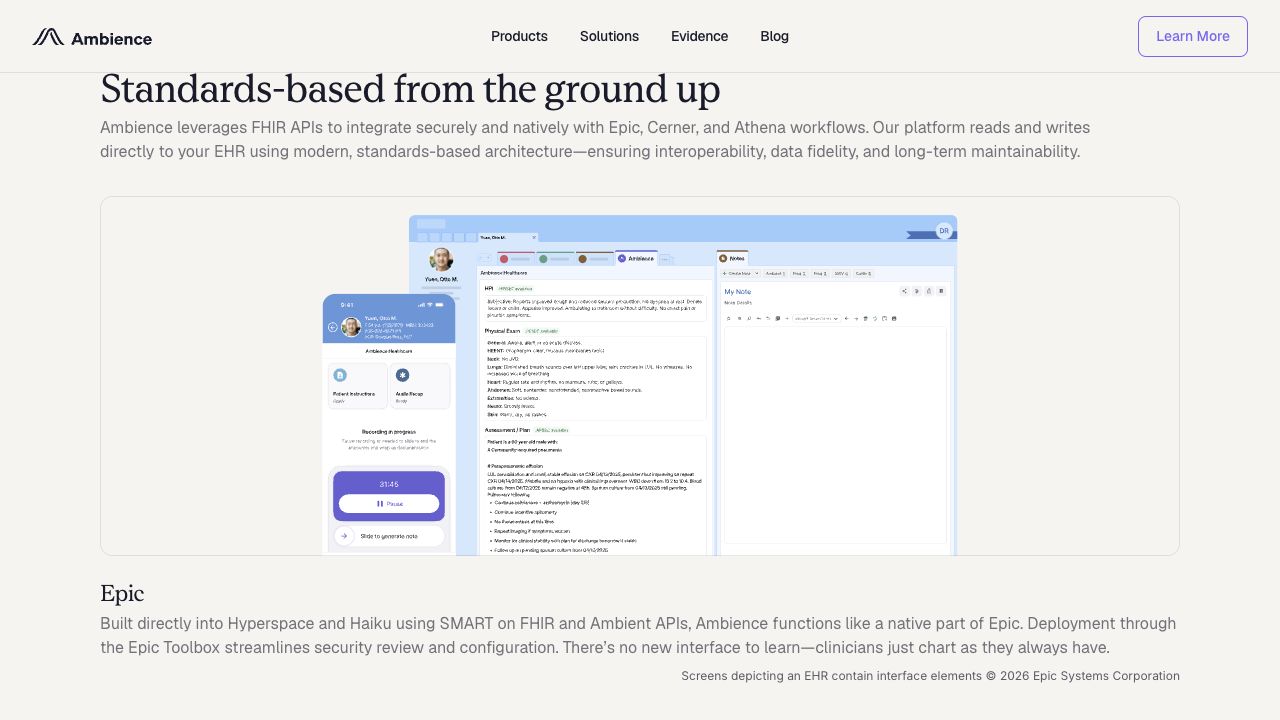
Ambience’s public informatics page and vendor-supplied interface illustration, captured October 15, 2026.
View the source
.
For each route, ask your EHR administrator to identify the exact launch point, chart-read permissions, note destination, structured-write scope and authentication boundary. A connection that inserts narrative may not update the medication list, create a task or submit an order. Even when each action is supported, your organization may intentionally authorize only some of them.
Then test a correction at the boundary. Edit the draft after its first transfer, save again, and reopen the encounter in the EHR. Determine whether the correction updates the existing draft, creates another version or leaves the old copy untouched. Record who can overwrite an unsigned note and what happens after authentication. The EHR integration guide explains these receiving-system distinctions in more detail.
Ambience advertises implementation assistance and 24/7 live support chat. Convert those statements into named responsibilities: who configures templates, fixes a failed write, communicates an outage and restores an interrupted encounter? Published support availability is not a substitute for contracted response and resolution targets. Informatics and support
What the Ambience research actually shows
Two product-specific publications cover clinician-reported workload and organizational deployment.
St Luke’s: perceived workload, with different survey populations
A JAMIA paper published online February 15, 2026 studied Ambience in St Luke’s ambulatory clinics, collecting data November 1, 2024–June 30, 2025. Of 415 eligible physicians and advanced practice providers, 329 responded at baseline and 212 at three months. Anonymous surveys could not pair individual responses. Mean cognitive task load was 9.4% lower; reported burnout fell from 45% to 35% overall, significantly for physicians but not for advanced practice providers.
The documentation finding concerns self-reported time outside working hours per shift:
- None or less than one hour: 92/329 (28%) at baseline versus 108/212 (51%) at follow-up, combining two response categories.
- More than three hours: 58/329 (18%) versus 11/212 (5%).
These are unpaired survey results—not measured minutes saved per note. Schneider and colleagues: Methods, Table 1, Results—Task load, and Table 3/Burnout and documentation time
For buyers, the finding supports measuring after-hours workload alongside local review effort. Opt-in participation, lower follow-up response, different respondent composition and no randomized control limit causal inference. The study does not establish note accuracy, patient benefit or performance of every feature sold in October 2026.
Cleveland Clinic: implementation at scale
An August 11, 2026 deployment paper describes onboarding more than 4,000 ambulatory clinicians in four months, supported by governance, training, support and iterative learning. Several coauthors were Ambience employees with equity interests. It is a health-system–industry implementation report, not a randomized effectiveness trial. Merlino and colleagues
For a buyer, the useful finding is organizational: large-scale adoption involved an operating model, not simply distributing access. It does not establish that a small clinic can reproduce the same rollout with one administrator, or that every current module was evaluated in that deployment.
Use this distinction when reviewing a business case. Adoption, note acceptance, coding agreement, documentation time and patient outcomes have different denominators. Ask what was measured, by whom, in which release and population, and whether failed encounters were counted. A strong result for one endpoint cannot fill gaps in the others.
AM-01: from conversation to note and action state
Fictional teaching case. Use the supplied source facts and expected results to examine three adjacent jobs: chart context, encounter narrative and suggested actions.
Fixed source packet
- Identity: synthetic patient AM-01, encounter E-101, October 15, 2026.
- Chart context: a signed October 1 note records a medication discussion. It does not establish current use or a prescription today.
- Patient: “I never started the medicine we talked about. My sister has diabetes; I haven’t been told that I do.”
- Clinician: “I’m recording that you did not start it. We are not making a medication change or placing an order in this encounter. I have not performed a physical examination today.”
- Authorized addition after capture: the clinician records that the clinic’s records team is to request the outside medication list, with a task due October 16. A covering clinician owns review if the usual clinician is absent. The request has not yet been sent.
Draft and suggestion defects to spot
Suppose a demonstration draft says: “Patient taking the previously discussed medicine. Diabetes. Examination normal. Medication renewed. Outside list requested.” Suppose a separate suggestion panel also proposes adding diabetes to the patient’s problem list.
There are five distinct errors in the note: current use contradicts the patient; a relative’s condition becomes the patient’s; an unperformed examination becomes normal; a renewal is invented; and an outstanding request becomes complete. The suggested problem-list addition is a separate defect even if the reviewer repairs the narrative. Correcting one output does not prove the others changed.
Show the corrected note and receiving-record checks
Corrected note: The patient reports not starting the medication discussed in the October 1 note. The reported diabetes history concerns the patient’s sister, not an established patient diagnosis. No physical examination was performed today. The clinician specified no medication change or order in this encounter. Records team to request the outside medication list; request not yet sent. Task due October 16, with covering-clinician review if the usual clinician is absent.
Suggestion review: Reject the unsupported patient-diabetes addition. No medication order is approved or transmitted. Retain the historical October 1 entry without converting it into current use.
Receiving record: Reopen AM-01 / E-101. Verify the corrected note, unchanged historical entry, absence of an unsupported problem-list addition or order, and an open task with the supplied owner and due date.
Completed fictional assessment: Narrative correction is acceptable against this packet. Overall acceptance remains held if the separate suggestion or task has not been checked. A corrected paragraph alone does not close the evaluation.
The important feature is not the particular diagnosis or medicine. It is the separation of documented history, current report, proposed action and completed action. A smooth note can be wrong in several ways at once; an accurate note can also coexist with an incorrect structured record. The reviewer should assess each destination explicitly.
A repeatable authorized demonstration
Ask Ambience and your organization to authorize synthetic testing before accessing a tenant or recording a demonstration. Use AM-01 unchanged as the baseline. Obtain the exact app/build, enabled modules, template version, EHR version and connector, user role, device, microphone, language and network conditions. Keep source and destination identifiers fictional and consistent.
Proposed rehearsal: run the following five checks with two repetitions each in one named configuration—ten attempts, including failures. Record findings for that configuration and test set.
| Check | Fixed variation | Expected result and evidence |
|---|---|---|
| AM-T1 Attribution | Read AM-01 verbatim with separate patient and clinician speakers. | Sister’s diagnosis stays with the sister. Save raw note and any diagnosis suggestions separately. |
| AM-T2 Template defaults | Use the same packet with the proposed examination template enabled. | No normal findings appear. Capture template settings and resulting examination section. |
| AM-T3 Approval boundary | Withhold approval for all proposed codes and medication actions. | No unapproved structured change or transmission. Inspect the EHR action/audit history, not just the note. |
| AM-T4 Interrupted capture | Pause before the clinician’s final sentence. Resume and repeat that sentence once. | Identify any missing or duplicate content; record capture state and recovery steps. Do not silently discard the failed attempt. |
| AM-T5 Saved version | Correct the draft after its first transfer, then repeat the save in a test encounter. | The reopened record preserves the correction without duplicate notes or tasks. Retain both versions and the save outcome. |
For each attempt, preserve raw output before editing. Log unsupported additions, omissions, attribution errors, action-state errors and destination discrepancies separately. Time active review, correction and transfer; report system waiting separately. Include failed sessions in the denominator rather than reporting only usable drafts.
For each run, retain the exact source, dated screenshots from the authorized tenant, actual output, correction log and reopened destination. Have a qualified clinician review the answer key and a health-IT reviewer inspect permissions and save behavior before a clinical rollout.
Ambience pricing and contract scope
No numerical direct-purchase tariff was found on the current Ambience pages reviewed on October 15, 2026. The homepage describes outcome-linked pricing and directs organizations toward a commercial conversation. Obtain a written quote rather than treating an unsourced per-clinician price elsewhere as an official offer. Current Ambience commercial positioning
A historical UK public-procurement document illustrates why channel and date matter: Hitachi Digital Services’ 2024 G-Cloud 14 fee sheet lists Ambience pricing as available on request, monthly fees excluding VAT, and a minimum 24-month licence agreement, with additional services using its rate card. That is a specific reseller document—not evidence that current direct U.S. contracts have the same term. G-Cloud fee sheet, page 3: Fee Structure
Make the quote comparable with these fields:
- Scope: exact modules, specialties, sites, EHR environments and languages included; distinguish pilot from production rights.
- Charging basis: currency, seats, encounters, minimum commitments, usage bands and any outcome-based adjustment.
- Outcome definition: baseline period, eligible cohort, exclusions, attribution of improvements, audit rights and treatment of failed encounters.
- Implementation: connector configuration, security review, template work, training and internal staff time.
- Ongoing operation: review effort, support coverage, integration maintenance, version-change testing and downtime work.
- Exit: renewal notice, export access, retained copies, deletion evidence and the cost of returning to the prior workflow.
Do not count every saved minute as a cash saving. A clinic may use recovered time for patient conversations or earlier departure without reducing payroll. Conversely, a lower software fee can be outweighed by repeated correction and manual transfer. Record those outcomes separately so a financial guarantee does not become a claim about clinical benefit.
Privacy review: follow each copy of the data
Ambience’s patient page describes care-focused use and says information is not sold or used for marketing. Its privacy policy also explains that clinical customer processing is governed by customer agreements, including applicable BAAs, and describes sharing de-identified patient information where contracts and HIPAA permit. Read those statements together; the patient page alone does not settle every reuse question. Patient information · Privacy policy
The reviewed public material does not establish one universal retention period for every clinical data copy. Request a product-specific inventory:
| Copy | Written answer needed | Responsible reviewer |
|---|---|---|
| Audio and transcript | Capture location, buffering, retention, authorized access and deletion after interruption. | Privacy lead and device administrator |
| Imported chart context and drafts | Read scope, processors, storage regions, reuse permissions and deletion triggers. | Privacy lead and EHR integration owner |
| Saved EHR record | Record ownership, amendment history, retention and separation from vendor-side deletion. | Records lead and clinical owner |
| Logs, backups and support artifacts | Contents, access restrictions, expiry, recovery copies and incident handling. | Security and operations leads |
For a U.S. HIPAA-regulated deployment, HHS explains that cloud handling of electronic PHI requires appropriate business-associate arrangements and risk management; encryption alone does not remove those duties. This is a U.S. framework, not approval for use in every jurisdiction. HHS cloud guidance
Ask for the applicable agreement, current security assurance material and subprocessors, then record the configuration your organization actually approves. Include recording consent, staff access, personal-device restrictions, patient opt-out and non-recording alternatives. Avoid placing real clinical content in a general sales form or public support attachment during procurement.
Ambience, Vero or the existing workflow?
Compare the same permitted source, reviewed note and receiving record. For an enterprise purchase, Abridge is a closer workflow peer; Vero offers a different entry route for a drafting-and-editing task.
Enterprise peer: Ambience and Abridge
Vendor-documented comparison, checked October 15, 2026. Scope: clinician note workflows.
| Requirement | Ambience | Abridge |
|---|---|---|
| EHR integration | Documents Epic, athenahealth and Cerner routes. Match the exact interface and permitted writes to the site. Integration routes | Abridge Inside Epic captures in Haiku and presents drafts in Hyperspace. Confirm care setting and local enablement; this does not establish identical behavior in another EHR. Clinician product |
| Review controls | Documents in-flow coding suggestions with contextual rationale. Note-to-source replay and co-sign controls are not established by this page; request a demonstration. Clinician controls | Linked Evidence connects generated note content to source information for verification. Confirm correction persistence and the receiving EHR’s signing rules separately. Linked Evidence |
| Implementation ownership | Advertises a vendor team working alongside the customer and 24/7 support chat. Agree local EHR configuration and incident ownership in the contract. Implementation and support | Its CHRISTUS account describes vendor-led user support, onboarding and training. That customer account is not a universal SLA; assign local integration ownership explicitly. CHRISTUS implementation account |
| Pricing access | Sales-led evaluation; no numerical direct tariff found on the reviewed pages. Request module scope, billing unit and implementation fees. Ambience sales route | The contact form asks for organization, EHR and clinician count; no numerical price is published there. Request a scoped quote, including support and renewal terms. Abridge contact |
What changes the shortlist: Abridge’s documented source-linking makes provenance review a concrete demonstration target. Ambience’s named routes make integration scope a concrete target. Ask both to run AM-01 through the actual proposed configuration, retain corrections in the saved record and price the same deployment scope.
Where Vero and an existing workflow fit
| Buying question | Ambience | Vero |
|---|---|---|
| Entry route | Organization-led commercial evaluation; direct numerical tariff not established on reviewed pages. | Self-service Free and Pro plans, plus Enterprise. Plans |
| Shared drafting task | Conversation documentation within its broader platform. Clinician workflow | Recording, typed context and uploaded files feed a selected note template. Create a note |
| Receiving record | Named EHR-connected routes; field-level scope depends on the deployment. | The documented workflow uses review/edit followed by copy or PDF, Word, print or email export; that does not establish automatic EHR write-back. |
| Operational tradeoff | Evaluate integration ownership, module permissions and organization-wide rollout. | Evaluate transfer effort and receiving-system controls as well as drafting effort. |
| Performance established here | Published workload and deployment findings; no local trial. | Documented workflow; no matched trial against Ambience. |
For a concrete access comparison, Vero’s pricing page lists a seven-day full-access trial followed by 10 free actions per month. Pro is $89 month to month or $69 per month billed yearly; Enterprise is custom-priced. Confirm the displayed dollar currency and applicable taxes at checkout. Vero terms checked October 15, 2026. Vero pricing
Ambience’s potential advantages are the documented integration routes, adjacent workflow functions and product-specific implementation evidence. Its buying constraints are quote-dependent scope, organizational setup and unresolved local performance. Vero’s practical fit is an accessible drafting-and-editing workflow. Include export, transfer and receiving-record checks in that workflow’s evaluation. Vero workflow
An existing EHR template or dictation workflow remains a valid baseline. If the main problem is a poorly configured template, unclear ownership or a missing follow-up queue, new generation technology may not fix it. Compare the complete task with and without a scribe, retaining clinician review and counting work transferred to other staff.
Bottom line: move Ambience to a bounded demonstration when the named EHR route, contract scope and data permissions match your organization. Base the decision on the note, suggestions and saved record from that demonstration. Use the clinical notes software checklist to make the receiving-record requirements explicit before signing.
Questions about Ambience Healthcare
Access, workflow boundaries, evaluation and buying decisions.
What is the Ambience medical scribe?
Ambient Scribe is Ambience Healthcare’s conversation-to-note capability. It sits within a broader clinical workflow platform; ask which surrounding functions are included in the specific agreement you are evaluating.
Is Ambience the same as ambient AI?
No. Ambience Healthcare is a company; ambient AI describes technology that captures a conversation in the background. Ambient Scribe is the company’s conversation-to-note capability.
Can an individual clinician sign up without an organization?
The reviewed Ambience pages lead to a sales conversation, not a published self-service subscription. Ask sales about individual eligibility and minimum commitments before planning an independent trial.
Is an Ambience free trial publicly available?
A standard free-trial allowance was not established in the reviewed public material. Confirm whether an offered demonstration includes a usable account, permitted test data and access to the resulting drafts.
Does Ambience publish a monthly price?
The current pages reviewed do not provide a numerical direct-purchase tariff. Request the billing unit, included modules, minimum volume and implementation fees together; a price without its scope is not comparable.
Will an advertised EHR integration work at every site?
No site-wide compatibility conclusion follows from a vendor naming an EHR. Confirm your version, enabled interfaces, fields, permissions and support ownership, then verify the reopened receiving record.
Show all questions
What should be tested for an interpreter encounter?
Use a qualified interpreter and reviewer for each tested language. Check patient versus interpreter attribution, translated uncertainty, missing speech and the approved note language. Report findings by language rather than pooling them into one accuracy figure.
Can a preferred examination template create unsupported findings?
It can create a review risk if defaults are mistaken for observations. Include a test where no examination was performed and verify that neither the note nor any structured field acquires normal findings.
Do coding suggestions establish the final billable code?
No. A qualified reviewer must verify the supporting documentation, encounter circumstances and applicable coding rules. A suggested code is a separate object from an accepted diagnosis or submitted claim.
Does a generated medication order mean a prescription was sent?
No. Distinguish a proposal, an approved order and a transmitted prescription. Require separate evidence of the action and its destination; note wording alone cannot establish completion.
Can Ambience be used without an internet connection?
Offline capture, local buffering and offline generation were not established in the reviewed sources. Obtain the supported behavior in writing and rehearse disconnection with synthetic information before relying on it.
What happens when a patient declines recording?
Use the clinic’s approved non-recording documentation route. Confirm that recording is off, explain the alternative and avoid making participation in the technology a prerequisite for the encounter.
Does an Ambience security claim make a clinic HIPAA compliant?
No. For a U.S. covered workflow, the organization still needs appropriate agreements, risk analysis, access controls and operating procedures. Obtain product-specific evidence rather than treating a website badge as approval.
What should be retained from a synthetic demonstration?
Keep the authorized configuration, exact source, raw draft, correction log, measured effort and saved destination, including failed attempts. Store evidence in the approved evaluation workspace, not in a public article or support form.
When is Vero a more relevant option to evaluate?
When the immediate task is creating and editing a note from encounter inputs, with a self-service entry route. Include transfer effort and receiving-record checks when comparing that workflow with an integrated deployment.