MIST Report: Trauma Handoff Structure and Worked Examples
 Sam Ellis · October 23, 2026 · 20 min read · Published by Vero Scribe Inc.
A MIST report organizes a trauma handoff into Mechanism of injury, Injuries, Signs and Treatment. Introduce the patient and yourself, communicate important changes, and confirm the receiving clinician understands the report. Some services extend or adapt the acronym; the local protocol determines the required format. DEMCA transfer-of-care protocol
This guide focuses on adult EMS-to-emergency-department communication. All cases are fictional teaching examples. Paramedic educator/emergency physician review: pending. Sources checked October 23, 2026; publication dates and jurisdictions are identified below.
Urgent care continues during handoff. Communicate a critical change immediately and follow the local emergency pathway; do not wait to finish the acronym. DEMCA explicitly preserves lifesaving interventions during its handoff pause.
A quick MIST report example
After verifying identity: “I'm Jordan, paramedic on Unit 12, handing over Casey, age 34, training encounter MT-101.”
M: “Casey reports falling from a bicycle at about 14:10. We did not witness the fall.”
I: “There is a right forearm wound; Casey reports pain at that site. Other injuries have not been established.”
S: “At 14:18, pulse was 96 and blood pressure 126/78. At 14:28, pulse was 92 and blood pressure 124/76. Casey remained alert and conversing at both checks.”
T: “We applied direct pressure and a dressing at 14:20. At 14:28, no further external bleeding was visible through the dressing. Pain remained 5/10. Medication and allergy history are still unverified.”
Receiver: “I understand the observations are from 14:28, and medication and allergy history still need checking.” Jordan confirms. The source packet and acceptance record below show what this short report includes—and what it does not establish.
What belongs in a MIST report
Use the headings to organize assessed information. Keep the source, timing and certainty of each statement visible, and distinguish care already provided from work still pending.
| Part | Reporting prompts | Avoid this shortcut |
|---|---|---|
| M — Mechanism | What happened, when, and according to whom? Include relevant circumstances and any uncertainty. | Turning a witness estimate into an exact time or a confirmed sequence. |
| I — Injuries | Observed injuries, their location and relevant patient-reported symptoms. Distinguish suspected from established injury. | Calling swelling a confirmed fracture, or describing an unexamined area as normal. |
| S — Signs | Timed observations, meaningful changes and measurement conditions. State when a value is unavailable or unreliable. | Reading the first set as if it described the patient on arrival. |
| T — Treatment | Care actually provided, when it happened and the observed response. Identify ongoing equipment or therapy and work still incomplete. | Equating “requested” with “given,” or assuming an intervention helped without reassessment. |
In MT-01, “no further external bleeding visible through the dressing” is narrower than “the injury is resolved.” The first statement reports an observation at a particular time. The second adds a conclusion the source does not support. Similarly, “history unverified” does not mean the patient takes no medicines or has no allergies.
Keep identification separate from the injury story. Link the verbal report, patient and encounter using the approved local identifiers. Avoid unnecessary personal details in a public corridor or on an unsuitable communication channel.
MIST, ATMIST and IMIST-AMBO are not identical
Teach the version used by the sending service and receiving facility. An additional letter can move information to a different place in the report; it should not make that information disappear.
| Published example | What the format specifies | Local distinction |
|---|---|---|
| MIST — DEMCA, Michigan; implemented 2020 | Mechanism or medical complaint/history; injuries or medical findings; signs; treatment. | The protocol places age/sex/name with M and incident/onset timing with I. Its 30–45-second report target is local, not universal. |
| ATMIST AMBO — BCEHS, British Columbia; 2023 guidance | Age, Time, Mechanism, Injuries, Signs, Treatment; then Allergies, Medication, Background and Other information. | The first T is incident/onset time; the last T is treatment and response. The visual aid includes name/date of birth with age. |
| IMIST-AMBO — Victoria, Australia; page updated 2025 | Identification; Mechanism/medical complaint; Injuries/information; Signs; Treatment and trends; Allergies; Medication; Background; Other information. | Identification is explicit, and trends appear with treatment. The ED and ambulance team also agree the handover-complete time. |
Sources: DEMCA protocol 8.36, BCEHS ATMIST AMBO visual aid, and Victoria's ambulance-to-ED protocol. Dates shown identify each source's publication or update.
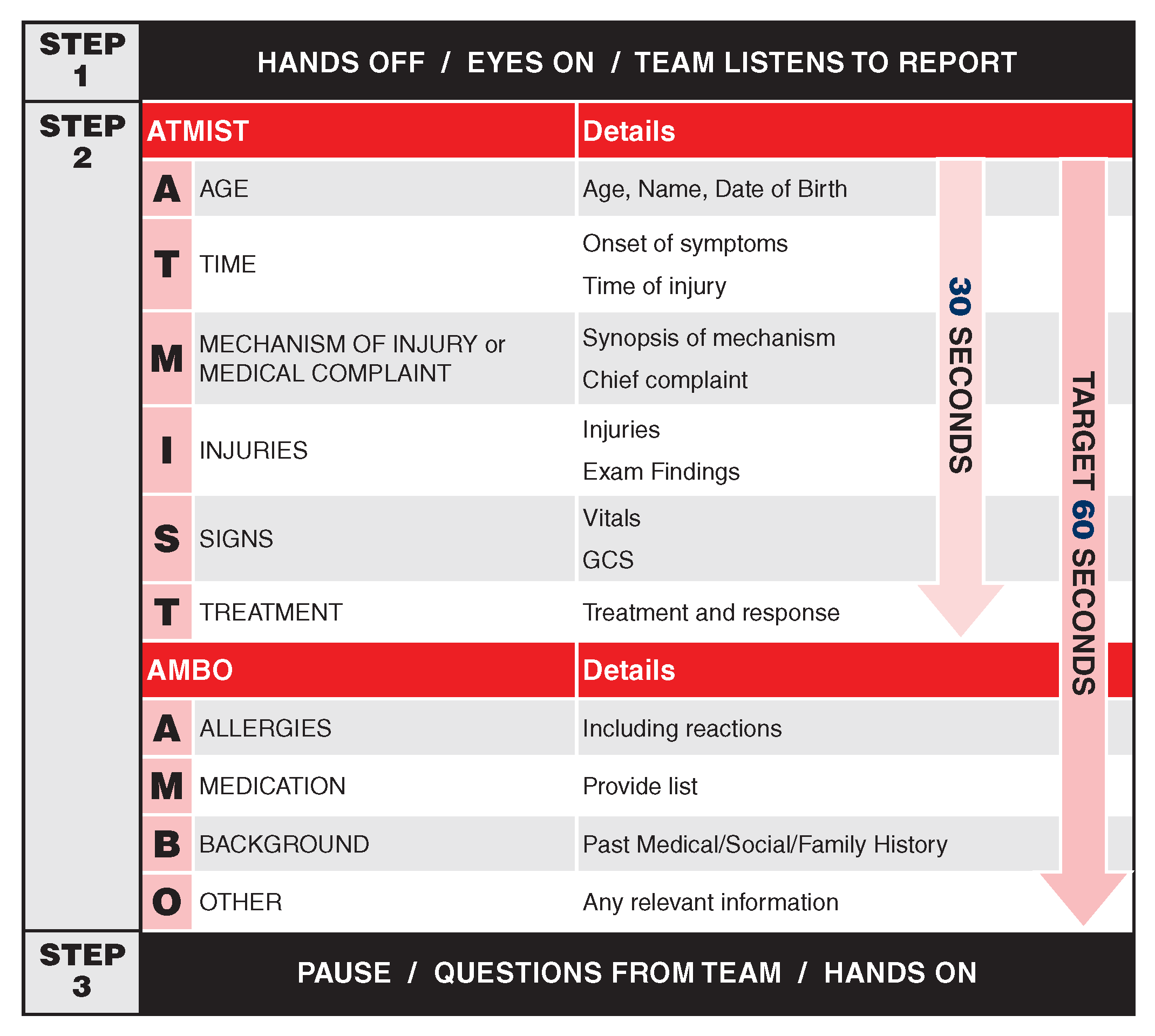
MIST versus SBAR: BCEHS uses ATMIST AMBO for transitions of care and SBAR for consultations such as CliniCall. Choose the format your service specifies for transferring care or seeking advice. See the BCEHS communication guideline and our SBAR examples for the request-and-response structure.
Example 1: a timed injury handoff
MT-01 source packet
The quick example above uses the following supplied facts to demonstrate source attribution, timed observations and receiver acceptance.
- Context: Casey, age 34, training encounter MT-101. Jordan, paramedic on Unit 12, verifies identity with receiving nurse Alex at 14:32.
- History: Casey reports a bicycle fall at approximately 14:10. The crew did not witness it. No further mechanism details are supplied.
- Findings: right forearm wound and patient-reported pain at that site. At 14:18, pulse 96/minute, blood pressure 126/78 mmHg, alert and conversing, pain 5/10.
- Completed care: direct pressure and dressing at 14:20.
- Reassessment at 14:28: pulse 92/minute, blood pressure 124/76 mmHg, alert and conversing, pain still 5/10. No further external bleeding visible through the dressing.
- Unresolved information: medication and allergy history have not been verified. No other examination findings, treatment or diagnostic results are supplied.
- Receiving event: Alex confirms the latest observation time and accepts care at 14:33, including responsibility for obtaining the unverified history. The team confirms the patient-record match and transfer is complete; Jordan supplies the interim written report.
What the report preserves

MT-01 chronology: the reported incident time, latest observation time and accepted-care time describe different events in this fictional case.
The report retains an approximate injury time, two observation times, the action performed and its observed result. It does not invent a normal respiratory assessment, imaging result or diagnosis. The fall history is attributed to Casey, while the wound and dressing observations are attributed to the crew.
The pulse difference is stated as two measurements, not described as proof of recovery. Pain remains unchanged despite the intervention. That matters because a handoff can be factually accurate yet misleading if it includes only the favorable observation.
A corresponding handoff entry
14:33 — MT-101: identity checked with Alex, receiving RN. MIST given with 14:18 and 14:28 observations and 14:20 dressing intervention. Alex confirmed latest observations were obtained at 14:28 and accepted care, including medication/allergy-history verification. Transfer completed; interim written report supplied. No verification outcome available at handoff.
The entry records the exchange without claiming that Alex has already completed the history. For later corrections or additions, preserve the original sequence rather than silently replacing it; see medical documentation and chronology.
Example 2: a change after the pre-alert
MT-02 source packet
- Context: Morgan, age 67, training encounter MT-102. A witness reports a fall down three steps at approximately 09:00. The crew observes a scalp wound; internal injury has not been established.
- At 09:08: pulse 88/minute, blood pressure 138/82 mmHg, respiratory rate 18/minute, oxygen saturation 97% on room air. Glasgow Coma Scale (GCS) 15: E4, V5, M6.
- Completed action at 09:10: dressing applied to the scalp wound.
- Pre-alert at 09:12: the 09:08 findings, scalp wound and 09:10 dressing are communicated to receiving nurse Avery; estimated arrival 09:20. A relative reports Morgan takes apixaban, but the dose and last administration are unknown and unverified. This call does not contain the later reassessment.
- Reassessment at 09:15: no additional external bleeding is visible through the dressing.
- Change at 09:17: GCS 13: E3, V4, M6; pulse 104/minute, blood pressure 112/70 mmHg, respiratory rate 22/minute, oxygen saturation 96% on room air. The crew identifies worsening responsiveness, updates Avery at 09:18 and continues the local clinical response during transport.
- Arrival at 09:20: the receiving team begins immediate assessment after the crew announces the change. At 09:21, the receiving clinician asks for the remaining history. No further treatment details or diagnostic conclusion are supplied in this communication exercise.
Lead with the change, then finish the handoff
The arrival message starts: “Morgan's responsiveness worsened after our pre-alert. GCS was 15 at 09:08 and 13 at 09:17. The last components were E3, V4, M6.” The receiving team begins assessment; the crew does not hold care until the whole script is complete.
When the receiver asks for the remaining information:
M: “The witness reports a fall down three steps at about 09:00.”
I: “We observed a scalp wound. Further injury is not established.”
S: “At 09:17, pulse 104, blood pressure 112/70, respiratory rate 22, saturation 96% on room air, GCS 13. The earlier set at 09:08 was pulse 88, pressure 138/82, respiratory rate 18, saturation 97% on room air and GCS 15.”
T: “Scalp dressing applied at 09:10; at 09:15 no additional external bleeding was visible through it. A relative reports apixaban use; dose and last administration remain unverified.”
Receiver check: “The 09:12 call described the earlier GCS of 15; the latest supplied assessment is 13 at 09:17, and the medication history is from a relative.” The sender confirms. The receiver assigns medication verification to the receiving team; its completion is not yet established.
Use the applicable EMS pathway for escalation, assessment frequency and treatment. The reporting task here is to preserve the change in responsiveness, its timing and the receiving team's response.
Three communication events, not three copies
The pre-alert prepares the receiver. The 09:18 update communicates a change before arrival. The bedside report reconciles what the team previously heard with the latest available information. Copying the first message into all three records would erase the clinically important event.
BCEHS distinguishes pre-arrival communication from the fuller handover and emphasizes reporting changes in condition. BCEHS A03 When a receiver repeats a critical detail, the sender should confirm or correct it; that closes the check-back loop. AHRQ check-back
Example 3: conflicting incident history
MT-03 source packet and correction
At 16:05, Taylor, age 42, training encounter MT-103, reports falling from standing. A bystander says Taylor fell from a low ladder at about 15:50. The crew did not witness the event. The crew observes left ankle swelling; Taylor reports pain there. No mechanism has been confirmed and no fracture diagnosis is supplied.
Overconfident report: “Fall from a ladder at 15:50 with an ankle fracture.”
Corrected M and I: “Taylor reports a fall from standing; a bystander describes a low-ladder fall around 15:50. We did not witness the event and have not resolved that difference. There is observed left ankle swelling and patient-reported pain; a fracture is not established.”
The receiver asks which account appears in the written record. The sender confirms that both accounts and their sources are recorded, with the discrepancy unresolved. No vital signs or treatments are supplied for this short exercise, so it is not a complete MIST report.
The useful correction is not simply adding “possibly.” It restores who said what and identifies what still needs assessment. This is especially important when someone who did not see the patient drafts or summarizes the record. Our hospital scribe workflow guide explains the distinction between recording a clinician's findings and supplying new clinical judgments.
Example 4: a DEMCA protocol field check
MT-04 maps a fictional report to DEMCA system protocol 8.36, Michigan, implemented December 1, 2020, and checked October 23, 2026. The table connects each MIST field and transfer step to its place in the written scenario. For local training, use the protocol version adopted by your service. DEMCA transfer-of-care protocol
MT-04 supplied facts
Trace each statement in the report to these supplied findings and events. Carry a negative finding into a record only when it was actually assessed.
- Identity and history: Robin Vale, age 48; sex recorded as male in the training record, encounter MT-104. Robin reports falling down two steps at approximately 10:55. The crew did not witness the fall.
- Inspection at 11:04: forehead abrasion, left forearm laceration and left shin scrape. The crew's head-to-toe external inspection identifies no other visible external injuries. That observation does not exclude an internal injury. Robin reports forearm pain of 4/10.
- First observations at 11:04: pulse 100/minute, blood pressure 118/76 mmHg, respiratory rate 20/minute, oxygen saturation 98% on room air and GCS 15 (E4, V5, M6). Glucose measured at 11:05 is 106 mg/dL.
- Care and reassessment: direct pressure and dressing applied to the forearm at 11:06. At 11:14, no additional bleeding is visible through the dressing; pain remains 4/10. Repeat pulse 92/minute, blood pressure 120/78 mmHg, respiratory rate 20/minute, oxygen saturation 98% on room air and GCS 15 (E4, V5, M6). Glucose is not repeated.
- Receiving sequence: the patient enters the designated ED room at 11:20. The hospital team leader completes an initial assessment and considers the patient stable for the report at 11:21. At 11:22, receiving RN Lee calls the EMS timeout; the team pauses noncritical activity and listens to the report. Paramedic Devon verifies the patient-record match and gives the report below.
- Closure: Devon invites questions, answers the glucose-timing question and confirms Lee's corrected repeat. Medication/allergy history remains unverified; Lee accepts that follow-up. Devon announces report completion and requests transfer. At 11:24, transfer is completed and Lee's transfer-of-care signature is recorded in the fictional ePCR's transfer section. The interim record is supplied; the final narrative retains the same times, values and unresolved history.
The mapped report and receiving exchange
M: “Robin Vale, 48-year-old man, reports falling down two steps.”
I: “Around 10:55; forehead abrasion, left forearm laceration and left shin scrape. No other external injuries seen on our head-to-toe inspection.”
S: “At 11:04: pulse 100, pressure 118/76, respirations 20, saturation 98% on room air, GCS 15. Glucose 106 mg/dL at 11:05. At 11:14: pulse 92, pressure 120/78; repeat respirations, saturation and GCS unchanged.”
T: “Pressure and dressing at 11:06. No additional bleeding visible at 11:14; pain remains 4/10. Medication and allergy history are unverified.”
Scripted question and check-back: Lee asks, “Was glucose measured at 11:14?” Devon corrects the time: “11:05; it was not repeated.” Lee repeats “106 mg/dL at 11:05, no repeat,” and Devon confirms. Record the transfer signature as a separate event after the spoken report and actual transfer.
Field-by-field comparison with the published protocol
| Protocol element | Evidence within fictional MT-04 | What the check establishes |
|---|---|---|
| Room, timeout and lifesaving-intervention exception | 11:20 room arrival; team-leader assessment at 11:21; RN timeout at 11:22, with noncritical activity paused. | Participants stop to listen. Only lifesaving interventions continue during the timeout; routine care pauses. |
| M: name, age, sex and mechanism/history | Robin Vale, 48, male in the training record; patient-reported two-step fall. | Identity and attribution match the supplied record; the mechanism is not crew-witnessed. |
| I: incident time and head-to-toe injury listing | Approximate 10:55 time; forehead, forearm and shin findings, in that order. | The report preserves the estimate and the scope of the external inspection. |
| S: first observations, changes and glucose | 11:04 first set, 11:14 repeat set and 106 mg/dL at 11:05. | The glucose time remains separate; an unchanged repeat observation is not an unmeasured default. |
| T: treatment and transfer signature | 11:06 dressing, 11:14 response and Lee's 11:24 signature in the transfer section. | Completed care, reassessment and signature are distinct documented events. |
| Questions, report closure and record consistency | Glucose clarification, confirmed repeat, transfer request and matching final narrative. | The written scenario preserves the correction and unfinished history verification. |
| Local 30–45-second report target | Not timed; MT-04 is a written scenario. | Measure report duration and check intelligibility and receiver understanding during a rehearsal. |
Urgent care takes priority over the formal report and signature. DEMCA allows transfer before the formal report when airway, breathing or circulation needs emergent attention, or at the resuscitation team leader's discretion. In MT-04, the formal timeout follows the team leader's initial assessment and determination that the patient is stable for the report.
Close the handoff and preserve the record
AHRQ describes handoff as transferring responsibility as well as information. Give the receiving person an opportunity to clarify uncertainties and confirm acceptance, rather than treating the final letter of the acronym as proof of transfer. AHRQ handoff guidance
For the examples here, close the exchange by checking:
- Correct patient and encounter: the spoken report and supplied record refer to the patient being received.
- Current versus earlier information: the receiver can distinguish the first set, later change and most recent measurement.
- Outstanding information: the receiving team knows what is unknown and who has accepted the next action.
- Actual transfer status: record the recipient, time and locally required acceptance, not just ambulance arrival.
- Record continuity: send the required written/electronic record through the approved route and confirm that any important correction reaches the receiver.
Victoria's published protocol illustrates why arrival and completion should not be conflated: its handover-complete definition combines information transfer with the patient moving from the ambulance stretcher into the receiving care area, and the teams agree and record the time. This completion definition is specific to Victoria's published protocol. Victoria handover protocol
An electronic patient care report (ePCR) remains a fuller record than a short verbal summary. If its final version adds or corrects something important, use the local notification and amendment process. An upload timestamp establishes an upload; it does not by itself establish that the receiver noticed a changed observation.
Practice: find the stale information
Use MT-02's source packet to review this draft:
“Morgan, 67, fell down three steps at 09:00. Scalp wound dressed. GCS 15 and vital signs stable. Takes apixaban. Handoff completed on arrival.”
Before expanding the answer, identify the unsupported certainty, missing change and transfer claim. A report can have every MIST heading and still fail this comparison.
Show the report review and correction
History: the fall time is an estimate from a witness, not an exact crew-observed event.
Stale information: GCS 15 belongs to 09:08. The report omits the 09:17 deterioration to 13 and substitutes “stable” for timed observations.
Medication certainty: apixaban use is a relative's report. Dose and last administration are unverified.
Transfer status: arrival at 09:20 does not establish a completed handoff. Immediate assessment began, and remaining history was requested at 09:21; no final acceptance time is supplied.
Correction: lead with worsening responsiveness; identify the 09:08 and 09:17 sets separately; retain witness and relative attribution; describe the completed dressing and observed response. Record acceptance only when it occurs and is confirmed.
Recheck: ask the receiver which GCS is latest and what remains unverified. Correct any mistaken repeat, and check the receiving record contains the change rather than only the pre-alert.
Copyable MIST report template
Copy this blank scaffold into an approved documentation or training workspace. It collects the spoken report and the receiving event separately. Replace its labels with the locally approved format where necessary. The worksheet is read-only on this public page; it does not collect patient information.
Use the blank fields to prompt checking, not to manufacture completeness. “Not obtained,” “patient unable to provide” and “relative reports” can be meaningful entries when accurate. Empty sections must not automatically become negative findings. A useful record also makes clear whether a number was measured before treatment, afterward or at a later reassessment.
A quality check for training and local adaptation
An educator can run these cases with a sender, receiver and observer. Give the sender the source packet; have the receiver repeat one time or value incorrectly. In another round, introduce the changed observation before the first report is finished. Assess whether the sender corrects the misunderstanding and communicates the new concern without delaying care.
Review each requirement against the actual words and receiver response:
- Source fidelity: no new injury, normal finding, medication detail or treatment appears without support.
- Chronology: incident estimates, measurements, interventions and handoff events retain their different times.
- Change detection: the receiver understands what changed after the pre-alert.
- Uncertainty: reported, observed, suspected and unverified information remain distinguishable.
- Closure: the receiving person, accepted responsibility and unresolved work are explicit.
- Record match: the final saved account preserves the important update and correct patient association.
Record findings as demonstrated, needs correction or not observed, with the exact supporting phrase. Do not turn a checked count into a clinical safety score. A polished verbal report can still contain an incorrect patient identifier, and a perfect transcript can still describe the wrong time point.
What an observed training result would need
Training status: these are written scenarios; no observed role-play or measured result is available.
For an educator-led run, retain the protocol/version, participant source packet, actual transcript, measured duration, receiver's question or mistaken repeat, sender's correction, final receiver response and educator's findings. Specify whether timing covers the report alone or also the questions. Mark unobserved steps as not observed. Use fictional identifiers and obtain participants' permission before publishing a recording or transcript.
Have the paramedic educator and emergency clinician align the training with the service's protocol, scope of practice, escalation process and receiving-system requirements.
For documentation structure after the handoff, continue with clinical note examples to preserve the exchange and its follow-up in the record.
If your team is also evaluating AI-assisted documentation, explore Vero's emergency-medicine workflow for preparing, reviewing and copying or exporting drafts within your organization's approved process. Keep the live handoff, receiver confirmation and final patient-care record review with the clinical team.
Questions about MIST reports and trauma handoffs
Acronym variations, uncertainty, changing observations and receiving-team confirmation.
What does MIST stand for in a trauma report?
Mechanism of injury, Injuries, Signs and Treatment. Establish identity and timing as well. The exact labels and additional fields vary by service; use the receiving system’s agreed handoff format.
Who gives the MIST report?
The designated clinician handing over the patient gives it to the identified receiving clinician or team. Agree who will speak so simultaneous reports do not obscure important changes.
How is ATMIST different from MIST?
ATMIST makes Age and Time explicit before MIST. The BCEHS visual aid also includes AMBO: allergies, medication, background history and other relevant information. Its two T positions have different meanings: time and treatment.
What does IMIST-AMBO add?
The Victorian model begins with Identification and adds Allergies, Medication, Background history and Other information after MIST. Its T includes treatment and trends. These are named local conventions, not interchangeable universal requirements.
Is a MIST report the same as SBAR?
No. MIST organizes the injury or illness handoff; SBAR explicitly includes an assessment and a recommendation or request. BCEHS distinguishes ATMIST AMBO for transitions from SBAR for consultations. Use the locally specified format for the task.
How long should a MIST report take?
Follow the local target while keeping the message understandable. DEMCA specifies 30–45 seconds for its EMS report; that is not a universal deadline. Questions and immediate clinical needs take precedence over finishing a memorized script.
Show all questions
Can MIST be used for a medical patient?
Some protocols adapt it for medical complaints. DEMCA explicitly includes medical complaint/history under M and medical examination findings under I. Confirm your service’s convention rather than forcing an illness into a trauma narrative.
What if the mechanism or injury time is uncertain?
Say which detail is unknown and identify the source of any estimate. A witness estimate, a dispatch timestamp and a patient’s recollection are not automatically the same event time.
Should I say suspected fracture or fracture?
Preserve the level of certainty supported by the assessment. Observed swelling, reported pain and a suspected injury are different from a confirmed diagnosis. Do not upgrade one to another just to shorten the report.
Which vital signs belong in the handoff?
Communicate the observations required by the local protocol and relevant to the patient, with their times and meaningful changes. In a worked example, only supplied measurements can be reported; missing values must not become normal findings.
What if a measurement is unreliable?
Identify the affected value and why it cannot be relied on, communicate other available findings, and follow the clinical reassessment process. Do not present an earlier valid value as a new measurement.
What belongs under Treatment?
Describe care actually provided, its time and the observed response. Where relevant and verified, include medication details, procedures and equipment still in use. A request or proposed intervention is not completed treatment.
Does a pre-alert replace the bedside MIST report?
No. A pre-alert prepares the receiving service; the patient may change before arrival. Reconcile the message with current findings at handoff and make any important change explicit.
What if the patient deteriorates while I am speaking?
Call attention to the new concern and use the local emergency pathway while care continues. Resume the remaining structured information when the receiving team can take it. Completing the acronym is not a prerequisite for urgent action.
Does finishing MIST complete the transfer of care?
The spoken report alone does not establish acceptance. Confirm the receiving person, unresolved information and the locally required handover record. Arrival, report completion, physical transfer and acceptance can be separate events.